The nearly rubbed-away line beneath the red address was not another place at all. It was a date, and it was the very night Lily’s mother vanished.
Officer Rachel Brooks stared at the back of the torn photograph again, then at the seven-year-old sitting nearby in the hospital.
The discovery did not prove where Lily’s mother was.
It did something almost as important.
It changed what the officers thought they were looking at.
Until that point, the story spreading through the apartment complex had been simple and ugly: a mother had left two children alone, one of them dangerously sick, and never returned.
People had already decided why.
Some said she had gone partying. Someone called her a deadbeat. Another person had livestreamed the scene before the ambulance carrying the children had even pulled away.
But Rachel now had a frightened child, a photograph with a man deliberately cut out of it, a remote wooded address written in red, and a date connected directly to the night the mother disappeared.
More troubling than any of those objects was what Lily had already revealed.
Her mother had been afraid before she left.
And Lily knew exactly who she had been afraid of.
Hours earlier, at 2:17 a.m., none of that was known.
All dispatcher Marcus Thorne had heard was a small voice on a 911 line.
Rain beat against the city while Marcus listened to the child breathe.
The girl was trying so hard to sound calm that the effort itself worried him.
He asked her name.
“Lily.”
He asked her age.
“Seven.”
Marcus stopped treating the call like an ordinary late-night contact.
He asked where her parents were.
Lily explained that her mother had gone out to get medicine because her little brother, Leo, had a very high fever. Their mother had promised to return quickly.
She had not.
Lily did not know how many hours had passed. Children rarely measure time the way adults do.
Instead, she gave Marcus the detail that mattered to her.
They had gone to sleep more than once waiting for Mom to come home.
That meant this was no quick pharmacy run anymore.
Marcus asked about Lily’s father.
For a moment, static was the only answer.
Then Lily lowered her voice.
Her father did not live with them, she said, and her mother had given her a specific rule: if he came to the apartment, Lily was not supposed to open the door.
Marcus asked whether the apartment was secure.
Lily said yes.
Her mother had shoved a chair beneath the door handle before leaving.
That detail stayed with him.
Parents warned children not to open doors for strangers all the time. Barricading a door before going out for medicine was different.
Marcus told Lily she had done the right thing by calling.
Her breathing changed.
Until then, she had sounded like a child repeating instructions and completing a task. After he reassured her, fear finally entered her voice.
The call traced to an aging apartment building in Detroit.
Officer Rachel Brooks responded without sirens.
The building was already dark. Water leaked through parts of the hallway ceiling into buckets. Damp clothing hung from improvised lines. The storm outside made the place feel even more cut off than it was.
A neighbor opened her door just far enough to watch Rachel pass.
When Rachel mentioned the children in 4B, the woman immediately offered a judgment about their mother, suggesting that she was always out running around.
Rachel asked one question in return.
Had the neighbor ever knocked to find out whether the children needed anything?
The door closed.
At 4B, Rachel found the barricade exactly as Lily had described it.
A heavy chair had been forced beneath the knob from inside.
Rachel did not pound on the door or demand that Lily open it immediately. She stayed outside and talked to her until the scraping sound of the chair finally came from the other side.
The door opened barely an inch.
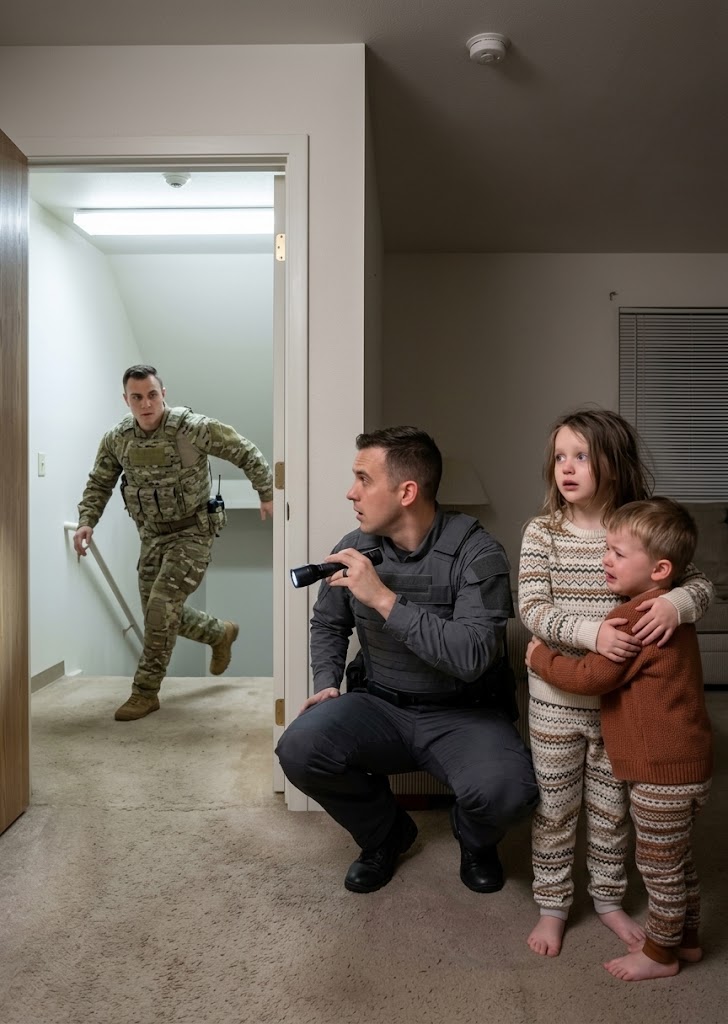
Lily stood barefoot behind it.
A worn fleece blanket was wrapped around her body. In her hand was a crumpled prescription she held against her chest as if the paper itself could explain everything.
Behind her sat Leo.