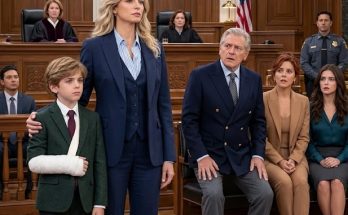
Across the defense table, Luke’s face went entirely slack. The color drained from his skin, leaving him looking sickly beneath the fluorescent lights. Beside him, my father, Bernard, gripped the wooden railing in front of him so hard his knuckles turned white. My mother, Celina, remained frozen, her hands hovering mid-air where her purse had fallen.
For ten years, Luke had told them I was a disgraced dropout, a dishonorably discharged veteran living off meager odd jobs in shame.
Instead, I stood before them as a Commander with fifteen years of active service, wearing a Navy Commendation Medal, a Meritorious Service Medal, and the insignia of federal oversight.
“Commander Sterling,” the prosecutor continued, turning to face the jury. “Is the defendant, Luke Sterling, your biological brother?”
“He is.”
“And are you currently listed as the fifty-one percent majority owner and primary veteran beneficiary of Vance Shield Recovery?”
“According to federal contracting records submitted by the defendant, yes,” I testified calmly. “According to reality, I have never held equity in Vance Shield Recovery, nor did I ever authorize my name, my service record, or my personal identifying information to be used by my brother.”
The defense attorney sprang to his feet. “Objection, Your Honor! The witness’s family history is well-documented. She was discharged under hardship conditions years ago—”
“Overruled,” Judge Harrison cut in sharply. “Counsel, sit down. The witness will proceed.”
The prosecutor picked up a heavy blue binder from her desk and walked toward the stand. She handed a copy to the defense and laid the original in front of me.
“Commander, please look at Exhibit 14-A. Can you identify the signature on line four of that federal contractor application?”
I looked down at the document. It was an application for a thirty-million-dollar emergency storm-recovery contract in Florida, submitted under the Veteran-Owned Small Business program. There was my forged signature, stamped alongside a fake copy of my military discharge paper—a falsified DD-214 claiming I had been severed from service due to psychological instability.
“That is a forgery of my signature,” I stated, my voice echoing off the mahogany walls. “And the attached separation document is fraudulent. I was never discharged. I was promoted.”
I looked up from the page and met Luke’s eyes.
His jaw twitched nervously. He leaned over to his attorney, whispering frantically, but his lawyer simply stared at the documents on his table with a look of profound, helpless horror.
“Can you explain to the court how this fraud was brought to the attention of federal authorities?” the prosecutor asked.
“Six months ago, during a routine cross-reference audit of storm-recovery contracts in my department, Vance Shield Recovery triggered a flag,” I explained calmly. “The firm had secured over forty million dollars in government contracts specifically earmarked for service-disabled veterans. When my team pulled the verification file, I found my own social security number attached to a company I had never heard of.”
I paused, letting the silence settle over the room.
“My brother didn’t just fabricate my discharge,” I continued, looking directly at my parents. “He used my military clearance level to bypass federal background checks, forged my signature on high-yield loan guarantees, and used our grandfather’s protected marshland as collateral for bank loans.”
My mother let out a small, strangled sob.
Bernard slowly sank back into his seat, his head bowed, his hands buried in his lap. The carefully crafted illusion of the “respectable Sterling family” was shattering around them, piece by piece, on federal record.
PART 3
The cross-examination was swift and brutal.
Luke’s attorney stepped up to the podium, attempting a desperate angle of defense.
“Commander Sterling,” he began, leaning on the wooden stand, trying to sound paternal. “Isn’t it true that you’ve been estranged from your family for a decade?”
“That is correct.”
“And isn’t it true that your brother, Luke, stepped up to manage your family’s real estate assets during a time when you were absent?”
“My brother systematically transferred those assets into his own name using fraudulent power-of-attorney documents,” I answered cleanly. “He didn’t ‘step up.’ He stole.”
The attorney flinched slightly at the directness of my answer, but pressed on. “Commander, wouldn’t you agree that family members often make informal business arrangements? Is it possible that your brother believed he had your implied consent to use your military veteran status for the family business?”
I looked at the attorney, then turned my gaze to the twelve jurors sitting in the box.
“Implied consent does not exist in federal procurement law, Counsel,” I stated firmly. “Nor does it exist when a person creates a fake dishonorable discharge paper claiming their sister is mentally unfit, simply to explain to her parents why she isn’t coming home for Thanksgiving.”
A murmur went through the jury box. Two jurors began taking furious notes on their pads.
The defense attorney took a slow, defeated step backward. “No further questions, Your Honor.”
I stepped down from the witness stand and walked down the center aisle of the courtroom. As I passed the defense table, Luke called out to me in a raspy, desperate whisper.
“Clover… please. It was for the family.”
I didn’t stop. I didn’t look back.
I walked through the double doors into the hallway, leaning against the cold marble wall as the courtroom door swung shut behind me. The weight of ten years of silence lifted off my shoulders, leaving behind a sharp, clean quiet.
Twenty minutes later, the court took a brief recess before closing arguments.
I was standing near the large arched windows overlooking the city skyline when I heard the slow, heavy footsteps approaching behind me.