Chapter 1: The Toast
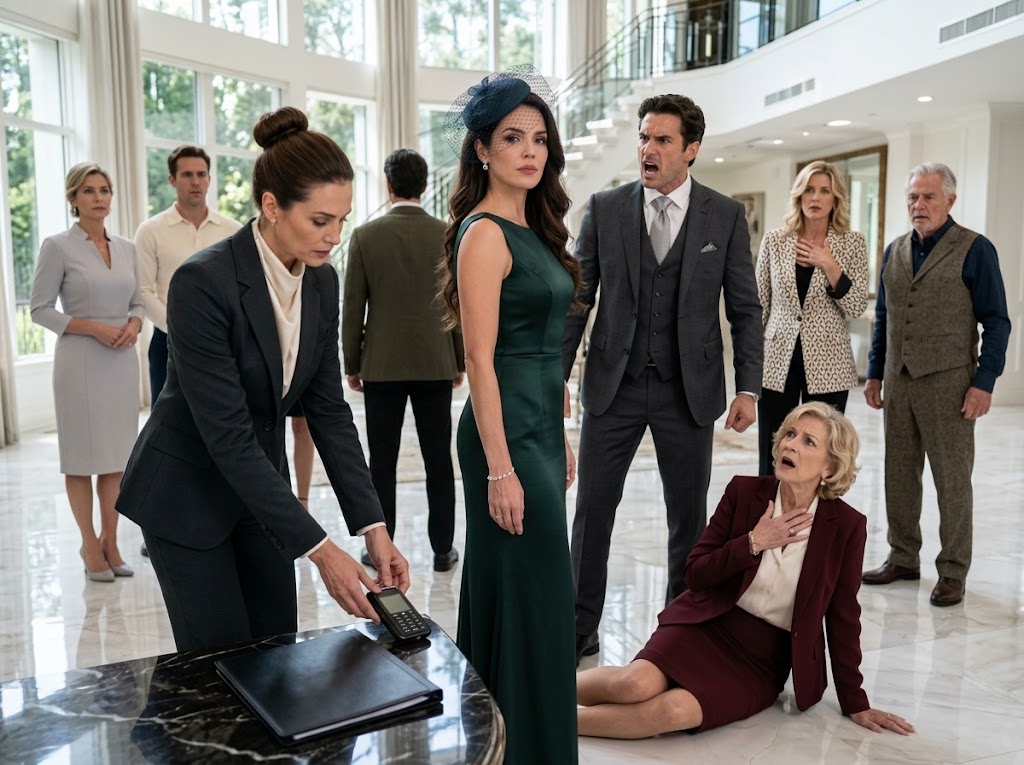
The post-funeral reception was still a low, murmuring hum of grief when my husband, Dermot, raised a heavy crystal tumbler of my dead father’s prized bourbon. He tapped a silver spoon against the glass, drawing the attention of forty mourning neighbors and family friends.
With a bright, almost euphoric flush on his cheeks, Dermot smiled and announced to the hushed room that my father’s inheritance was finally going to obliterate his family’s suffocating mountain of debt.
I stood frozen by the kitchen doorway, a tray of wrapped sandwiches in my hands, my blood turning to ice.
My mother-in-law, Wilhelmina “Billy” Castner, had already toured the house she intended to buy with that money. Six hundred thousand dollars. Four bedrooms. A sweeping wraparound porch in a heavily gated community within Biltmore Forest. She had texted me the Zillow listing a mere three days before we buried my father, appending a single, sickening line of text beneath the link:
Something to look forward to after all this sadness.
I had said absolutely nothing. Not at the rain-soaked graveside, not during the reception, not even when Billy had gripped my hand earlier that afternoon, her eyes shining with fake sympathy, whispering, “Your father is in a better place now, Odette. And so are we, really.”
I had simply nodded, retreated to the kitchen to refill the coffee urn, and continued thanking people for their condolences. I functioned on the autopilot of a woman raised to keep a room comfortable, entirely regardless of what it cost her own soul.
But two days later, the cost of that silence was called due.
We sat in the wood-paneled office of my father’s estate attorney for the formal reading of the will. Marguerite Pell, a careful, silver-haired woman who had navigated my father’s legal affairs for thirty years, reached into her bottom drawer. She retrieved my father’s battered, scratched-up cell phone and placed it deliberately on the polished mahogany table between us all.
She looked directly at my husband, her expression unreadable, and pressed play.
Six seconds. That is all it took.
Six seconds of garbled, then shockingly clear audio, and Dermot shot out of his leather chair so violently it tipped backward, cracking against the floorboards.
“Turn that off!” he bellowed, his face contorting from arrogance to sheer panic. “Turn it off right now!”
He should have been a great deal kinder to me before that phone started playing.
Because what was on that recording sucked the breath right out of my chest. And the look of absolute, cornered terror on my husband’s face when he realized exactly what my father had orchestrated from beyond the grave is a memory I will treasure, quietly and fiercely, for the rest of my life.
If you have ever sat silently while someone you loved showed you exactly who they were, forcing a smile because you weren’t quite ready to believe the monster standing in front of you, then pay close attention. This is a story about the moment a quiet person finally stops being underestimated, and I promise you, the ending is worth the wait.
My name is Odette Castner. I am forty-one years old. I work as a pediatric physical therapist at a bustling rehabilitation clinic in Asheville, North Carolina. My days are spent coaxing small, terrified children to trust their own bodies again after brutal surgeries, car accidents, and diagnoses no child should ever have to comprehend.
Half of my tiny patients are too young or too frightened to articulate where the pain lives. So, over fifteen years in cramped clinic rooms, I have learned to read what people refuse to say out loud. I know the microscopic flinch that precedes a painful word. I recognize the brittle smile that stretches the mouth but never thaws the eyes. I can spot the way a body subtly braces for impact a half-second before the mind even admits it is afraid.
I could read everyone in my life with surgical precision. Everyone, it turned out, except the two people who sat closest to me at my father’s funeral.
Or perhaps I could read them perfectly fine, and the crushing truth was simply this: I didn’t want to.
My father was Silas Renfrew. He was seventy-four when the cancer finally took him, and he was, without a single syllable of exaggeration, the finest man I have ever known.
He spent his entire career as a structural engineer. He was the kind of man who meticulously calculated whether a steel bridge would hold a rush-hour load, or if a concrete parking deck would still be standing half a century from now. He applied that exact same rigorous, unyielding quality to every corner of his personal life. Silas measured twice. He never rushed. He inherently distrusted anything that couldn’t be independently verified.
And so, he checked everything.
He built his wealth the exact same way he built his structures: slowly, carefully, and invisibly. Over four decades, there was no flash, no reckless stock market gambling. Just steady, grueling work, endless patience, and a stubborn Appalachian refusal to spend a single dollar he hadn’t first turned over in his palm and thoroughly considered.
My mother, Colette, passed away in 2016 after a brutal, drawn-out illness. Losing her nearly finished him. But my father was one of those rare, beautiful people whom profound grief makes gentle instead of bitter.
In his twilight years, it was mostly just the two of us. Sunday pot roast dinners at his quiet house up on Boatcher Ridge, followed by long, slow conversations on his back porch about nothing in particular. Above us, the heavy brass wind chimes my mother had hung years ago would tick softly in the mountain breeze.
I never once, in forty-one years, heard that man raise his voice in anger.
Which is precisely why what my husband did was so unspeakably obscene. Dermot took the mildest, most decent man who ever drew breath and treated his death like the maturity date on a high-yield municipal bond.