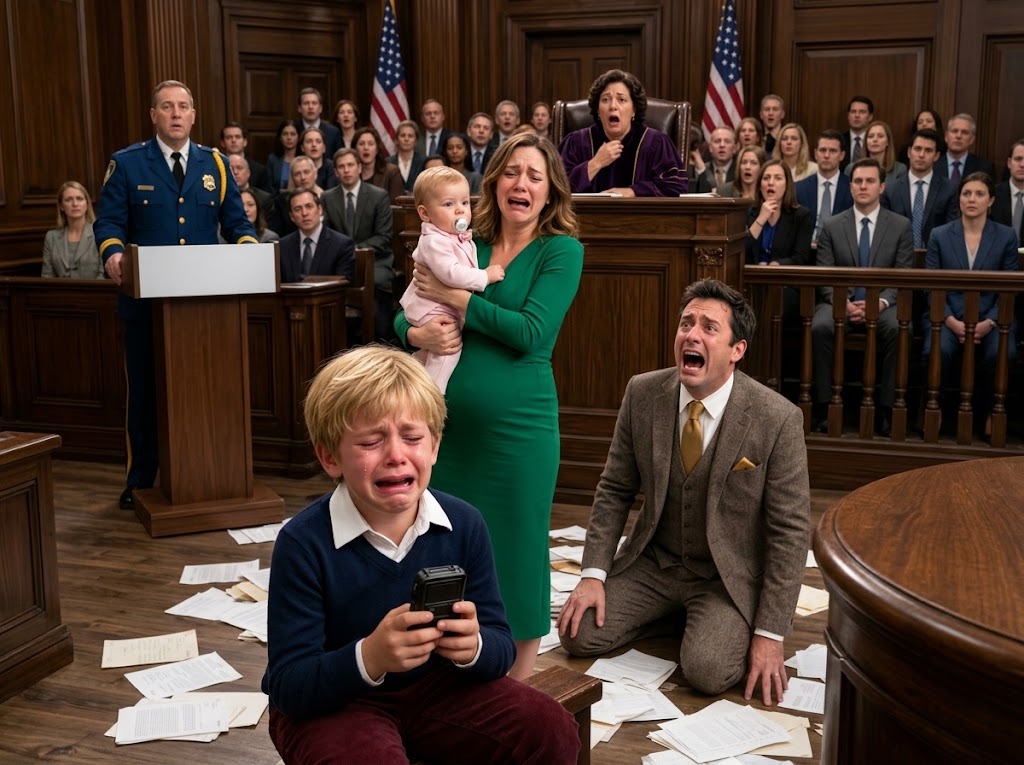
Chapter 1: The Architecture of Defeat
The Franklin County Family Court reeked of damp wool, stale institutional coffee, and the metallic tang of desperate prayers. Fluorescent lights buzzed overhead like trapped hornets, casting a sickly, sterile pallor over the heavy oak benches. The coldness of the room wasn’t just physical; it was built into the very architecture, designed to make you feel small, insignificant, and entirely at the mercy of the robed figure sitting high above.
I sat with my hands clamped together in my lap, my knuckles white enough to show bone. A faint, pale indentation still circled my left ring finger—a ghostly reminder of a decade I was currently being punished for.
I had agonized over my outfit that morning. I wore my best cream-colored silk blouse. It wasn’t designer, nor was it particularly new, but I had spent thirty minutes ironing it before the sun came up, desperate to project an image of capability. Beside me, my appointed attorney shuffled through a meager stack of papers, her sighs heavy with the reality of our uphill battle.
Directly across the aisle sat Michael.
He looked entirely untouchable, a portrait of impenetrable composure in bespoke navy wool. Not a single strand of his dark hair was out of place. His posture carried the terrifying, quiet arrogance of a man who firmly believed that enough money could dictate the ending of any story.
His legal team’s table was a fortress of intimidation. It groaned under the weight of meticulously tabbed binders, laminated bank records, projected educational portfolios, top-tier medical coverage summaries, and aggressive investment statements. Every single piece of paper had been weaponized, curated to prove one devastating narrative: Michael was the pillar of stability. I was a crumbling foundation.
At exactly 9:17 a.m., the wooden gavel cracked against the sounding block. The hollow sound reverberated in my chest, syncing with the frantic, terrified flutter of my heart.
Michael had filed for this divorce eight months ago. In my desperation to shield our children from the fallout, I had surrendered almost everything without a fight. I let him keep the sprawling mid-century modern estate in the hills. I signed over the luxury SUVs, the stock portfolios, and the exclusive country club memberships. I walked away from the lifestyle because none of it mattered.
The only thing I refused to yield was my sons.
My boys, Ethan and Noah, were only nine years old. They sat on a bench just behind my table, flanked by a court-appointed child advocate. Noah, always the more sensitive soul, seemed folded into himself, shrinking away every time the baritone voice of the bailiff echoed off the marble walls. Ethan sat rigidly upright, his jaw locked, one small hand pressed firmly flat against the front pocket of his corduroy trousers. He looked like a tiny soldier bracing for an impact he knew was coming.
Michael’s lead attorney, a razor-sharp woman named Ms. Sterling, rose to her feet. She didn’t walk; she glided to the center of the floor, commanding the room before she even opened her mouth.
“Your Honor,” Sterling began, her voice dripping with practiced, mournful concern. “My client, Mr. Walker, stands before you today capable of offering unparalleled structure, physical safety, elite educational opportunities, and absolute financial invulnerability. Conversely, Mrs. Walker has not maintained steady, documented employment in over ten years. Her medical records indicate recent bouts of anxiety, demonstrating a concerning emotional fragility that we believe renders her unfit to be the primary caretaker of two developing boys.”
The words were precision-guided missiles. They landed exactly where they were designed to hit, detonating my self-worth in front of a gallery of strangers.
My decade of packing lunches, soothing midnight fevers, managing the invisible, endless logistics of a household, and staying up until 2 a.m. folding laundry while the rest of the world slept—all of it was surgically reduced to ‘unemployment’ and ‘dependency.’ The profound, all-consuming love I poured into my children was twisted by a high-priced lawyer to look like a pathetic weakness.
Michael lowered his head, resting his chin on his perfectly manicured hands, playing the role of the wounded, reluctant patriarch to perfection.
“I tried to avoid bringing this into the public record,” Michael said, his voice soft, trembling with manufactured grief. “But my paramount concern—my only concern—is the well-being and safety of my sons. I cannot, in good conscience, leave them in an unstable environment.”
A surge of hot, blinding adrenaline hijacked my nervous system. Before my brain could catch up, my legs pushed me upward. My chair screeched violently against the polished floor.
“That is a lie!” I shouted, the raw desperation in my voice cracking the enforced silence of the room. “You don’t care about their daily lives! You only want them to hurt me!”
The judge’s gavel slammed down, sharp as a gunshot.
“Mrs. Walker, you will contain yourself and sit down immediately, or I will have you removed from my courtroom,” the judge warned, her eyes narrowed.
I sank back into my chair, my vision blurring with frustrated tears. I had played right into his hands. I knew that displaying even a fraction of justified anger would only validate Sterling’s narrative of my ’emotional instability.’
Across the aisle, Michael didn’t even bother to turn his head to look at me. But I didn’t need to see his eyes. I could see the minute, triumphant curve at the corner of his mouth. He was winning. He was taking my world away, and the law was holding the door open for him.
Then, the judge shifted her gaze away from the warring adults. She looked over her glasses, focusing on the back bench.
“Ethan. Noah,” the judge called out, her tone softening considerably. “Please, step forward to the railing.”
The air in the courtroom suddenly vanished. Every lung held its breath. The boys hesitated, their small frames trembling, before stepping into the aisle, walking toward a precipice that would define the rest of their lives.