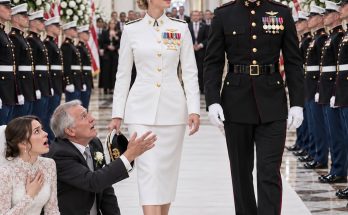
CHAPTER 1 — YOU ALREADY MISSED YOUR CHANCE
“You were three hours late to your own wedding, so don’t come here playing the victim.
My son already married a woman who knows how to put him first.”
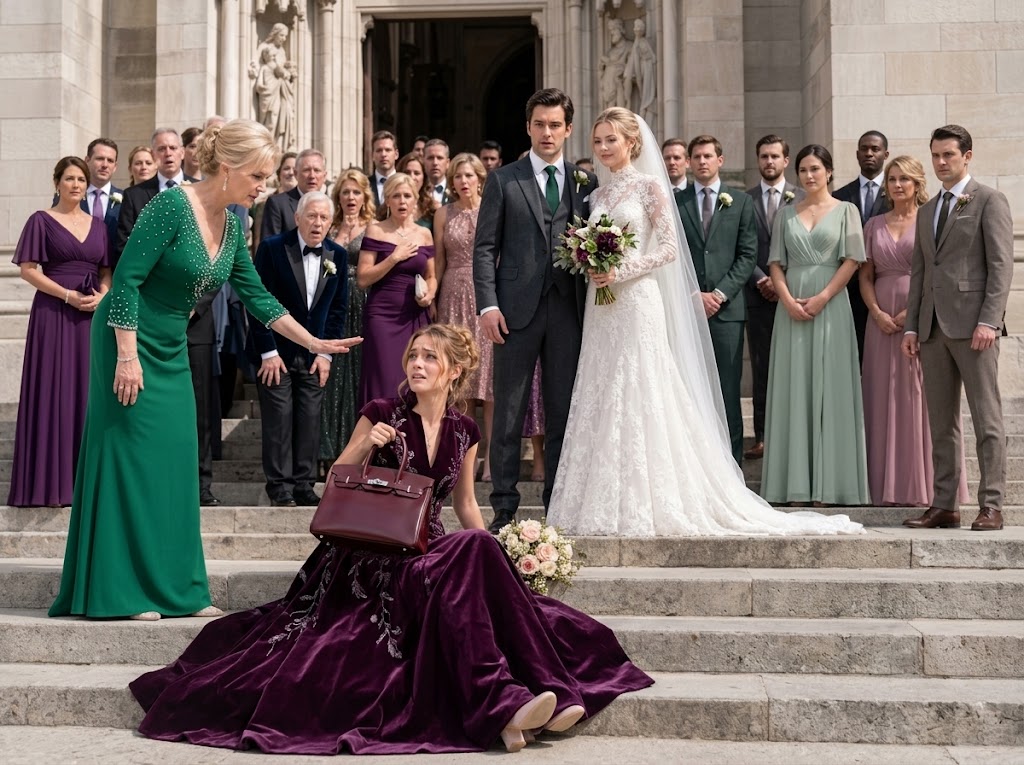
Those were the first words my almost-mother-in-law, Brenda, spat at me as I hurried up the marble steps of the San Antonio event center, my wedding dress crumpled, my hair slipping from its pins, and the sharp antiseptic scent of an operating room still clinging to me.
My name is Samantha Miller.
I was thirty-four and had spent eight years becoming a pediatric trauma surgeon.
That morning, I was supposed to marry Andrew Foster, the man I had lived with for nearly two years and believed would be my partner for life.
I want to tell this story from the beginning, because for a long time I thought it was about the worst humiliation of my life.
It took almost a year to realize it was actually the luckiest thing that ever happened to me.
Both versions begin in the same place: me standing on those marble steps in a ruined gown while a cruel woman told me I had already missed my chance.
What she did not know — what none of them knew — was that missing that particular chance would begin my real life.
I have come to believe many important events arrive looking like one thing and reveal another only much later.
That day, everything looked disastrous: public humiliation, betrayal by the two people closest to me, and the collapse of the future I had spent two years building.
If someone had photographed my face, they would have captured pure devastation.
Yet one year later, that same moment looked like the luckiest thing that had ever happened to me — the door closing on a life that was quietly diminishing me and opening onto one I was actually meant to have.
Same event.
Same marble steps.
Two opposite meanings.
The difference was time and where I stood when I looked back.
I did not know that then.
Standing on those steps, I could see only disaster. The lucky side of it would stay invisible for months.
And that is what I most want anyone standing in the wreckage of their own imagined future to understand: you cannot always see what an ending is becoming while you are still inside it.
The humiliation is real.
So is the pain.
I would never pretend otherwise.
I only know now that what something means today may not be what it means forever.
Mine took almost a year to turn around.
When it did, I stopped seeing myself as a woman left at an altar.
I became a woman who had been set free at one.
It was the same morning.
It had always been both.
CHAPTER 2 — SIX TWELVE IN THE MORNING
At 6:12 that morning, my phone buzzed with an emergency call from St. Luke Memorial Hospital.
“Dr. Miller, we have a critical six-year-old girl incoming — severe blunt abdominal trauma, suspected ruptured spleen, and her blood pressure is crashing fast.”
I stared at my white wedding gown hanging on the closet door in the gray dawn.
Then I looked at Andrew, still sleeping peacefully beneath the sheets.
I grabbed my coat and left a note on his nightstand:
An extreme emergency came in and I have to go operate right now.
I will do everything humanly possible to make it back on time, because I love you.
Twenty-five minutes later, I was scrubbing in while the team prepared the patient.
Her name was Paisley.
She had fallen from a rusted climbing structure at a neighborhood playground and arrived pale, barely conscious, and bleeding internally.
Her father ran beside the gurney with tears streaming down his face until a nurse gently stopped him at the double doors.
Just before they shut, I saw him wrap his arms around his little girl and whisper something.
I caught only the end.
I will be right here waiting when you wake up, pumpkin.
I did not know that man’s name yet.
I did not know that a year later he would be my family.
All I knew was that a child was dying, and everything else in the world — including a wedding — had suddenly become very small.
CHAPTER 3 — FIVE HOURS
For the next five hours, my wedding disappeared from my mind.
There was room for nothing except the small life on my operating table.
I will not describe the surgery in detail because those details belong to Paisley and are not the point.
It is enough to say the damage was much worse than the scans suggested, requiring delicate, painstaking work deep into the morning, with long stretches when none of us knew whether we would win.
A six-year-old body is fragile.
We fought for hers with everything we had.
At 11:47 a.m., we closed the final incision.
Her vital signs held.
Steady.
Strong.
Her own.
Paisley was alive.
She was breathing independently, her blood pressure was climbing back to normal, and she was headed to intensive care.
After eight years, that feeling has never dulled — the instant you realize a child is going to live.
There is nothing like it.
There is certainly no wedding like it.
I want to explain that because everyone in my old life — Andrew, Brenda, all of them — either could not or would not understand it.
People outside this work sometimes imagine a surgeon’s dedication as ambition, a hunger for status or achievement. They weigh it against other priorities and call it selfish.
She loves her career more than she loves me.
As though a career were a rival.
But that is not what it feels like to those who do this work properly.
When I stand over a dying child and help bring her back, what I feel is not the satisfaction of achievement.
It is closer to what a parent feels, or what someone feels pulling a stranger from a burning car: the absolute recognition that an irreplaceable human life is in your hands and nothing else you could be doing matters more in that instant.
A wedding can be rescheduled.
A party can wait.
A dress can be pressed again.
A six-year-old bleeding internally cannot wait.
There is no decent version of me who checks the clock and thinks about caterers while a child’s blood pressure falls.
Andrew called that choosing my patients over him.
But it was never a choice between Andrew and my patients any more than saving a drowning child is a choice against whoever is waiting for you at dinner.
It was a choice between being someone who saves a life when she can and someone who does not.
I have never been able to become the second kind of person.
I eventually understood that a man asking me to be one was not asking me to love him more.
He was asking me to become smaller and worse than I was.
Love is not allowed to ask that.
When I finally left the surgical suite and pulled off my mask, I felt the deep, clean exhaustion of a difficult case won.
Then I checked my phone.
And the other problem waiting across the city came rushing back.
CHAPTER 4 — TWENTY-SIX MISSED CALLS
Twenty-six missed calls filled my screen — from Andrew, Brenda, and Gemma, my best friend since college.
I called Andrew immediately.
It went straight to voicemail.
So I sent a quick message:
The emergency surgery was a success and the little girl survived.
I’m changing now and driving straight to the venue.
I changed from scrubs into my wedding dress in the front seat of my car beneath the concrete lights of the hospital garage.
I put on lipstick using the rearview mirror, my hands finally beginning to shake as the surgical adrenaline wore off.
Then I drove across the city through heavy weekend traffic as fast as I safely could, rehearsing my apology.
I was certain the people who loved me would understand once I explained why I was late.
That was the last moment I believed they loved me.
I did not know it yet.
I reached the venue shortly before three in the afternoon, nearly four hours late, my heart pounding with the ordinary dread of a bride who had kept everyone waiting.
At that point, I still thought lateness was the worst thing that had happened that day.
What was waiting inside was something entirely different.
CHAPTER 5 — HIS ACTUAL WIFE
The outdoor courtyard was full of guests drinking cocktails and chatting casually.
Nobody seemed to be waiting for a ceremony.
Then every guest turned toward me as I approached, wearing the same sickening mixture of pity, gossip, and awkward recognition.
Brenda stepped from the foyer with her arms crossed.
“You have nothing left to do here, Samantha.
Save yourself the embarrassment.”
“Where is Andrew?” I asked, breathless.
A small, cruel smile crossed her face.
She pointed through the glass doors.
“He’s inside.
With his actual wife.”
For a moment, I thought exhaustion had made me hear her incorrectly.
I pushed past her.
Andrew stood inside wearing the exact charcoal suit we had chosen months earlier.
Beside him stood Gemma.
My best friend of more than ten years.
She wore a white bridal gown.
She held white roses.
And on her finger sat the diamond ring I had personally helped Andrew choose, under the story that he needed to send it away for resizing.
I stood in the doorway as the room seemed to tilt.
The two people who knew me longest and best — the man I was meant to marry and the friend who was supposed to stand beside me while I did it — had simply replaced me in front of everyone I knew.
CHAPTER 6 — YOU NEVER PUT ME FIRST
“What is going on here?”
My voice sounded small and unsteady.
Andrew sighed.
Actually sighed.
As though I were the inconvenience.
“I waited for you, Samantha.
You didn’t show up.”
“I was in an operating room saving the life of a dying six-year-old child!”
“You’re always saving someone else,” Andrew said, cold and flat.
“You never put me first.”
That sentence cut deeper than seeing Gemma in a wedding dress.
Because it named the fear I had carried for two years — that the thing I valued most in myself, the work I had devoted my life to, was a defect in his eyes.
To Andrew, loving my work meant loving him less.
Brenda stepped behind him and sneered.
“Just leave.
You’ve made enough of a scene for one day.”
Gemma would not look at me.
Her eyes stayed fixed on the floor.
And I understood that her silence was the final thing she would ever give me.
It was worth nothing.
I did not scream.
I did not cry in front of those guests.
I turned and walked toward the exit, my ruined dress brushing the marble, promising myself I would fall apart somewhere they could not watch.
CHAPTER 7 — DR. MILLER
Just as my hand closed around the brass door handle, a deep voice called from the courtyard.
“Dr. Miller!”
I turned.
It was the father of the little girl I had operated on that morning.
He had learned where I had gone and come to thank me in person for saving his daughter.
His name, I would soon learn, was Zachary Howard.
He took in the scene with one glance: my wrinkled wedding dress, the guests, Andrew standing with his arm around Gemma.
He was a stranger.
He owed me nothing beyond the gratitude he had come to express.
Yet he understood immediately.
He did not ask invasive questions.
He did not make me explain or relive what had happened.
He simply walked over, opened the passenger door of his truck, and said quietly,
“Let’s get you out of here.”
I remember that moment because it was the first real kindness I received all day.
And it came not from the people who claimed to love me, but from a construction worker in a faded shirt whom I had technically met only that morning through a pair of operating-room doors.
I got into his truck.
I did not look back.
I have never regretted it.
I often think about the strangeness of who showed up for me that day.
The people who were supposed to love me — my fiancé, my closest friend, my almost-family, and guests who had known me for years — either betrayed me or watched my humiliation without intervening.
The person who crossed the room to help me was someone I had known for only hours.
By every normal expectation, it should have been reversed.
The people with years of love and obligation should have stood beside me.
The near-stranger should have politely kept his distance.
Instead, the history meant nothing when it mattered, and the stranger became my escape.
That day taught me something I never forgot: the length of a relationship says surprisingly little about whether someone will show up when you fall.
Some people spend years beside you without ever intending to carry any weight.
Others have no history or obligation at all, yet move toward you simply because they see someone in trouble.
Andrew owed me everything and gave me nothing.
Zachary owed me nothing and gave me a way out.
After that day, I stopped measuring people by how long I had known them.
I used one simpler measure:
When I was on the floor, did they move toward me or away?
It has never lied to me.
CHAPTER 8 — THE COFFEE SHOP
Zachary drove me to a quiet coffee shop near the River Walk, far from the venue.
I sat in my rumpled wedding gown.
He sat opposite me wearing the faded shirt he had worn all morning while waiting for news about his daughter.
“Paisley’s resting comfortably in the ICU,” he said gently, sliding a warm cup of coffee across the table to me.
“Her recovery outlook is very strong.”
For the first time that entire day, I released a long breath and felt some tension leave my shoulders.
“Then everything that happened today was worth it,” I said.
He studied me.
“You really mean that.”
“Completely.
I can replace a wedding,” I said.
“That little girl could never replace her life just so I could be somewhere taking photographs on time.”
Something changed in his expression.
He was quiet for a moment.
Then he told me, simply and without self-pity, that his wife had died three years earlier from a sudden medical condition, leaving him to raise Paisley alone while building a small residential construction business.
He did not say it to earn sympathy.
I think I had offered him one true thing about what a life was worth, and he responded with a truth of his own.
When we stood to leave, he gave me a crooked smile.
“Since you’re already in the dress,” he said, “if you ever need an emergency backup boyfriend, let me know.”
And I laughed.
A real, surprised laugh.
The first one all day.
I had no idea that, standing in that parking lot, I had just been handed the first thread of my actual future.
CHAPTER 9 — THE FOLDER
The next morning, I drove to the townhouse Andrew and I shared to pack while he was away.
I filled two suitcases with clothes, boxed my medical textbooks, and gathered my lab coats.
What struck me was how little evidence I had left in that house after two years.
It was as if I had always been a guest there.
Then, while clearing the bottom drawer of Andrew’s desk, my hand caught on a thick folder.
The tab displayed two printed names:
Andrew Foster and Gemma Salas.
Inside were official marriage-license applications, vendor receipts, and catering forms.
Then I saw the dates.
The paperwork had been submitted almost two weeks before my scheduled wedding.
I stood motionless as the truth reorganized itself around me.
This had not been an impulsive decision caused by my lateness.
Andrew and Gemma had not fallen into one another’s arms while waiting for a bride who never came.
They had planned it.
Carefully.
For weeks.
My late arrival had simply given them a convenient public explanation — a way to bury their betrayal beneath my supposed failure.
There was even a bank transfer from Brenda covering the fee to expedite their new license.
His mother had helped.
I photographed every page.
My hands were steady now.
The grief was changing into something colder.
Something clearer.
CHAPTER 10 — FOUR MONTHS
After photographing the documents, I called Andrew.
“How long have you been sleeping with Gemma?” I asked, the moment he picked up.
A long silence.
“Samantha —”
“How long, Andrew?”
“About four months,” he admitted, quietly.
A strange relief passed through me.
It meant the last thing I had supposedly done wrong had actually meant nothing.
“So my being late to the venue had nothing to do with any of it.”
“You missing the start time was the final push I needed to go through with it,” he said, defensive.
I laughed without humor.
“Andrew.
I’m standing here holding legal paperwork dated two full weeks ago.”
Another pause.
Then he said the sentence that destroyed the last bit of respect I had left.
“My mother told me you’d eventually choose your patients over me.
I just wanted to be prepared.”
He had taken a secret affair and, with his mother’s help, turned it into a fully arranged backup wedding.
Then he used the one morning I saved a child’s life as proof that his suspicion about me had been right.
“You’re unbelievable,” I said.
I hung up before he could offer another excuse.
And I realized something surprising.
I did not feel destroyed.
For the first time in two years, I felt able to breathe.
CHAPTER 11 — FAVORITE DOCTOR IN THE WORLD
That afternoon, I went to St. Luke Memorial to check on Paisley.
She was sitting upright in bed, and her entire face lit up when I entered.
“Did you fix my tummy?” she asked, clutching a stuffed bear.
“I certainly did,” I said, sitting on the edge of her bed.
“And you’re going to feel much better very soon.”
“My dad said you’re a real-life superhero who saved my life.”
She announced it with complete authority.
Zachary sat in the corner armchair, watching us with a tired, warm smile.
Paisley wrapped her small fingers around my hand.
“That means you’re my favorite doctor in the whole world.”
“How many doctors do you actually know, young lady?” I teased.
She considered the question seriously.
“Only two.
But you’re winning.”
I laughed.
Something that had been clenched inside me since the venue loosened slightly.
Over the next several days, my post-shift rounds gradually became small visits with Paisley.
I did not consciously decide it.
It just happened.
When Zachary learned I was staying in a long-term hotel while apartment hunting, he offered to rent me a vacant apartment he owned near the medical district.
I accepted only after insisting on full market rent.
I had spent two years being made small in one home.
I was not going to begin any new relationship, of any kind, by owing someone.
Paisley left the hospital twelve days later, walking out under her own power and grinning.
By then, somehow, the three of us had begun to belong in one another’s days.
I have tried since to identify exactly when we became a family.
There was no single moment.
No decision.
No conversation.
No threshold we deliberately crossed.
It happened gradually, the way dawn does.
One week I was a surgeon visiting a recovering patient.
Some weeks later, my day did not feel complete without a message about cherries or school or some new question Paisley considered medically urgent.
I could not have named when the shift occurred.
And I have come to think that real families often form this way.
Not through grand ceremonies and formal declarations, but through the quiet accumulation of ordinary days spent genuinely caring about each other.
My wedding to Andrew had been going to be an enormous public declaration of a family that did not truly exist.
A form without substance.
What I found instead with Zachary and Paisley was the opposite.
A real bond formed without ceremony.
By the time Zachary eventually placed a sapphire ring on a table, we had already been a family for most of a year.
The wedding did not create it.
It only announced what had already become true.
That is the difference between the two kinds of belonging I have known.
One is a ceremony hoping to create a family.
The other is a family that already exists and eventually gets around to having a ceremony.
The first is what I almost had.
The second is what I found beyond the door I thought had slammed in my face.
CHAPTER 12 — GEMMA’S CALL
About a month later, my phone rang from a number I no longer had saved.
Gemma.
“I really need you to understand that neither of us ever meant to hurt you,” she said, nervous, rushing the words.
“Gemma,” I said, “you sat on my couch and helped me plan my wedding while you were sleeping with my fiance.”
Silence.
“I’m not going to spend my energy being angry at you,” I went on.
And as I said it, I realized it was true.
“I’m just genuinely shocked that I mistook whatever this was for a real friendship, for over a decade.”
I ended the call.
Seconds later, a text from Zachary appeared.
Paisley urgently needs to know whether you like sweet cherries.
She insists it is a matter of serious medical importance.
I laughed aloud, alone in my apartment.
And I noticed how light I felt.
Lighter holding that silly text than I had felt during the final two years of the relationship I once believed was my future.
I did not yet fully understand why.
Nor did I know that Andrew and Gemma’s marriage was already beginning to fracture across the city while the life I had never planned to start was quietly growing.
CHAPTER 13 — THE SPACE THAT SHIFTED
The next few months became, to my surprise, some of the most peaceful of my adult life.
My schedule remained brutal.
Long surgeries.
Overnight call.
Quick meals over patient files.
The work had not changed.
Everything surrounding it had.
I no longer apologized simply for doing my job.
Nobody waited at home with a list of grievances about my schedule.
Nobody kept a private record of every evening the hospital had cost them.
Nobody used the thing I was proudest of as proof that I was failing.
Without planning it, Zachary and Paisley kept filling the quiet spaces in my weeks.
At first, our messages were about Paisley’s recovery.
Her incision tickles when she sneezes.
Is she allowed movie-theater popcorn yet?
Then, gradually, they became the ordinary texture of shared life.
Paisley has announced she’s going to be a surgeon too, but only if she can start her shifts after ten, because she hates waking up early.
One Sunday, I met them at a farmers market outside the city.
Paisley conducted what she called a rigorous scientific survey of four fruit stands before declaring her research complete.
On the drive home, she fell asleep in the back seat.
Zachary turned down the radio and asked,
“When was the last time you did something fun without checking your watch?”
I could not remember.
That was the honest answer.
I genuinely could not remember.
CHAPTER 14 — WHAT ANDREW NEVER ASKED
Zachary’s question made me reconsider the entire structure of the relationship I had escaped.
For two years, I had confused a comfortable arrangement with a partnership.
They are not the same.
Andrew said he loved me, and perhaps some part of him believed he did.
But in two years, he never once asked how a difficult surgery had gone.
Never asked whether a patient survived.
At his business dinners, he liked mentioning that his partner was a surgeon.
It reflected well on him.
But privately, he resented every hour that actually being a surgeon required.
He wanted the title without the reality.
The ornament without the woman who earned it.
Gemma praised my dedication to my face while using the night shifts that dedication demanded to take my place.
And Brenda never really wanted a daughter-in-law.
She wanted a woman who would organize her life around Andrew’s comfort and call it love.
What made Zachary different was not perfection.
It was something much simpler.
He never asked me to become smaller so he could feel larger.
When I talked about a difficult case, he listened.
When the hospital called me away, he did not keep score.
I had spent two years hearing, in a hundred small ways, that the best thing about me was an inconvenience.
Then I met a man who treated that same quality as one of the reasons he admired me.
Written down, that sounds like a very low bar.
It should be the floor.
But after two years with Andrew, the simple absence of contempt felt almost generous.
And I have thought a lot about that.
How does someone become grateful for basic respect?
Slowly.
A diminishing relationship lowers your expectations a little at a time until ordinary decency begins to feel exceptional.
That is its quietest damage.
Not necessarily the obvious cruelties.
It is the gradual resetting of your own sense of what you deserve.
Downward.
Notch by notch.
Until you forget where the floor was supposed to be.
I did not realize, during those two years, that I was being trained to expect less.
You rarely do while it is happening.
I recognized it afterward through contrast.
I would sit across from Zachary while he listened closely to me describe a difficult case and feel astonished.
Then I would realize I should not have been astonished at all.
That was how it should have felt from the beginning.
Relearning that — expecting basic decency as the floor rather than receiving it as a gift — became part of rebuilding my life.
Zachary did not give me more than I deserved.
He gave me what I had always deserved and had slowly been taught not to expect.
My astonishment showed how far my expectations had fallen.
CHAPTER 15 — BOTH OF US WILL BE RIGHT HERE
One evening, over tea at Zachary’s kitchen table, he spoke about his late wife, Hannah, a gifted commercial architect who had died three years earlier.
“After I lost her,” he said, “I was sure I’d never want to build a life with anyone again.”
“And now?” I asked, softly.
He glanced toward Paisley, asleep on the sofa with a bag of cherries in her lap.
“Now I’m not so sure anymore.”
Then he looked straight at me.
I stayed quiet because my heart was beating too fast to trust my voice.
I was not afraid of Zachary.
I was afraid of how much I already did not want to lose what we had built.
And I was afraid of trusting again too quickly after trusting the wrong person for so long.
In September, Paisley started first grade.
“Dr. Samantha, are you going to be there on my first day?”
She looked up at me with enormous hope while Zachary pretended very seriously to focus on making coffee.
“Of course I’ll be there,” I said.
That morning, she walked toward the school doors holding Zachary’s hand on one side and mine on the other.
At the classroom threshold, she turned and called loudly,
“Are you both going to be right here when school’s done?”
Zachary answered immediately.
“Both of us will be right here.”
When the classroom door closed, he looked at me.
“Thank you for being here today.”
“I promised her I would be,” I said.
He looked at me with something quiet and deep in his eyes.
“You always keep the promises you make.”
Andrew had used that same quality — my refusal to break a promise, even to a stranger on an operating table — as proof that I was a neglectful partner.
Zachary saw the identical trait and called it my greatest strength.
Same loyalty.
Two men.
One of them was finally seeing me.
And that became one of the most important lessons I took from everything that happened.
Very often, the problem is not the trait someone criticizes in you.
The problem is the person doing the criticizing.
For two years, Andrew had held up my deepest loyalty — my refusal to abandon a patient, my inability to break a promise, the core of what made me a good surgeon and, I believed, a good person — and presented it as a defect.
You always put others first.
You never put me first.
You care more about strangers than about me.
Because I loved him, I had partly believed him.
Criticism from someone you love has terrible authority.
I began treating my own loyalty as a flaw to manage, something excessive I should apologize for.
Then another man looked at the exact same trait — unchanged, undiminished — and called it one of the best things about me.
Nothing about me had changed.
The trait remained constant.
Only the person evaluating it had changed.
And suddenly the same quality went from defect to virtue.
That taught me to be careful about whose criticism I allow inside.
Someone who does not truly want what is best for you can take your finest qualities and call them flaws precisely because those strengths are difficult to control.
If they can convince you your strength is weakness, they can persuade you to put it down.
Andrew was not trying to fix something wrong with me.
He was trying to talk me out of a strength because that strength did not serve him.
Once I understood that, years of criticism rearranged themselves in my memory.
They stopped looking like observations about my flaws.
They looked like instructions to diminish myself.
I have never accepted that kind of instruction again.
CHAPTER 16 — THE POST
In October, the past returned, though not because I brought it back.
St. Luke Memorial held a small community banquet recognizing several notable surgical cases from that year.
Paisley’s was among them.
The hospital shared a photograph of Paisley in the recovery wing with her arms wrapped around my neck.
Zachary reposted it publicly with a caption that was simply a father’s gratitude:
This surgeon set aside everything on her calendar that morning to save my daughter’s life, and our family will never be able to repay her for those hours.
The post spread quickly through the local community.
Then someone asked what he meant by “set aside everything on her calendar.”
A former nurse who had worked that day replied that Dr. Miller had been scheduled to attend her own wedding during those same hours.
A neighbor connected that to Andrew and Gemma’s sudden marriage.
Then one of Andrew’s cousins, apparently carrying opinions of his own, wrote the truth plainly:
Andrew had married the maid of honor at the venue while Samantha performed emergency abdominal surgery on a dying child.
Another guest added that Andrew’s mother had stood on the steps and ordered the exhausted surgeon off the property so the celebration could continue.
I did not write any of it.
I did not need to.
The truth assembled itself publicly through people who had been there.
Andrew had spent months hiding behind the story that I was late.
Now that story came apart in real time in front of everyone he knew.
CHAPTER 17 — CLARIFY WHAT, ANDREW
Andrew called repeatedly that evening.
I let every call go to voicemail.
Then the messages began.
You need to talk to me right now, people are ruining my reputation online.
You need to publicly tell everyone to take those slanderous posts down.
I finally replied with one line.
I haven’t posted a single word about you anywhere.
But you can make a statement clearing my name!
Clarify what, exactly, Andrew?
My phone went silent.
He understood as well as I did that there was nothing to clarify.
Every fact being shared was true.
Defending his reputation would have required lying about what had happened.
Even Andrew could not find a lie big enough to cover it.
I felt no triumph.
Only something quieter.
I had spent two years twisting myself to maintain the approval of a man who, faced publicly with the plain truth of his own conduct, had no defense he could honestly speak aloud.
There was freedom in that realization.
The opinion I had once worked so hard to preserve belonged to someone who could not even defend himself with the truth.
I put down my phone.
I never answered him again.
CHAPTER 18 — THE FOUNTAIN
Two weeks later, I ran into Gemma at a shopping center.
She looked nothing like the polished woman I remembered.
Her eyes were tired.
Her mouth looked tense and unhappy.
“Samantha,” she said, stepping into my path near a fountain.
I kept walking, intending to avoid a confrontation.
Then she blurted,
“Andrew and I have separated.”
I stopped.
“Brenda took over every single detail of our household,” Gemma said, bitterness spilling out.
“She criticized what I cooked, how I dressed, how I spent money.
And Andrew always took her side.
Always.”
“He did exactly the same thing when he was with me, Gemma,” I said, quietly.
She lowered her eyes.
“I really thought it would be different for us,” she whispered.
Then she told me the detail that completed the circle.
Andrew had started complaining that she lacked ambition.
He told her, pointedly, that at least Samantha had an impressive career.
When he was with me, he resented my work.
With Gemma, he resented that she was not me.
And suddenly the whole truth of Andrew came into focus.
It had never really been about my career.
It was not about Gemma’s lack of one either.
It was about a man with an endless need to blame something outside himself for dissatisfaction that lived inside him.
“Is there any way,” Gemma asked, “that you could ever forgive me?”
I considered it honestly.
And I realized I could.
“I forgive you, Gemma,” I said.
Her face lifted.
“But forgiving you doesn’t mean letting you back into my life.
There are burdens I’m putting down for good, and I won’t pick that disrespect back up.”
I walked away without anger.
More than anything, that absence of anger told me I had healed.
But I want to be precise about what I mean by forgiveness.
I did not decide what Gemma had done was acceptable.
It was not.
She spent months helping me plan a wedding while sleeping with the groom.
There is no interpretation that makes that okay.
What I did was different.
I stopped carrying her.
That, stripped of all the sentimental language, is what forgiveness became for me.
Not saying the wrong was small.
Not restoring trust.
Simply setting down the weight because I finally understood that I was the only one still carrying it.
My anger was not hurting Gemma.
She was already living inside the consequences of her own decisions.
My anger was only exhausting me.
By that fountain, I realized I could put it down.
Not for her.
For myself.
That is why forgiveness and refusing to let her back into my life were not contradictory.
Forgiveness answered one question:
What am I willing to keep carrying?
Boundaries answered another:
Who am I willing to trust?
I put down the anger.
I kept the door closed.
Both were acts of self-respect.
The absence of anger never meant the return of trust.
It simply meant I stopped allowing someone who had left my life to keep occupying space inside me.
CHAPTER 19 — THE BACKUP OFFER
December arrived with crisp air and strings of lights.
One evening, while Paisley did homework at the kitchen table, she set down her pencil and looked at us very seriously.
“Are you two officially dating now?”
I nearly choked on my coffee.
Zachary stayed composed.
“Why do you ask, sweetie?”
“Because you look at each other the same way Sofi’s parents look at each other.”
Then she made such an exaggerated dreamy expression that I burst out laughing.
“Well, yes,” Zachary said, looking at me with obvious warmth.
“I believe we are.”
Paisley turned toward me.
“You think so too, Dr. Samantha?”
“Yes,” I said.
“I agree completely.”
She picked up her crayon again.
“Good.
I just needed to verify the facts.”
In February, in the same quiet coffee shop near the River Walk where Zachary had taken me on the worst day of my life, he reached into his coat.
“Do you remember the joke I made right here, a year ago?”
“You said that since I was already dressed for a wedding, you were available as an emergency backup.”
“It was a terribly cheesy line.”
“It was absolutely terrible,” I agreed.
He placed a small velvet box on the table.
Inside was a sapphire ring.
“I’d like to upgrade that backup offer,” he said, “into something permanent.”
Then he said the words that undid me completely.
“Samantha, I am never going to ask you to step away from your work.
I don’t ever want to compete with your patients, and I will never ask you to change your surgical schedule to prove you love me.
All I want is for you to come home to us whenever you’re done taking care of the world.”
For the first time, a partner was offering me love without asking me to amputate the best part of myself to receive it.
“Yes,” I whispered.
“Absolutely yes.”
CHAPTER 20 — EXACTLY ON TIME
When we told Paisley, she shrieked with joy and bounced across the couch.
Then she suddenly became serious.
“Are you going to arrive on time for this wedding, Dr. Samantha?”
I froze for two seconds.
Then all three of us dissolved into laughter.
“I’ll certainly try, sweetie,” I managed.
“Actually, no,” Paisley corrected herself.
“If the hospital calls to save another little kid, you need to be late again.”
Zachary looked down at her.
“You sure about that, pumpkin?”
“Yes,” she said simply.
“Because I’m only sitting here right now because she was late to her old wedding.”
In one sentence, a six-year-old had summarized the entire meaning of my life.
We married a few months later on a small garden terrace in San Antonio.
My mother flew in.
A few colleagues from St. Luke came.
There was no crowd of distant acquaintances and no show staged for anyone’s approval.
Only people who genuinely loved us.
Paisley carried the rings down the aisle with the seriousness of a head of state.
As I adjusted my veil in the bridal suite, my phone rang.
The hospital.
Zachary caught my eye from the doorway and smiled.
“Go ahead and answer it.”
“Zachary, I’m three minutes from walking down the aisle.”
“I know.
Answer it.
And if it’s a trauma,” he said, taking my hands and kissing my forehead, “then we’ll hold the ceremony whenever you get back from saving a life.”
It turned out to be only a resident asking about a medication dose.
But I have never forgotten what Zachary said before we knew that.
It captured the entire difference between my two weddings.
One man had left me at an altar because of who I was.
The other would have kept the altar waiting indefinitely for exactly the same reason.
A year after Paisley’s surgery, I learned I was pregnant.
Our son was born on a crisp Wednesday morning.
We named him Matthew.
Paisley ran into the hospital room carrying a drawing in bold marker.
Four figures stood beneath a bright yellow sun — Zachary, Paisley, me, and a swaddled baby — with OUR FAMILY written carefully across the top.
“Matthew doesn’t have fingers yet,” she explained seriously.
“I’ll draw them when he’s bigger.”
I kept that drawing.
It now hangs framed in the hallway of the house we share.
I stop in front of it more often than I would admit.
Four figures beneath a yellow sun.
One fingerless baby who has long since grown his fingers.
OUR FAMILY written above them in a six-year-old’s careful capitals.
To me, it is the truest document I own.
Truer than any diploma on my office wall.
Truer than any certificate in a drawer.
A marriage license is a legal document declaring a family into existence.
Andrew and Gemma had one of those.
Filed.
Expedited.
Paid for.
It never made them a real family.
A child’s drawing of the people she loves standing together under the sun is different.
It does not create anything.
It reports what already exists.
Paisley did not draw us together to make us a family.
She drew us together because we already were one.
That was the difference between the wedding I missed and the family I found.
One was a document trying to create a truth.
The other was a truth that paperwork could only catch up to later.
Then Paisley climbed onto the edge of my hospital bed, looked at her new brother, looked at me, and said the truest thing anyone said in this entire story.
“You know what I think, Dr. Samantha?
I think you were already part of our family the minute you fixed my tummy.
We just didn’t know it yet.”
I have thought many times about everything that first morning cost me and everything it gave me.
Eventually, I stopped believing they were separate things.
I arrived three hours late to a wedding that was never truly meant for me.
That is a fact.
But by being late to that altar, I arrived exactly on time to save a child.
I walked out of a door I thought represented defeat and found, on the other side, the family I had always wanted.
A real family does not ask you to destroy the best parts of yourself to earn a seat at the table.
Someone who truly loves you does not ask you to dim your light so theirs appears brighter.
Sometimes the thing that feels like the worst humiliation of your life is not an ending at all.
Sometimes it is a heavy door closing to protect you.
You can spend months staring at that closed door in heartbreak.
Or eventually, you can turn around and see where it was forcing you to go.
I missed a wedding on a sunny Saturday morning.
And if anyone asked whether I would do it again — walk into that operating room knowing exactly what it would cost me hours later — my answer has never changed.
Without a second’s hesitation.
Without a flicker of regret.
Yes.
I would be three hours late all over again.