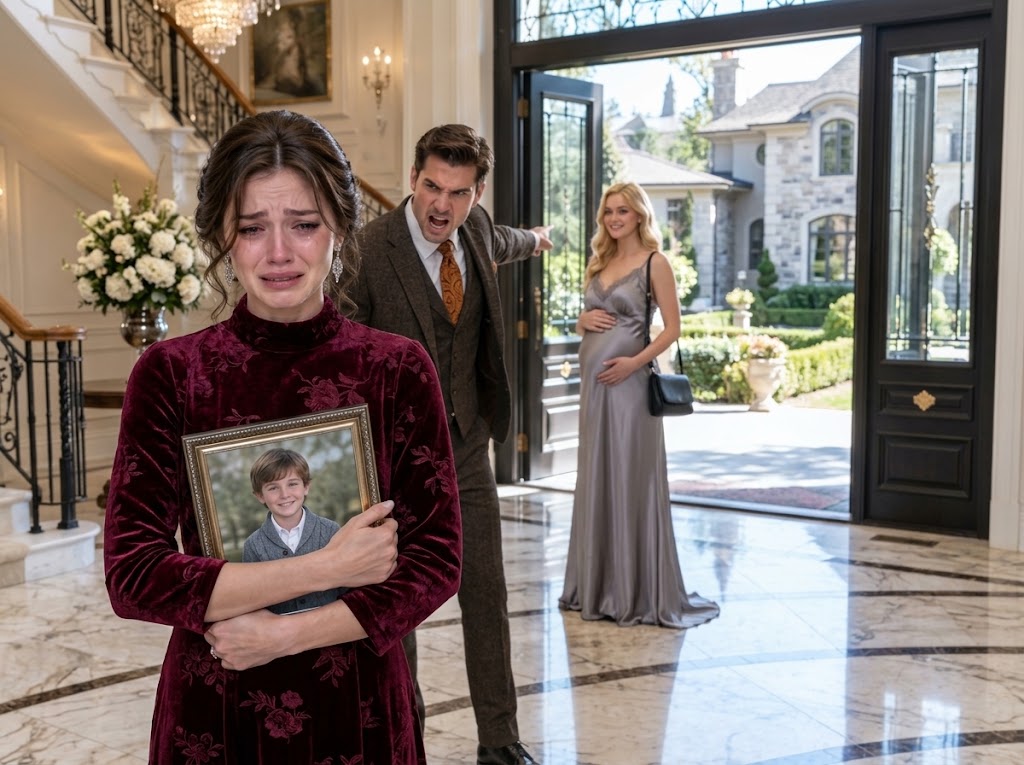
Chapter 1: The Soil on My Shoes
The damp earth from the cemetery was still caked in the treads of my black pumps when the man I had promised my life to delivered his decree.
“We put our son in the ground this afternoon,” he said, his voice flat, devoid of tremor. “You have forty-eight hours to pack your bags and vacate my property.”
For a fractured, spinning moment, standing across the granite expanse of our kitchen island, I desperately wanted to believe that the agony of the day had shattered his mind. I wanted to believe that no husband, no human father, could ever utter that sequence of words on the bleakest day of our existence.
I was still suffocating inside my wool mourning suit. My skull pulsed with a migraine so blinding that the drive back from the burial site remained a total blank in my memory. On the counter beside him sat a cluster of wilting white lilies, abandoned by well-meaning relatives. Just inches away, resting on its usual drying mat by the sink, was a small, bite-marked blue plastic cup. The cup my boy used for his apple juice every single morning.
I will not chronicle the specific horrors of my son’s illness in these pages, nor the agonizing minutiae of his death. I state this immediately so you comprehend it as a deliberate boundary, not an oversight.
His name was Leo. He was four years old, and he was the beating center of my chest.
Whatever brutal fate befell him belongs to him, and to me. It is sacred ground. This narrative is not an exhibition of his suffering. Rather, this is the chronicle of the knife my husband tried to slide into my back while I was standing in the darkest shadow of that loss. It is the story of the terrifying armor I discovered within myself when I thought I had been hollowed out.
Leo is the catalyst for every breath I took afterward. But his pain is not a spectacle. I will merely tell you that three hours before Julian issued his ultimatum, I had stood staring into an open rectangular hole in the earth. There is no linguistic equivalent for that specific agony. And Julian knew precisely the depth of my devastation when he chose that exact evening to strike.
“What,” I rasped, my throat raw from hours of silent weeping, “did you just say to me?”
Julian crossed his arms over his chest. He looked bored. “Two days, Clara. That’s more than enough time to throw some clothes in a suitcase.”
“And where,” I stammered, gripping the edge of the granite to remain upright, “do you expect me to go?”
He offered a casual, dismissive shrug. “Not my problem anymore.” He paused, letting the silence of our tomb-like kitchen stretch out, before delivering the killing blow he had likely been savoring all day. “Besides, Chloe is pregnant.”
The oxygen vanished from the room.
Chloe. My confidante since our freshman year at university. The woman who had slept in a plastic chair beside me in the pediatric intensive care unit during the longest, most harrowing three weeks of my life. The woman who, mere hours ago, had gripped my shoulders at the graveside, her tears soaking my collar, whispering, You are never going to be alone, Clara.
My vision narrowed. “Whose child is it?” I whispered, though the icy dread pooling in my stomach already knew the answer.
Julian’s lips twitched upward into a self-satisfied smirk. “Mine.” He said it with the puffed-chest pride of a man announcing a promotion. “I get a second chance to be a real father. After everything that happened with the boy, I feel like the universe is finally handing me a clean slate.”
After everything that happened. That was the sterile, bureaucratic phrase he chose. On the day we buried our flesh and blood, my son was no longer Leo. He was a logistical hurdle that had finally been cleared from Julian’s path to a shiny new existence.
I didn’t scream. I didn’t reach for the heavy marble cutting board and smash it against his skull, though my hands twitched with the urge. Instead, I looked past his shoulder to the refrigerator. Taped to the stainless steel with a crooked strip of blue painter’s tape was a crayon drawing of a lopsided green dinosaur. Leo had colored it two months ago.
I turned on my heel and walked silently up the stairs. Behind me, Julian shifted his weight. I heard him pull out a barstool, utterly unbothered, as I ascended toward a realization that would alter the trajectory of my entire life.
Chapter 2: The Shape of an Absence
I went straight to Leo’s room.
His twin bed remained perfectly made, tucked tight exactly as it had been during the interminable weeks he was trapped in the hospital. I hadn’t possessed the strength to rumple the sheets. By the floorboard, parked haphazardly under the window, sat a dented red metal fire engine.
Propped carefully against his pillow was a small stuffed dinosaur. Its soft, moss-green velvet was rubbed thin at the neck where Leo used to grip it during his sleep.
That was where the dam finally broke.
I collapsed onto the center of the plush rug, pulled my knees to my chest, and grieved. It was a feral, suffocating grief—the kind I had suppressed all day to spare the delicate sensibilities of our funeral guests. I will not attempt to paint it for you. A mother’s mourning for a small child is a lightless, mapless ocean trench. I sank into the black water on the floor of his quiet room, completely alone, and I stayed there for hours.
Yet, looking back, it wasn’t the weeping that defined that hour. It was the horrific epiphany that slowly crystallized in the dark.
Directly beneath me, on the first floor of the house, the man I had called my husband for eight years was undoubtedly plotting logistics. While I lay curled on the rug, physically clutching the shape of my dead child’s absence, Julian was downstairs doing arithmetic. Calculating timelines. Drafting eviction schedules.
The vertical distance between those two floors was the exact, terrifying gap between a grieving mother and an apex predator. I had shared a mattress with this predator for nearly a decade and had never once seen the teeth.
I am not a gullible woman. I am analytical by nature. I built my career and my life on a foundation of sharp judgment. So how, I asked the empty room, did I sleep beside a monster for eight years without noticing the chill?
The brutal truth is that predators don’t have to work tirelessly to conceal their true nature if their victim is already doing the heavy lifting. Love is the ultimate accomplice to deception. Love supplies the benefit of the doubt. Love looks at a husband’s cold, dismissive comment and rationalizes, He’s just overwhelmed with work. He’s tired. He didn’t mean to sound so callous.
Julian didn’t trick me because I was stupid. He tricked me because I loved him, and he expertly weaponized my own loyalty to explain away his shadows. I had crafted his mask myself, stitched together with my own desperate hopes, and strapped it to his face.
But tonight, he didn’t need the mask anymore. He believed I was utterly broken. The sheer horror of the kitchen wasn’t just the eviction or the mistress. It was the realization that my husband had never existed, and the stranger downstairs was simply waiting for me to leave. But as I finally pushed myself off the rug, wiping the salt from my jaw, I realized he had miscalculated one critical detail.