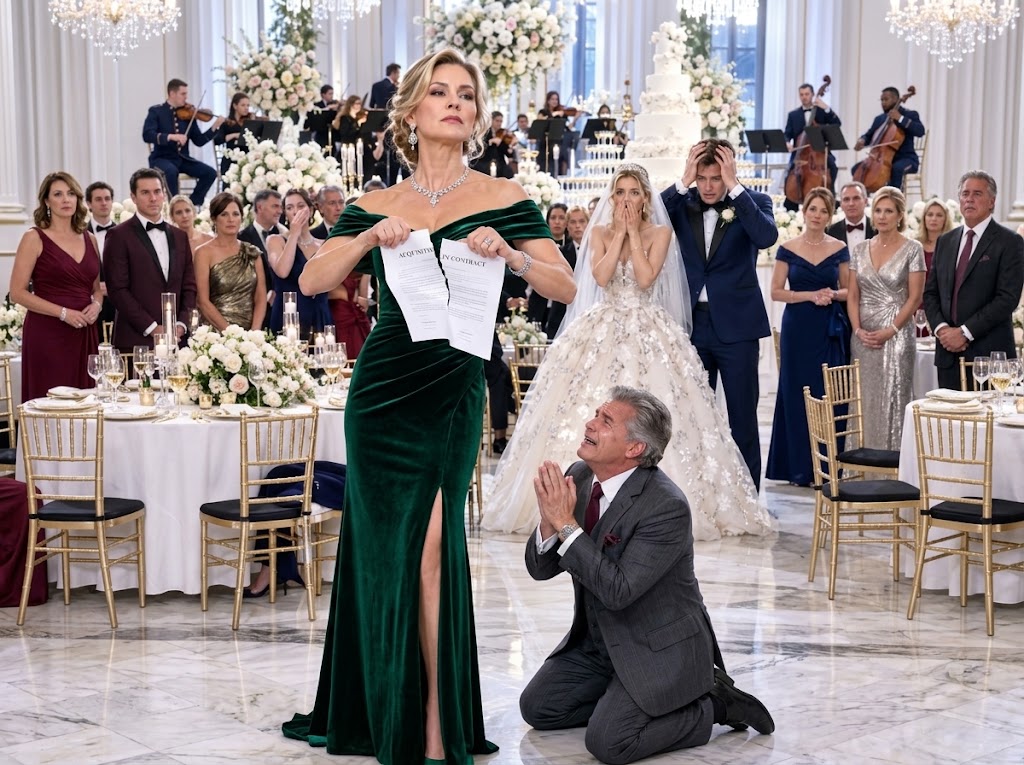
Chapter 1: The Ghost in the Ledger
For three decades, I have cultivated a species of influence that the world rarely recognizes. It is a silent authority, one that refuses to broadcast its presence through tailored Chanel suits or the obnoxious glint of a diamond tennis bracelet. I am a woman who appreciates the quiet hum of a well-oiled machine over the deafening roar of a parade.
When a man I had never met looked me dead in the eye at my only daughter’s rehearsal dinner and declared I wasn’t important enough to warrant his breath, I didn’t raise my voice. I didn’t slam my fist against the mahogany table. I simply reached for my phone, dialed a secure line I hadn’t utilized in years, and uttered a handful of syllables that would systematically dismantle his corporate empire before the waiter could clear our appetizer plates.
He had absolutely no inkling of the leviathan he had just casually provoked. By the time the realization finally dawned on him, the water was already over his head.
People often operate under the delusion that when a person accumulates staggering wealth, they possess a biological imperative to showcase it. I understand the psychology behind the assumption. Most individuals in my tax bracket crave the validation: the corner office boasting floor-to-ceiling panoramic glass, their surname etched in brushed steel above a lobby, the glossy profile in Forbes carefully lit to highlight their formidable presence.
I discarded those appetites a long time ago. Specifically, the day my husband, Michael, passed away.
It was an aneurysm. Sudden, violent, and devoid of the agonizing grace period that allows for final words. He died when our daughter, Emily, was just eleven years old. I vividly recall standing in the sterile stillness of our kitchen a week after the funeral. I watched Emily mechanically eating a bowl of cereal, her small shoulders curved inward, and I experienced a moment of crystalline clarity. I had a choice. I could continue mutating my firm, Reed Capital Partners, into the sprawling, voracious behemoth it was rapidly becoming, or I could raise the only living fragment of Michael I had left.
I chose Emily. I have not entertained a single second of regret since.
My retreat from the public eye was deliberate and absolute. I relinquished the visible helm of the firm to lieutenants I trusted with my life, restructuring my equity through a labyrinthine holding company that scrubbed the name Josephine Reed from every public-facing document. I still held the reins. Every catastrophic risk and monumental acquisition eventually required my signature, but I tended to my financial garden from behind an opaque, impenetrable fence.
Emily grew up operating under the vague assumption that her mother managed investments—a mundane description a child accepts without probing. She lived in a comfortable but unremarkable house. She was raised by a woman who coached her middle-school softball team, a mother who drove the exact same battered Ford truck for twelve years simply because the engine purred and she despised wasteful vanity.
What she did not know, what remained classified strictly within my innermost circle, was that Reed Capital had stealthily evolved into one of the most formidable private investment funds on the Eastern Seaboard.
And hidden deep within that tangled canopy of holdings sat a massive equity position in the Carter Group.
I hadn’t engineered the connection. Finance is a small world, and capital possesses a strange, magnetic irony. My chief strategist and oldest friend, David, had brought it to my attention months prior during a quarterly audit.
“Peculiar coincidence,” David had murmured, sliding a manila folder across the expanse of my desk. “Carter Group. Isn’t that the family your daughter is marrying into?”
I had stared at the embossed logo on the folder, feeling a cold, nameless knot pull tight in my chest. I chose silence. I wanted Emily to navigate her love for Daniel, her fiancé, without the distorting lens of my portfolio. But as I stared at the financial architecture of the Carter family’s upcoming endeavors, I realized their entire future hinged on a singular, massive technology acquisition. An acquisition they were recklessly underfunded for. An acquisition that required a final, $200 million tranche of private equity.
Equity that, through four layers of corporate obfuscation, belonged entirely to me. I closed the file, unaware of how soon I would need to weaponize it.
Will the Carters prove worthy of my daughter, I wondered, or will I have to show them exactly who holds their leash?