Chapter 1: The Locket on the Counter
I was already halfway across the 520 floating bridge, watching the glittering skyline of Bellevue dissolve in my rearview mirror, when the realization hit me. I had left my mother’s locket on the guest bathroom counter.
My foot involuntarily slipped off the accelerator. The sedan tailgating me flashed its high beams angrily, but the harsh light barely registered. This wasn’t merely a piece of misplaced jewelry. It was a delicate, worn oval of brushed gold, harboring a tiny photograph inside—my mother at thirty-two, head thrown back, laughing at a joke happening just outside the frame.
She had pressed it into my sweating palm two years ago, lying in a sterile hospital bed during one of her final, lucid nights. Her voice was a papery whisper, fragile as dry leaves.
“Keep this close, Lyra,” she had rasped. “It’ll remind you that someone loves you fiercely, even when I can’t be here to say it.”
I hadn’t unclasped it from my neck since the morning we lowered her into the damp earth. Not until tonight. I had taken it off to wash my hands in Roberta’s powder room, setting it on the cool marble countertop. I had walked out, distracted by the sound of my fiancé, Sebastian, calling my name from the living room, completely forgetting to put it back on.
My wedding was exactly fourteen hours away.
I flicked my turn signal, cut across two lanes of black asphalt, and took the next exit, looping back toward Bellevue. The rational, highly organized sector of my brain—the part that managed compliance portfolios for a living—told me to simply text Sebastian. Ask him to grab it and hand it to me in the morning before the ceremony.
But the other part of me, the bruised part that still occasionally reached for the phone to call my mother before remembering she was gone, couldn’t stomach the thought of that locket sitting abandoned in someone else’s house on the eve of my wedding. It needed to rest against my collarbone. I needed to be the one holding it.
I justified the detour. The drive back was only twenty minutes.
I had known Sebastian for four years. We collided at a financial planning summit in Portland, both serving as panelists on a blisteringly dry regulatory compliance session. During the coffee break, he leaned over the catering table, his blue eyes crinkling, and whispered, “You absolutely dismantled that moderator.” His lopsided grin made my chest perform an inconvenient, fluttering maneuver.
We endured eight grueling months of long-distance before he finally relocated to Seattle. He was a steady, grounding force. He was relentlessly thoughtful, and he never, not once, made me feel insignificant.
His mother, Roberta, was a different equation entirely. I had spent four years convincing myself she was simply fiercely protective of her son. She resided in a luxury Bellevue high-rise with his younger sister, Paisley, a twenty-three-year-old perpetually “figuring out her direction.”
I had extended financial lifelines to Roberta twice—once for an unexpected medical bill she claimed blindsided her, and once for a massive transmission repair on her SUV. I had also quietly floated Paisley’s university tuition for a semester when her financial aid supposedly hit a bureaucratic wall. A few thousand dollars here, a few thousand there. I didn’t track the expenditures obsessively in a spreadsheet. They were about to be my legal family.
I owned a charming, historic townhouse in Seattle’s Capitol Hill neighborhood. I purchased it four years prior, right before the housing market exploded into the stratosphere. Currently, I leased it to a quiet couple, which effortlessly covered the mortgage and generated a tidy passive income. I maintained a sterile, functional studio apartment downtown to minimize my daily commute.
The master plan was simple: after the wedding, Sebastian and I would move into the townhouse together once the current lease expired in the spring. It was a solid, practical blueprint. It felt like laying the foundation for a secure, shared future.
I parked my car along the curb in front of Roberta’s imposing building just after 9:00 P.M. The marble-floored lobby was deserted. I stepped into the elevator, mentally rehearsing the swift exchange. Ring the doorbell, offer an apologetic smile, explain I left a necklace by the sink. Be back in the elevator in three minutes. Simple.
The brass doors slid open on the sixth floor. The hallway was heavily carpeted, muffling the click of my heels. I moved toward apartment 612.
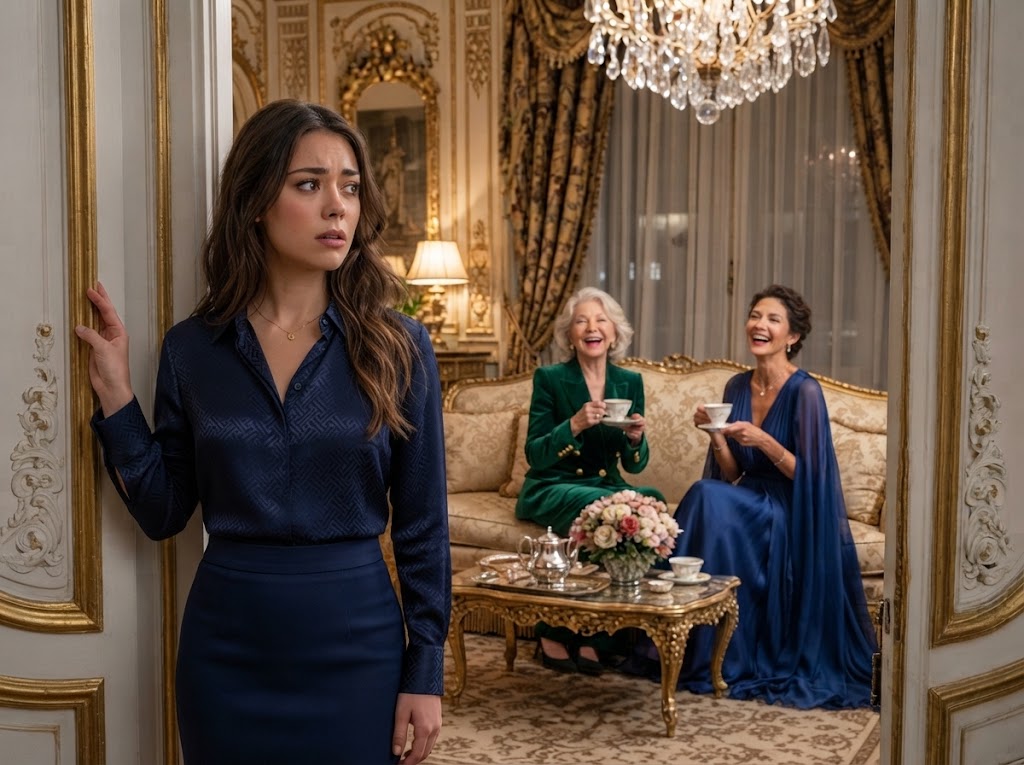
I could hear the voices before I even reached the door frame.
It was Roberta. Her voice carried that low, emphatic, authoritative cadence she deployed when she was utterly convinced of her own brilliance. Layered beneath it was Paisley’s voice, a higher, faster register, breathless with amusement.
I slowed my pace. Something in the frequency of their tone made me freeze six feet from the mahogany door. I stood there, perfectly rigid in the hallway. The specific words were muffled through the thick wood, but the energy bleeding into the corridor was entirely wrong. They were talking rapidly, laughing conspiratorially. It was a celebration, and I was decidedly not on the guest list.
I took two silent, gliding steps closer and pressed my right shoulder lightly against the textured wallpaper beside the doorframe.
Roberta’s voice cut through the wood, chillingly clear.
“Honestly, I couldn’t believe how easy it was. She just handed it over. Both times without a second thought.”
“Mom,” Paisley giggled, a sound that grated against my spine. “She has absolutely no idea.”
“That is exactly the point,” Roberta purred. “She is a sweet girl. Very trusting. Very industrious.” The last word dripped with a toxic, condescending pity. “Do you have any concept of what that Capitol Hill property is worth right now? I pulled the county tax records. That specific neighborhood surged fourteen percent in valuation this year alone.”
My fingers instinctively found the cold edge of my iPhone inside my purse before my brain had consciously decided to reach for it.
“So, what happens after the wedding?” Paisley asked.
“After the wedding,” Roberta stated, the sound of ice clinking against a glass accompanying her words, “she officially becomes Sebastian’s wife. And what belongs to her, as far as any reasonable, family-oriented conversation goes, belongs to the family.”
My thumb hit the screen. I opened the voice recorder app and pressed the red circle.
“We convinced her to add Sebastian’s name to the deed as a show of good faith,” Roberta continued. “That is a completely normal, standard procedure for a newly married couple. She’ll sign the paperwork because she loves him. Once his name is on the title, we refinance. We pull out the equity. Paisley, you get the new car you want, and I finally get out from under this suffocating apartment lease.”
“But what if she refuses to sign?” Paisley challenged.
“She won’t,” Roberta laughed, a harsh, dismissive sound. “Sebastian knows exactly how to handle her. He’s been massaging her ego for four years.”
A heavy pause hung in the air.
“He didn’t quite grasp exactly what we required when I initially pitched the idea to him,” Roberta added, her voice dropping to a conspiratorial murmur. “But he fully understands now that this marriage needed to happen for reasons far beyond the romantic. He’s not a stupid boy.”
The carpeted hallway suddenly felt like it was pitching violently to the left.
“And what about the money she already lent us?” Paisley asked.
“Gone,” Roberta declared. “Evaporated. She is never going to make a scene about past debts to her new mother-in-law. She would be far too embarrassed. That is the fundamental weakness of women like her—they are utterly terrified of appearing ungrateful or difficult.” A short, flat laugh. “She gave me a handwritten card on Mother’s Day, Paisley. A card. I highly doubt she’s going to retain a lawyer to sue me.”
I stood paralyzed against the wall for exactly three minutes and forty seconds. I know this precise duration because I stared at the timer on the recording app later that night. Every poisonous word was captured. Every pause, every cruel laugh. The audio clarity was almost comical in its horror, as if they were confessing directly into a studio microphone rather than plotting behind a hollow-core door.
When I heard the squeak of barstools pushing back and footsteps moving toward the kitchen, I stepped away from the wall. I turned, smooth as a ghost, and walked back to the elevator.
My hands were not shaking. My heels made zero sound against the carpet.
Inside the polished chrome elevator car, I stared at my reflection in the mirrored back wall. My hair was still perfectly styled from our rehearsal dinner. My mascara was flawless, completely untouched by tears. I looked exactly like a woman heading home after a perfectly pleasant evening.
“Okay,” I whispered to the hollow-eyed woman in the glass. “Okay.”
The drive back across the bridge to Seattle felt like navigating through a sensory deprivation tank. The water of Lake Washington was a sprawling, ink-black void on either side of the highway. I gripped the leather steering wheel until my knuckles turned white and let the recording loop in my head. I needed to absorb every jagged syllable before I permitted my body to react.
Sebastian knows exactly how to handle her. He’s been doing it for four years.
I thought back to the evening he casually mentioned that his mother had praised me, noting I seemed like the kind of woman who would “never let a family struggle.” He had delivered the comment like a profound compliment. Like an idiot, I had worn it like a badge of honor.
I unlocked the door to my studio apartment at 10:15 P.M. The space was small, sterile, and intensely familiar.
My wedding dress hung suspended from the closet door handle inside its opaque garment bag, the white nylon zipper running straight up its spine like a scar. I had purchased it alone. Not because I lacked friends, but because I desperately wanted one afternoon during the chaotic planning process that belonged entirely to me. I remembered standing on the pedestal in the bridal boutique on Pine Street, looking in the trifold mirror, thinking, This is real. This is finally happening.
I sat heavily on the edge of my mattress and stared at the white bag for a long time.
I didn’t cry. The shock of the betrayal was too surgical, too clean for messy tears. What I felt was closer to the specific, crystalline clarity you experience when a complex mathematical equation you’ve been struggling with for hours suddenly clicks into place. Everything was brutally, undeniably simplified.
I pulled out my phone and texted my closest friend, Tori.
You awake?
Three gray dots appeared instantly. Tori never closed her eyes before midnight.
Yeah. What’s wrong?
Nothing’s wrong, I typed back. And that was the terrifying truth. The world had just righted itself. I just need to speak with Marguerite tomorrow morning, first thing. Can you send me her direct number?
Tori had introduced me to Marguerite Aldous two years prior. Marguerite was a ruthless, highly sought-after civil litigation attorney who had also been one of my mother’s sorority sisters in college. She was the breed of woman who spoke exclusively in complete, perfectly parsed sentences and never, under any circumstances, raised her voice. Somehow, that made her far more intimidating than a lawyer who screamed.
Tori texted the contact card at 10:22 P.M.
I set my phone alarm for 6:00 A.M., switched off the bedside lamp, and lay flat on my back in the dark, listening to the distant hum of city traffic. Sleep dragged me under faster than I anticipated. It wasn’t the peaceful sleep of the innocent. It was the heavy, absolute sleep of a woman whose decision was already carved in stone, and whose body understood the mandate before her conscious mind had fully caught up.