Chapter 1: The Kitchen Threshold
The heavy swing doors of the banquet kitchen hit the industrial rubber baseboard with a dull, hollow rhythm. Every three minutes, another waiter kicked them open with the heel of a polished oxford, sending a greasy gust of steam, scraped salmon trimmings, and half-drained dregs of pinot noir across my table.
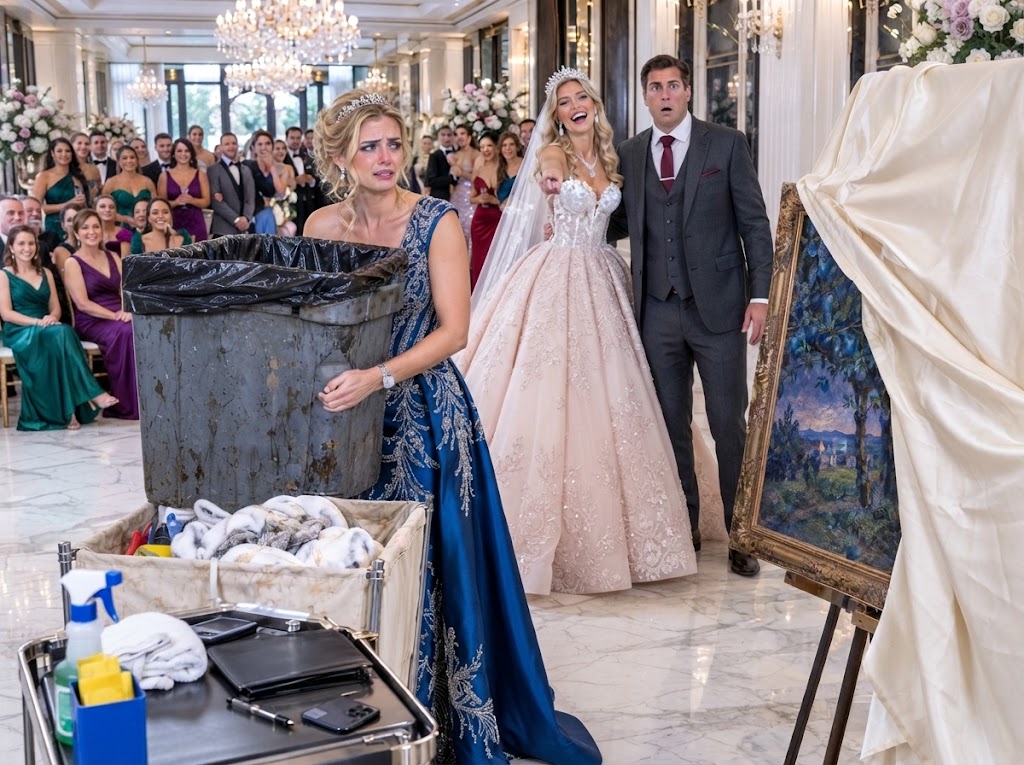
I was thirty-nine years old, a senior conservator accredited by the International Institute for Conservation, with a master’s degree in archaeological chemistry from Columbia. I spent my weeks reversing centuries of thermal decay, micro-flaking, and oxidized linseed oil on canvases worth millions of dollars. Yet on this humid September evening, my own family had seated me at a wobbly wooden utility station tucked between a soiled linen hamper and an industrial rubber trash bin.
“Don’t look so tragic, darling,” my sister, Brielle Reed, had whispered to me twenty minutes earlier, adjusting the gossamer train of her custom gown while the string quartet played Bach’s Air on the G String in the grand hall. “The service corridor has superior air circulation anyway. The trash won’t mind sitting beside you. Besides, you know how Caleb’s family values spatial symmetry. We simply ran out of room at the family dais.”
Behind her, our mother, Marianne Reed, had smoothed the silk crepe of her tailored gown, wearing the rehearsed pout she reserved for minor social embarrassments.
“Now, Jocelyn, please,” Marianne had murmured, her voice dripping with artificial sweetness. “Let us not make a scene on your younger sister’s day of triumph. An eccentric older sister being placed near the entrance is considered rustic, almost European. Try to smile. It gives your cheekbones some much-needed color.”
Several groomsmen within earshot had barked soft, appreciative laughs, assuming the exchange was merely playful banter among affectionate sisters. But running to the gravel lot was not an option. Walking away meant forfeiting the game before the opening move.
I sat down. The wooden backrest transferred a sticky square of old banquet tape to my silk blazer. I adjusted my posture, keeping my spine perpendicular to the floorboards, and settled my calfskin portfolio firmly between my heels.
“It is quite all right,” I had replied, my tone level and flat. “I will occupy whatever space you assign me.”
Brielle had flashed her rehearsed smile—the one that had garnered three hundred thousand followers on her lifestyle channels—before pivoting toward the ballroom.
Now, alone in the culinary crossdraft, I reached for the table setting. Unlike the heavy linen place settings visible through the glass double doors, mine consisted of a single paper napkin and an unembossed slip of cardstock. Next to it rested the official banquet program.
I turned the heavy cardstock over, and the air seized in my lungs.
Embossed across the header was an emblem: a twilight orchard beneath an indigo sky, its stylized boughs bearing luminous, cerulean apples. Beneath it, stamped in gold leaf, ran the inscription: Eleanor’s Orchard – The reed Family Legacy.
My hands remained still, but my fingers contracted against the paper until the weave groaned. It was not called Eleanor’s Orchard. The composition was titled The Blue Orchard, an oil-on-panel executed in 1914 by the post-impressionist master Henri Levasseur. And until four months ago, it had hung above the brick mantelpiece in my grandmother Eleanor Reed’s sunlit parlor.
My gaze dropped to the bottom right quadrant of the menu. There, printed in minuscule gray lithograph, was an emblem: a stylized oak leaf inside a crest, accompanied by the inscription: Hawthorn Art Advisory.
Hawthorn.
For ninety days, my attorney and I had chased that phantom shell entity across three states, attempting to pinpoint who had spirited the Levasseur away from our family estate storage locker before the probate inventory had cleared the probate court. And here it was, splashed across Brielle’s wedding stationery as a decorative backdrop.
I withdrew my phone, lowered the shutter volume, and angled the lens. Three rapid, high-resolution photographs captured the menu, the Hawthorn imprint, and the distant seating board visible through the service glass. Across the hall, Marianne’s gaze intercepted mine through the glass panel. She leaned into Brielle’s ear with a conspiratorial smirk. To them, I was merely the lonely, bitter spinster taking snapshots of the floral arrangements to nurse my resentment.
A sudden draft swept past the service entrance.
The emergency exit clicked open, admitting a damp chill and a tall figure brushing raindrops from the lapels of a charcoal wool coat. Marcus Bell paused in the threshold, his gaze searching the cavernous room before traveling down the narrow corridor toward the utility doors.
We had been seeing each other for several months—a quiet, uncomplicated relationship forged over strong espresso, cold museum galleries, and an unhurried mutual respect. Marcus was an independent provenance specialist, an archival bloodhound hired by private collectors and trusts to verify the ownership chains of high-value antiquities before private sales closed.
“I am so sorry, Jocelyn,” he said, pulling out the splintered chair beside me without an ounce of hesitation. The clatter of metal trays and the sour aroma of discarded champagne glasses didn’t elicit a single complaint from him. “The express from South Station suffered an electrical fault outside Providence. I had to sprint from the cab stand.”
“You made it,” I murmured, my hand reaching across the linoleum to brush a drop of moisture from his cuff. “That is all that matters.”
Before Marcus could sit, rapid, heavy footfalls clicked on the oak parquet behind us.
It was the groom. Caleb Von, heir to the Von shipping and real estate trust, was rushing toward the service door with a bundle of spare programs. He rounded the corner, glanced up, and froze.
The color vanished from Caleb’s complexion with horrifying rapidity, leaving his skin the shade of chalk. His eyes fixed upon Marcus, then flicked downward to the dinner program resting beside my cheap place card. Through the double glass doors, Brielle’s laughter died on her lips; she took two hesitant steps forward, her bouquet dangling loosely at her side.
Caleb closed the distance, ignoring me entirely. His voice was a strained, breathy rasp.
“Marcus?” Caleb whispered, his knuckles whitening against the doorjamb. “What in God’s name are you doing at this table?”
Marcus rose slowly. “I am Jocelyn’s guest, Caleb. Congratulations on your marriage.”
Caleb’s gaze dropped to the menu again. Then Marcus’s eyes followed his down to the blue apple trees and the Hawthorn logo.
The neutral mask on Marcus’s face fractured into cold comprehension. He looked at Caleb, then down at me, the professional gears locking into place behind his gray eyes.
“Jocelyn,” Marcus said, his voice dropping into a register that was no longer that of a dinner companion, but of an officer of the court. “We need to step into the foyer. Now.”