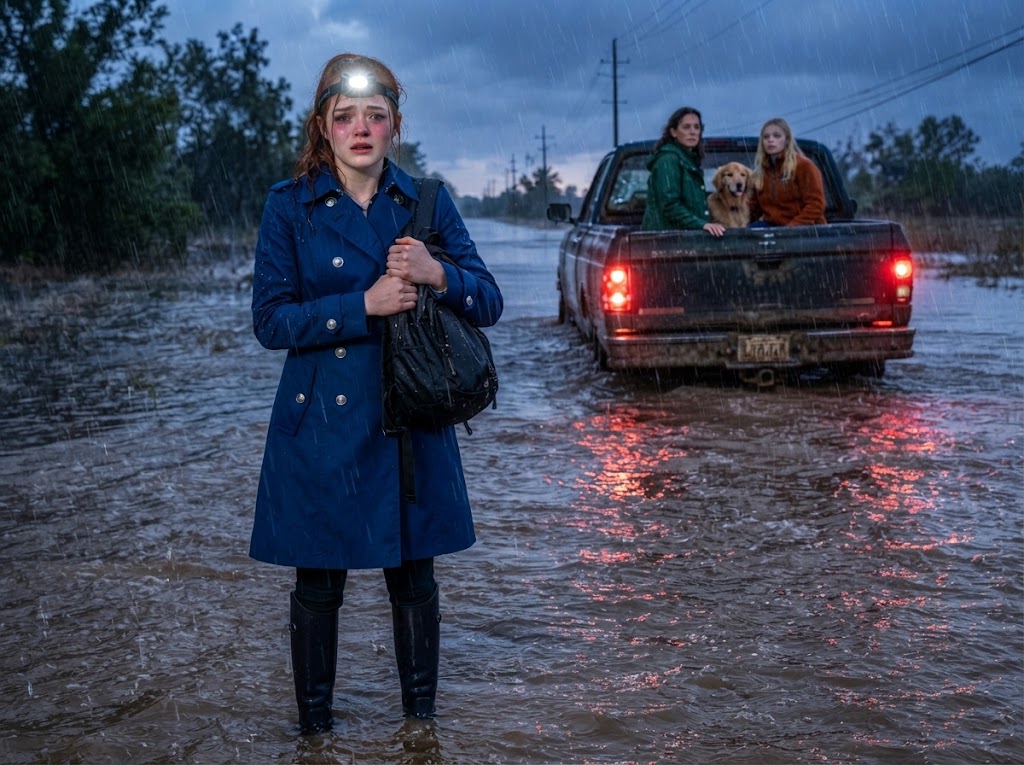
Chapter 1: The Weight of an Extra Seat
The warning on the NOAA weather radio had ceased being an advisory forty minutes before the creek jumped its banks. It had become a continuous, shrill banshee wail that vibrated against the wood paneling of our kitchen.
Outside, in the pitch-black hollow of Cypress Bend, Cibolo Creek was devouring our lower acre with a guttural, churning roar that sounded less like water and more like a freight train dragging rusted iron through the mud. It was 3:45 on an October morning in the Texas Hill Country, and the floodwater was already licking at the foundation blocks of the utility shed.
My father’s 2009 Ford F-150 stood idling in the driveway, its high-beam halogen headlights cutting two yellow funnels through the torrential deluge. The bed of the truck was already sealed under a taut black canvas tarp: a portable generator, two red gasoline cans, two plastic storage totes packed with my sister’s clothes, and four five-gallon buckets of dry provisions.
Inside the cab, the arrangement had been decided before my boots had even touched the gravel.
My father, Dale French, sat behind the steering wheel. The green plastic nasal cannula was looped over his ears, his oxygen regulator hissing rhythmically in time with his labored, shallow breaths. Next to him, on the passenger side, sat my mother, Denise, clutching an accordion folder of household deeds and insurance policies against her breast like a holy shield.
Behind them, the Super Cab’s split rear bench had been converted. The narrower jump-seat had been folded flat to accommodate his portable oxygen concentrator—a thirty-pound medical appliance that would short out and die if a single raindrop penetrated its vents.
That left the wider side of the rear bench. One seat.
My younger sister, Brooke, stood on the running board, soaked to the skin, her arms wrapped around a thirty-two-inch galvanized wire kennel. Inside it, trembling so violently the metal latches rattled like castanets, was Tucker—her fifty-five-pound yellow Labrador mix.
“Put the crate in the footwell,” I shouted over the deafening drumming of rain on the truck’s roof. Water was streaming down my neck, plastering my hair to my skull. “I’ll sit back there with him. Put his front paws across my knees. We can all squeeze in.”
“He can’t ride on your lap, Kate!” Brooke screamed, her voice pitching into that shrill, hysterical frequency that had dictated our family’s emotional weather since she was four years old. “He’s an emotional support animal! He’s got an official medical certification! If he’s out of the kennel during a thunderstorm, he claws through the door panels! He has panic attacks!”
“Brooke, the water is six inches over the lower cattle guard right now,” I said, keeping my cadence low, flat, and clinical—the same tone I used when de-escalating irrational customers across the counter at the pharmacy. “We have about eight minutes before the bridge is impassable. Let me climb in.”
“I’ll ride in the bed,” I added, turning to my father’s open window. “Toss me a tarp. I’ll brace against the wheel well.”
“No,” Dale rasped, coughing until his chest hitched against the seatbelt. He stared straight through the streaming windshield, his knuckles white on the steering wheel. “Current over the low-water crossing will sweep an adult out of an open bed in three seconds. You know that, Katie.”
“Then leave the oxygen concentrator,” I said, pointing through the window. “Dad, your tank has four hours of compressed reserve. We’re driving eleven miles to the shelter in Ridley. You don’t need the wall unit until sunrise.”
My mother turned in the passenger seat. The amber dashboard lights caught the severe, unforgiving contours of her face—a face that had spent twenty-five years managing the administrative affairs of First Baptist Cypress Bend.
“He was discharged from the pulmonary ward nine days ago, Kate,” Denise said. Her voice didn’t waver. It didn’t rise. It carried the crisp, chilling efficiency of an ecclesiastical decree. “That machine does not get left behind.”
“Then what are you proposing, Mother?”
Dale unbuckled his belt, stepped down into the mud, took the galvanized wire kennel from Brooke’s shaking arms, and shoved it onto the rear cushion. He took the heavy ratcheting cargo strap from behind the headrest, looped it through the cage’s wire mesh, and pulled it taut with two sharp, mechanical clicks.
He didn’t look at my face. He spoke directly to the nylon webbing.
“It’s simpler this way, Katie,” he muttered, his breath wheezing through his teeth. “You’ve got your boots. You’ll be at the ridge before the county grader even starts moving.”
My mother leaned across the passenger door, rolling the window down just two inches to keep the squall from dampening her leather purse.
“That dog needs saving, Kate,” she said through the gap, her voice flat and matter-of-fact. “You don’t. Walk to higher ground.”
She began to wind the crank back up. “The road is all uphill from our mailbox. If you get cold, Marlene is up on the—”
She clamped her mouth shut. The glass hit the rubber seal with a muffled thud.
She had caught herself. She had almost said a name she wasn’t supposed to say.
Brooke scrambled over the transmission hump into the front middle seat, wedging herself between our parents. Through the glass, I could see her phone illuminated in her left palm, her right fingers poking through the kennel’s wire to stroke the dog’s nose. She didn’t glance out the side glass once.
The red taillights flared. The F-150’s tires spun once in the slick river gravel, caught traction, and surged down the driveway toward the low-water bridge.
I stood in the downpour and counted.
One. Two. Three.
I watched the red lights plunge down into the dip where the creek crossed the blacktop. The water was already bubbling up to the truck’s chrome hubs, throwing white sheets of spray into the brush on either side. The engine bellowed, the tires bit into the submerged asphalt, and the truck hauled itself up the far bank, disappearing around the cedar ridge toward Ridley.
I stood alone in the dark for twenty seconds.
Then I reached inside my rain jacket, pressed my thumb against the heavy plastic seal of the one-gallon Ziploc bag tucked against my ribs—verifying that my father’s daily medications, his rescue inhaler, and my phone were bone dry—and switched on the elastic headlamp strapped to my brow.
Kate can take it.
I turned my back on the drowning house and started walking up the hill.
The county road was an unlit ribbon of caliche and limestone that climbed nine-tenths of a mile from our valley floor to the limestone plateau where the church stood. That night, it wasn’t a road; it was an ankle-deep spillway. Brown runoff tore down the ruts, carrying dead cedar limbs and fist-sized river rocks that battered against the steel toes of my work boots.
There were fourteen creosote utility poles between our cattle guard and the highway. I knew the count because I had counted them during every summer jog of my adolescence.
At pole four, the water reached mid-calf.
At pole seven, my left boot caught a submerged root, and I pitched forward onto my knees, my hands sliding into the jagged limestone gravel. The sharp rock sliced through the denim of my jeans, reopening an old white scar that had rested across my left palm since I was nine years old—a souvenir from a splintered deck board my father had pulled out with tweezers while Brooke wailed inside the house.
Kate can take it. Your sister’s the one who can’t.
I didn’t pause to check the blood. I pushed myself up, wiped my palms on my wet thighs, and kept moving.
At pole fourteen, the road leveled off onto the plateau. The white wood-frame steeple of First Baptist Cypress Bend loomed out of the dark, its storm shutters rattling against the brickwork. The gravel parking lot was empty. The sanctuary was locked tight.
I stepped under the covered entryway, dripping water onto the red welcome mat. I pulled the Ziploc bag from my breast pocket. The cracked screen of my phone lit up: 4:55 AM. Battery at thirty-one percent.
I opened the family group thread and typed three words: At church. Safe.
At 5:02 AM, the notification below the message shifted: Read by Dale. Read by Denise.
No reply followed. No ellipses danced on the screen.
I sat down on the cold concrete steps, leaned my head back against the heavy oak doors of the house of God, and waited.
At 5:40 AM, twin headlights swept across the wet cedar scrub. A silver Honda Odyssey minivan slowed as it approached the church gates, hesitated, and swung abruptly into the lot.
The passenger window hummed down.
“Kate?”
Marlene Tibbs stared at me from behind the steering wheel, her hair tucked under a plastic rain bonnet, a yellow slicker thrown over her flannel nightgown. She was sixty-four years old, the director of our church’s Benevolence Committee, and my mother’s closest confidante for two decades.
“Oh, sweet Lord above,” Marlene whispered, her face draining of color. “Get in this automobile right now. Get in!”