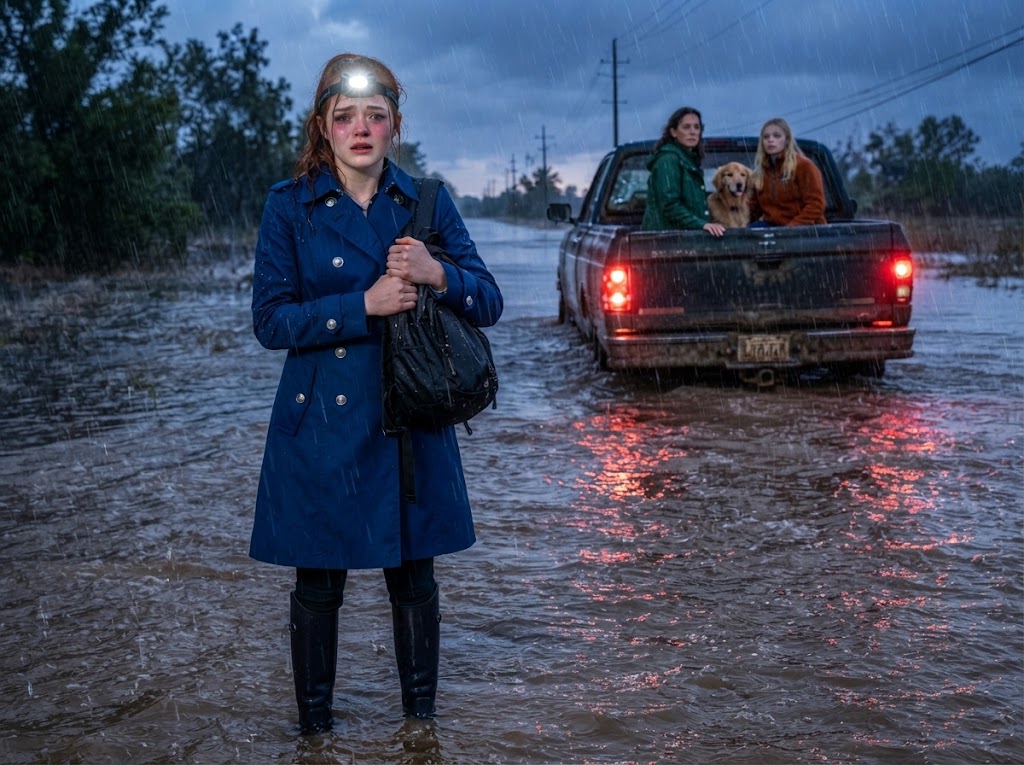
Chapter 5: Higher Ground
The reckoning that followed was not cinematic; it was administrative, quiet, and final.
On the Thursday following the service, the Board of Deacons of First Baptist Cypress Bend convened behind locked doors. They voted unanimously to strip Denise French of her administrative duties, demanded the return of her office keys by sunset, and issued a formal legal notice requiring the restitution of the $4,000 benevolence grant alongside Marlene Tibbs’s $1,500 personal gift, to be repaid in monthly installments of $450.
No criminal charges were filed with the Harland County Sheriff. Pastor Tom Alder handled the matter as an internal ecclesiastical fraud, though the state fundraising platform took down the campaign page within forty-eight hours after Brooke submitted a notarized confession retracting the narrative. Sixty-two donors requested refunds; the platform seized the remaining funds in the linked account to cover the chargebacks.
Denise paid the first restitution installment in December. My father signed the check from a new, individual account he opened at the credit union in Seguin.
Dale didn’t file for divorce. At sixty-one, with forty percent lung capacity and thirty-six years of marriage behind him, he lacked the emotional vocabulary for legal dissolution. Instead, he simply packed two duffel bags, his portable oxygen concentrator, and his blue plastic medication organizer into his brother Ray’s truck, and moved into the apartment above Ray’s diesel repair shop behind the feed mill.
In January, an envelope arrived at my apartment in New Braunfels.
Inside were two sheets of yellow legal paper covered in my father’s cramped, angular printing:
Katie,
I strapped that wire kennel into the rear seat because I was terrified of what your mother would do to that house if the town saw the truth. That is not an excuse. It is an indictment. I spent twenty years letting you be the anvil because it was easier than standing between you and the hammer. You were the only person on this earth I trusted to fill my medicine box, and I treated you like baggage that could be left on the side of the road. I don’t ask you to forgive me. I just want this written down in my own hand so you know that I know what I did.
Dad.
I didn’t burn the letter. I folded it into thirds and placed it in the bottom drawer of my desk, beneath my surgical receipts.
Once a month, I drive down to Seguin on a Sunday morning. I sit at Uncle Ray’s laminate kitchen table, set out the prescription bottles, and fill my father’s seven-day organizer with the blood pressure tablets, the steroids, and the breathing capsules. We drink black coffee. We talk about the weather and the price of diesel.
We never speak my mother’s name. And neither of us ever mentions what a daughter can or cannot take.
Brooke moved to San Marcos in February. She lives in a small, third-floor studio apartment three blocks from an outpatient addiction recovery clinic, paying her rent with twenty-five hours a week of dog grooming at a veterinary hospital. She attends twelve-step meetings four nights a week, with Tucker sleeping quietly beneath her folding chair.
She took out a four-thousand-dollar personal loan through a regional credit union to finance her clinical therapy. I didn’t co-sign the note. I didn’t offer a single dollar.
For the first time in twenty-eight years, Brooke is paying the retail price for her own life.
She texts me every Tuesday evening after her group session concludes:
Week 14 clean.
Tucker says hi.
I text back:
Proud of you, Brooke. Keep walking.
Denise lives alone in the repaired house on the banks of Cibolo Creek.
The insurance settlement replaced the water-logged subfloors with cheap laminate and installed particle-board cabinets in the kitchen. She attends a small, non-denominational church thirty miles away in Boerne, where nobody knows her maiden name and nobody has ever heard of the French family’s recovery journey.
She mailed a Christmas card to my apartment in December. Inside, she had written one sentence in her neat, church-office cursive:
A mother protects the child who needs her most; one day you will understand.
I didn’t reply. I didn’t need to.
I understood everything. I understood that when a family assigns one child the role of the survivor, they aren’t praising her strength; they are budgeting her endurance so they can spend it on someone else.
It is May now. Seven months since the creek climbed the hill.
I am thirty-three years old. I still clock in at Haskell’s Pharmacy at 2:00 PM every afternoon, still count out two hundred prescriptions a shift with a stainless-steel spatula, still verify every label against the ledger with mechanical, uncompromising precision.
Every morning at sunrise, before the Texas heat settles over the river, I lace up my boots and walk the paved limestone trail that climbs from the Guadalupe River up into Landa Park.
It isn’t a mountain. It’s just an ordinary Hill Country ridge, climbing four hundred feet above the pecan groves and the limestone bluffs.
I don’t carry my father’s deer-hunting headlamp anymore. It sits in my kitchen cabinet next to a second, smaller medication organizer—a white, seven-day tray that holds the single synthetic levothyroxine tablet I must swallow every morning for the rest of my life to replace the thyroid gland my mother erased from the public record.
My mother was almost right that morning in the driveway.
I didn’t need saving from the rising water. I walked out of that dark draw on my own two legs, through fourteen power poles and six inches of limestone gravel, with a cut palm and water in my boots.
What I needed saving from was the terrible, seductive trap of being the one who never broke. The one who could always swallow the insult, pay the balance, absorb the scandal, and surrender her seat so the fragile could ride in comfort.
I saved myself from that on a church aisle on a Sunday morning.
I can still take it. I have never doubted my capacity to endure the storm.
The only difference now is that I am the one who decides what is worth carrying—and when the road turns uphill, I leave the dead weight behind.