Chapter 5: The Voice of the Invisible
I did not scream for help. I did not scream out of terror.
I screamed with the furious, calculated intent to ensure every single person on that hospital floor witnessed his demise.
“Get your hands off of me!”
The two detectives rounded the corner in a fraction of a second, hands resting on their holstered weapons. Richard’s eyes went wide. He released my wrist and spun around, attempting to bolt toward the emergency stairwell. But Mrs. Gable stepped out from the side corridor, holding a piping-hot, styrofoam cup of hospital coffee like a grenade.
“Don’t you dare take another step, you piece of garbage!” she bellowed.
Trapped between armed law enforcement and the wrath of a Miami widow, Richard froze.
The detectives slammed him face-first against the cinderblock wall. The metallic ratcheting of handcuffs echoed loudly down the corridor. As they hauled him toward the elevator, he twisted his neck, trying to shoot me one final look of domination, as if he could still command me to shrink into the shadows.
“You are going to regret this for the rest of your miserable life, Maya!” he screamed.
I slowly raised my arm, displaying the angry, red finger marks rapidly bruising my skin.
“No, Richard,” I replied softly. “I am just finally remembering who I actually am.”
My mother regained consciousness as the pale pink light of sunrise bled through the hospital blinds.
Her eyelids fluttered open slowly, fighting against the heavy sedatives. I rushed to the side of her bed, grasping her cold, fragile hand.
“What about… him?” she rasped, her throat dry from the intubation tube.
“He is in custody, Mom. Denied bail. The detectives have the notebook and the audio.”
A single, brilliant tear rolled sideways down her cheek, pooling in her ear. “The capsule…?”
“It spoke, Mom,” I whispered, kissing her knuckles. “It told them everything they needed to hear.”
She closed her eyes and offered a faint, profoundly tired smile. “I told you… my body would testify.”
For the first time in a very long time, I didn’t command her to be strong. I gently brushed her silver hair back and told her she had finally earned the right to rest.
The ensuing days were a chaotic whirlwind of sworn police statements, emergency court filings, aggressive divorce attorneys, and the unearthing of painful truths that stung even worse after the immediate physical danger had evaporated. The forensic audit revealed that Richard had utilized my social security number to open multiple fraudulent lines of credit. He had attempted to forge my signature on a covert deed transfer to sell our marital home to a shell company. He had taken out a massive, multi-million dollar life insurance policy in my name, with a secondary, sinister strategy to have my mother legally declared mentally incompetent if she ever tried to report his activities to the state.
I also discovered a heartbreaking secret of my own. My mother had actually driven herself to a local domestic violence advocacy center twice over the past year. Both times, she had sat in her parked car, wept, and turned the ignition back on without ever walking inside.
“I didn’t want to be the reason your marriage fell apart, sweetie,” she confessed to me weeks later, sitting in her armchair at home.
That sentence fractured my heart. Mothers will sometimes willingly shatter themselves in utter silence, tragically believing that by absorbing the abuse, they are shielding their children from the blast radius.
When Teresa was finally discharged and crossed the threshold of her Miami sanctuary, the potted bougainvillea in the front yard were slightly trampled from the neighborhood standoff, but they were still vibrantly alive. Mrs. Gable had meticulously swept the porch, watered the garden beds, and left a fresh, steaming pot of chicken soup on the stovetop. The plaster St. Jude statue rested exactly where it belonged, illuminated by the soft glow of a newly lit prayer candle.
My mother walked slowly over to the window, lowering herself into her floral chair.
“I honestly thought I was never going to see this room again,” she whispered, tracing the fabric of the armrest.
“So did I, Mom.”
She gazed out the glass toward the sun-drenched street. The palm fronds rustled in the humid breeze, and in the distance, the faint, chaotic hum of the city marched on. Miami remained the same—loud, stubborn, relentlessly alive, and packed with ordinary, invisible people who quietly perform miracles without ever expecting a medal.
Months later, the formal preliminary hearing arrived. Richard sat at the defense table. He didn’t look like the omnipotent corporate architect who had once made me feel so incredibly small. Stripped of his tailored suits and his aggressive cologne, he was just an arrogant, desperate man in an orange jumpsuit. His overpriced defense attorney attempted to weave a narrative portraying my mother as a confused, senile old woman prone to paranoid delusions.
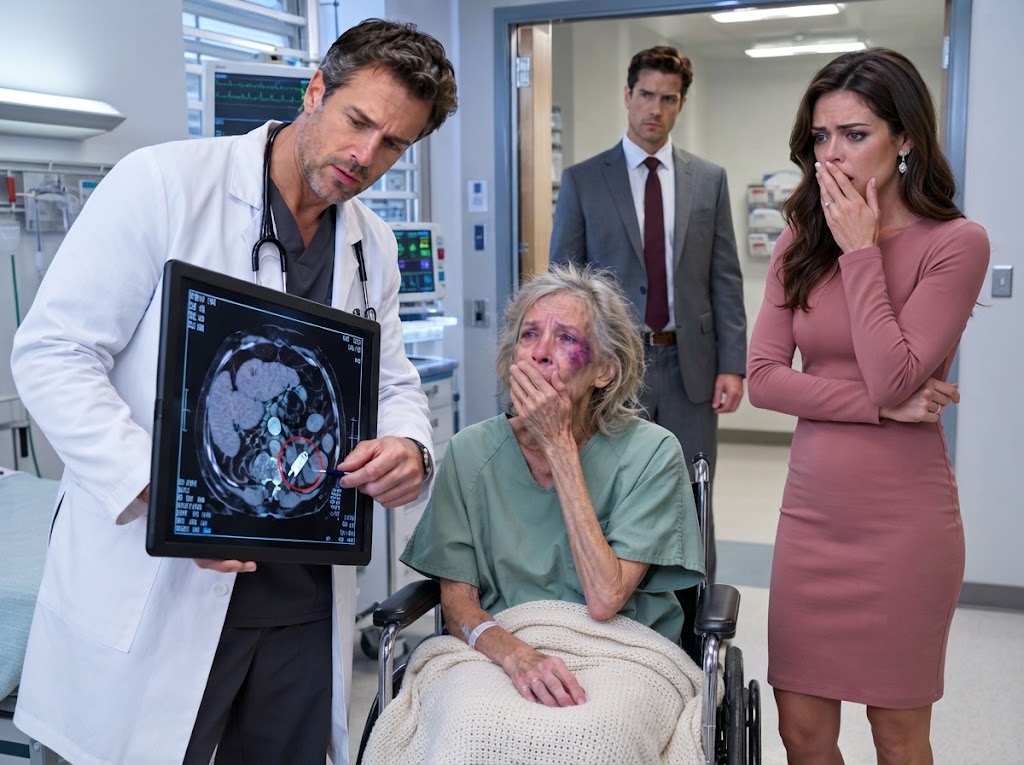
But the video recording spoke. The blue ledger spoke. The digital footprint spoke. The corroded capsule spoke.
And in the end, faced with the mountain of evidence, even Richard’s silence spoke volumes.
When we walked out of the heavy brass doors of the courthouse, a local investigative news reporter approached us with a microphone, asking if we wished to make a public statement regarding the high-profile indictment. I instinctively raised a hand to politely decline, but my mother squeezed my fingers firmly.
She stepped forward, squaring her shoulders despite the lingering pain in her abdomen, and looked directly into the camera’s lens.
“When an elderly woman looks you in the eye and tells you that something is hurting her, you need to listen,” Teresa stated, her voice steady and commanding. “Sometimes it isn’t just the aches of old age. Sometimes, it is the truth, screaming from the inside out.”
That brief video clip exploded online by midnight.
Thousands of strangers commented that my mother was a hero. Dozens of women shared their own harrowing stories of living under the thumb of financially abusive, controlling men who weaponized their isolation. Countless daughters wrote that they were picking up their phones in that exact moment to call their mothers.
I read every single comment aloud to her as we sat in her living room, drinking warm chamomile tea, the soft hum of the television playing in the background.
My mother was seventy-five years old.
Richard had constantly claimed she just wanted attention. In a twisted, ironic way, the monster had been right.
My mother just wanted someone to finally look at her.
And when the world finally stopped and looked, they didn’t find a frail woman succumbing to a disease.
They found a mountain of evidence. They found undeniable justice. And they found the indestructible voice of a mother who, even with a failing, agonizing body, absolutely refused to let her daughter remain buried alive in the dark.