Chapter 1: The Paper Guillotine
For nearly three thousand consecutive days, my husband reminded me that my existence was an act of his personal charity.
Eight years. It is an extraordinary length of time to sit across from a man and watch him congratulate himself for having plucked you from obscurity. Every grocery receipt folded upon the counter, every vacation itinerary dictated down to the economy-class seat, every patronizing nod from his mother across a mahogany dining table—all of it came anchored to the same refrain.
“You’re lucky, Eleanor.”
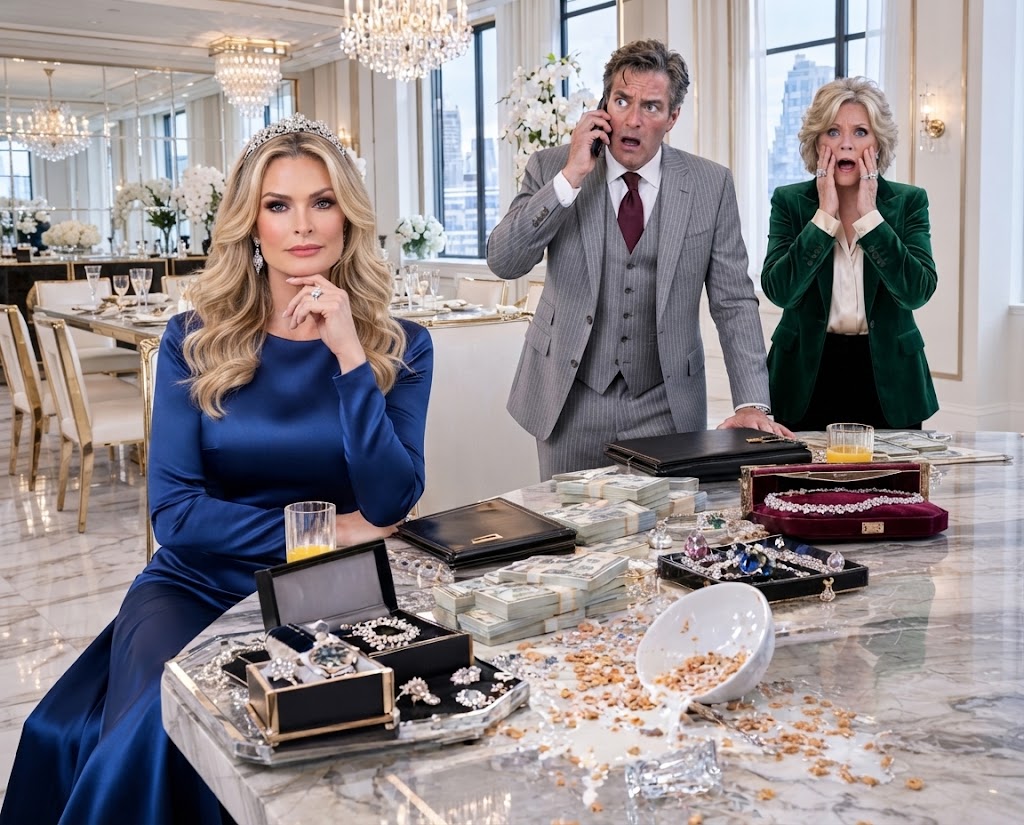
Blake murmured it like a lullaby when he wanted to feel benevolent, and he snapped it like a bullwhip when he felt small. “You’re lucky I’m an expansive man. You’re lucky I have the stomach to carry a woman who doesn’t bring a single red cent to this household.”
We were gathered in the private conservatory dining room of L’Aurore, the glittering crown jewel of Crawford Hospitality Group. It was a space of polished Venetian plaster, towering brass sconces, and Belgian linen so heavily starched it crackled under the forearms. Around the table sat the Crawford dynasty in miniature: Blake’s mother, Priscilla, draped in antique sapphires and sharp condescension; his younger brother, Julian, nursing an expensive bourbon he hadn’t earned; Julian’s socialite fiancée; and three second cousins who smelled of trust funds and country club lockers.
At the center of it all sat Blake. He was thirty-nine, trim, outfitted in a bespoke charcoal three-piece suit, his hair swept back with effortless grooming. He had spent the entire evening holding court, gesturing with an engraved gold Montblanc pen between courses, narrating his latest real-estate acquisitions as though he had single-handedly tamed the wild frontier of commercial gastronomy.
I sat at the foot of the table, wearing a dove-gray cashmere dress that Priscilla had once declared “sensible for an office clerk.” I was sipping still water with a slice of cucumber. To anyone watching, I was the drab ornament, the plain little sparrow Blake had rescued from the rain and generously allowed to perch on his gilded fence.
When the dessert plates—pear tarts glazed in spun sugar—were cleared away, Blake tapped his crystal water goblet with the edge of a silver dessert fork. The pure, bell-like ring brought the room to an immediate hush. Julian leaned back, grinning as if he were privy to an inside joke. Priscilla adjusted her sapphire necklace, her painted lips curving into a tight, conspiratorial crescent.
“Before we bring out Mother’s digestif,” Blake announced, his baritone voice effortlessly filling the velvet-draped room, “there is one small matter of personal housekeeping I need to address.”
The table chuckled softly. Blake loved theatricality. He lived on the applause of waiters, valets, and sycophants.
Slowly, deliberately, he reached into the breast pocket of his bespoke jacket. He didn’t produce a velvet jeweler’s box or a vintage wristwatch. Instead, he pulled out an accordion of folded legal documents, bound with a crisp blue backing sheet.
He tossed it down the center of the linen tablecloth. It slid past the butter crocks, parted the floral centerpiece of white calla lilies, and came to an abrupt halt against the rim of my porcelain saucer.
Printed in black, unyielding bold font across the top were the words: PETITION FOR DISSOLUTION OF MARRIAGE AND SEPARATION OF ASSETS.
Already executed. Already notarized. Blake’s sweeping, aggressive signature slashed across the final page in wet black ink.
He leaned back into the button-tufted leather of his chair. He laced his fingers over his vest, his diamond cufflinks catching the halogen downlights. Then he offered the room that devastating, rehearsed grin he usually reserved for restaurant opening nights and television profiles.
He pitched his voice loud enough for the busboys standing against the mahogany credenza to hear every syllable.
“Let’s see how long you last in this city without my money, Eleanor.”
Across the table, Priscilla let out a high, melodic laugh. It was a sound of pure, unadulterated triumph—the laugh of an empress watching a stray dog finally being kicked through the palace gates.
Julian tapped his knuckles on the table in rhythmic approval. The cousins exchanged smirks over their cordials.
My pulse did not spike. My fingers did not tremble. The cold cucumber water in my stomach remained perfectly still. For eight years, I had prepared for this room to reveal its bottom; I simply hadn’t realized how shallow that bottom would actually be.
Beside my water glass lay a simple, brushed-steel ballpoint pen provided by the establishment.
I picked it up.
I did not read the terms. I did not flip through the attached schedules or check to see what pittance of temporary alimony Blake had magnanimously scribbled into the boilerplate text. I simply flipped to the final execution page, clicked the pen, and signed my name.
Eleanor Vance Crawford.
A clean, decisive sweep of black ink. No hesitation. No tremor.
Priscilla was still laughing when I finished. Her hand was still resting against her throat, enjoying the cruelty of her golden boy’s masterpiece, when the metallic click of my pen capped the silence.
I took the thick sheaf of papers, squared the edges against the table linen with a quiet, dry thwack, and slid them straight back across the twenty-foot expanse of damask cloth. They stopped precisely at the edge of Blake’s dessert spoon.
I looked directly into his warm hazel eyes—eyes that had once seemed soulful, but now looked as hollow as vacant storefronts.
I spoke a single word.
“Thank you.”
The laughter died in Priscilla’s throat so abruptly that she choked on her own saliva, coughing into a silk napkin. Julian’s smirk froze into a grotesque grimace.
Blake’s smile didn’t vanish immediately; instead, it began to crumble at the margins, curdling into an expression of profound, irritated confusion. That was not the line in the script. The script called for tears. The script called for me to clutch at the tablecloth, to stammer, to beg for a three-month reprieve in the guest house, to look upon his towering self-sufficiency and weep for my own ruin.
“Smart girl,” Blake recovered quickly, though his voice had thinned, losing its theatrical velvet. He snatched up the papers and shoved them back into his pocket. “Save us both the expense of a protracted legal circus. We’ll have your suitcases on the portico by Friday.”
“Tomorrow morning will do,” I replied softly.
I folded my cloth napkin, placed it neatly beside my untouched pear tart, stood up, smoothed the creases from my dove-gray skirt, and walked out of the restaurant.
I didn’t take a cab. I walked the twelve blocks back to the brownstone in the cold October drizzle, breathing in the smell of wet pavement and ozone. For the first time in ninety-six months, my chest did not feel compressed by the ceiling of that man’s monstrous vanity.
He thought he had cut my lifeline.
He had no idea that he had just severed his own anchor.