Chapter 1: The Crucible of Clarity
We named her June. She came screaming into the world on a crisp Tuesday in late September, a seven-pound, four-ounce force of nature possessing her father’s delicate nose and an immediate, visceral determination to make her exact feelings known to the universe.
There was no polite buildup when June required sustenance. She didn’t whimper or fuss. She simply demanded, her hunger an absolute absolute that shattered the quiet of our home. When exhaustion claimed her, it did so with terrifying speed, dropping her into a dead sleep mid-flail. And when she was pleased, her gummy smile possessed a radiance so pure and uninhibited it felt as though she had swallowed the sun.
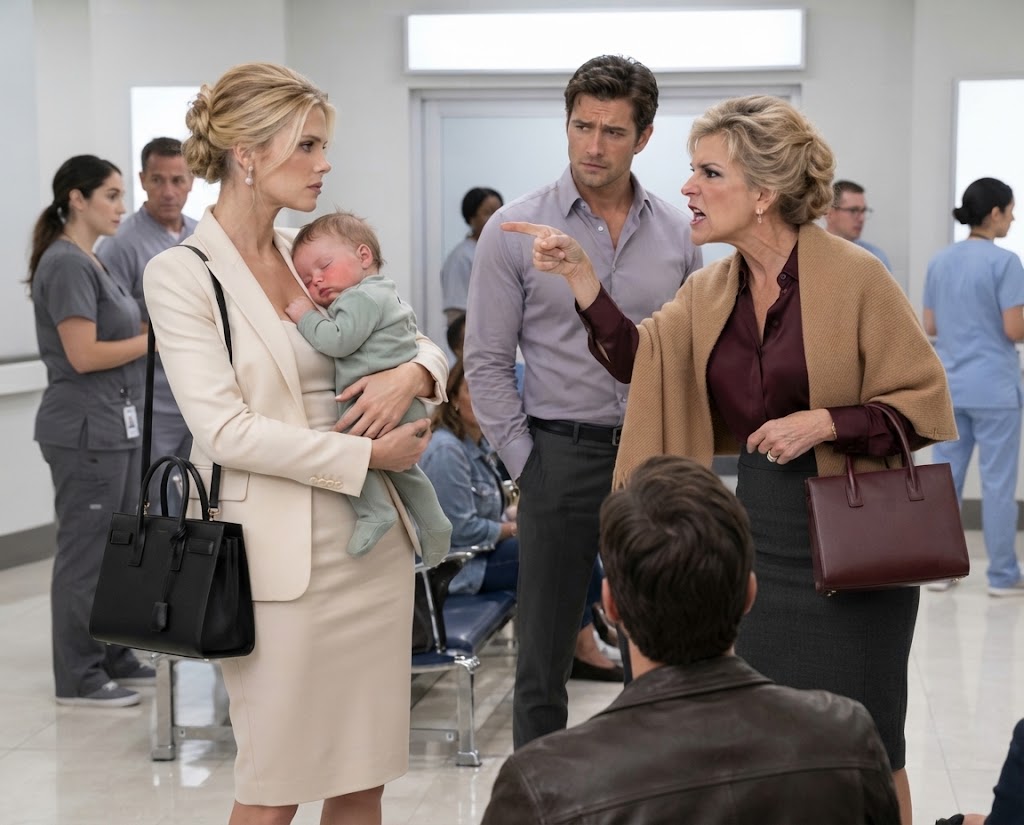
She had only been breathing air for four months when the fever spiked, breaching the terrifying threshold of 104 degrees.
But before I can explain the tectonic shift that occurred in that sterile, fluorescent-lit emergency room, you must first understand the architecture of the woman I was before that night.
My name is Rachel Donnelly.
I was thirty-one the morning they placed June upon my chest. By then, I had spent six grueling years as a nurse practitioner specializing in emergency medicine. The trauma bay is a brutal instructor, but it teaches a vital curriculum: how to function with absolute precision while everyone else in the room is suffocating on their own terror.
When a human body is failing on a steel gurney, someone has to act as the anchor. Someone must filter out the cacophony of sobbing relatives and blaring alarms to interpret the monitors. Someone has to instantly separate the critical from the merely urgent. And often, someone has to turn to a mother or a husband—people whose minds are actively rejecting the nightmare unfolding before them—and translate medical devastation into something they can momentarily digest.
For years, that anchor was me.
In the ER, you learn a harsh but necessary discipline: panic is a luxury reserved for the aftermath. Later, you are permitted to lock yourself in your sedan, grip the steering wheel, and let the tremors rack your spine. Later, you can seek the shadowed corners of the parking garage and weep into your scrubs. Later, you can lie awake staring at the ceiling, replaying the gruesome mathematics of the shift. But inside that room? You remain glacial. Clarity first. Always.
I hadn’t just learned this endurance from the hospital, however; I had inherited it from my mother, Eleanor.
Two years prior to June’s arrival, Mom was diagnosed with early-onset Parkinson’s disease. She was only fifty-eight. I was twenty-six. She absorbed the catastrophic news the exact same way she navigated every other storm in her existence—with ramrod-straight dignity, an infuriating stubbornness, and a complete disdain for anyone’s pity. She was a woman who had successfully raised three headstrong children after my father decided family life was too restrictive.
Her life philosophy was brutally simple: If a task requires doing, and you possess the physical capability to do it, you execute it. Not when the timing aligns perfectly. Not when a choir sings your praises. You simply identify the void, and you fill it.
Following the neurologist’s grim verdict, I seamlessly folded her care into my already chaotic life. I audited her prescriptions, scheduled her specialists, commuted to her neighborhood twice a week, and sacrificed my Sunday afternoons to sit on her porch. We would debate literature, critique her beloved hydrangeas, and dissect the scandals of her neighbors. She held razor-sharp opinions about every soul on her street, and she had zero intention of relinquishing her vibrant mind just because her nervous system had staged a rebellion.
I never framed my duties to her as heroic. It was simply the necessary work of loving someone. I possessed the capability; therefore, I acted.
And then, there was my husband.
Ethan was thirty-three on the afternoon we exchanged vows. A brilliant software architect, he possessed an agile mind, a devastatingly dry wit, and a capacity for thoughtfulness that made falling for him feel less like a choice and more like gravity. If a twelve-hour shift had ground me into dust, he possessed an uncanny radar for it. Often, I would unlock the front door to find a glass of Pinot Noir poured and dinner simmering on the stove. If I casually mentioned a book I wanted to read, a hardback copy would materialize on my nightstand three weeks later.
During our honeymoon phase, he was the exact iteration of a partner I had always prayed existed.
He was also the only offspring of Sylvia.
And that singular, immutable fact existed within the foundation of our marriage like a hairline fracture in a load-bearing wall. Most days, the plaster hid it well. Weeks would pass where I forgot the structural vulnerability entirely. But the weakness was always there, waiting for the right amount of pressure.
Sylvia was sixty-two, a woman wrapped in cashmere and absolute certainty. She had been tethered to Ethan’s father, Gerald, for three and a half decades. Gerald was an amiable, quiet man whose primary survival skill was an extraordinary ability to remain physically present while remaining completely uninvolved in whatever sweeping mandates Sylvia handed down.
She possessed militant opinions on everything from geopolitical conflicts to the proper way to roast a chicken. But the blazing, undisputed center of her universe was Ethan. He was her singular achievement. From the second the umbilical cord was cut, her love had formed an impenetrable, stifling dome around him.
I never doubted the ferocity of her love. What I feared was its toxicity. Her devotion had so thoroughly insulated him from the concept of discomfort that neither mother nor son seemed to realize how deeply it had deformed his resilience.
I noticed the rot early on.
When my first pregnancy ended in a devastating miscarriage at nine weeks, the silence from Sylvia was deafening. I lay in our bed, my body aching and hollowed out, while she phoned Ethan every single afternoon for seven days. She didn’t call to check on the woman bleeding in the bedroom. I could hear her hushed, dramatic tones seeping through the drywall as Ethan paced the hallway.
“This must be tearing you apart, sweetheart.”
“You are bearing this with such incredible strength.”
“Just tell me what I can do to ease this for you.”
I was the one who had harbored the life. I was the one whose biology had violently betrayed her. Yet, in Sylvia’s warped theater of tragedy, Ethan was the sole protagonist suffering.
A cold dread coiled in my gut then, but I swallowed the bile. I rationalized it. As a medical professional, I knew grief made people clumsy. I convinced myself that Sylvia was simply emotionally unequipped to comfort a daughter-in-law, defaulting instead to the only role she knew: the fiercely protective mother.
So, I bit my tongue. I chose to preserve the peace of my young marriage.
Years later, sitting in the biting chill of a hospital waiting room, I would finally recognize the fatal flaw in that logic. Dodging a conflict doesn’t neutralize it; it merely provides the rot a dark, quiet place to fester and spread, waiting for the moment you are weakest to bring the whole house down.