Chapter 1: The Phantom Blueprint
“The craftsmanship in this kitchen is simply breathtaking,” my mother declared, a serene smile plastered across her face. “And with those three vacant bedrooms down the hall, your brother’s family will have more than enough space when they move in. He’s already severed his lease.”
She dragged a perfectly manicured hand down the sheer length of my kitchen island. Her palm rested flat against the glacial surface of the polished granite, claiming territory in a house she had already mentally partitioned and gifted away. She had been standing inside my home for less than thirty minutes. In all that time, she had not posed a single inquiry. Not one. I am Rosalie Danner. To the woman inspecting my drawer glides, I was still Rosalie Teague.
I remained rooted to the hardwood, letting the silence stretch, letting her finish her delusion.
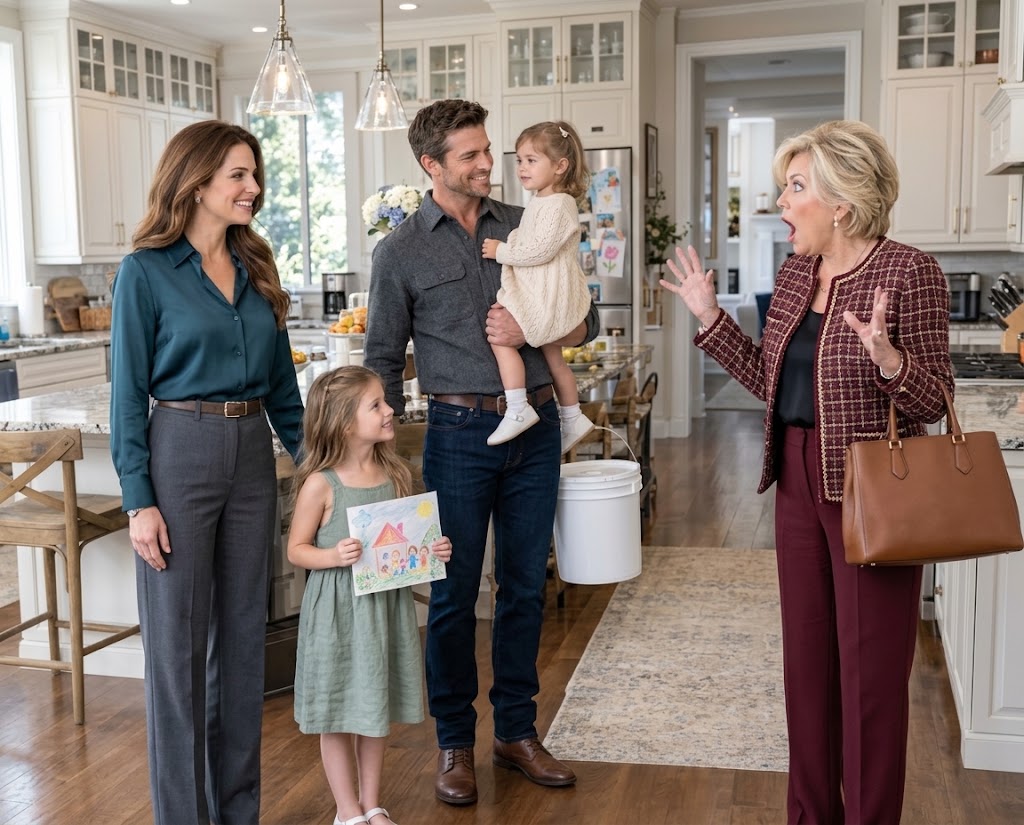
Then, the heavy wooden screen door at the back of the house groaned open. The coiled spring attached to the frame let out a sharp, metallic whine—a distinctive screech I could pick out of a sonic lineup of a hundred identical doors. My husband stepped into the kitchen. He had our three-year-old daughter balanced effortlessly on his right hip, while a heavy gallon jug of grayish wall primer dangled precariously from two fingers of his left hand.
A heartbeat later, our six-year-old barreled past his legs, making a beeline for the stainless steel refrigerator, yanking the heavy door open with both small hands.
My mother’s jaw unhinged. The confident, proprietary gleam in her eyes shattered into a million confused shards.
“When… when exactly did you get married?” she stammered, the words tumbling out as she darted her gaze wildly from the two little girls to the hallway she had just moments ago converted into her son’s impending sanctuary.
My brother was currently packing his entire life into cardboard boxes, fueled by a promise of three rooms within a life she had never once bothered to investigate.
To understand the sheer gravity of this collision, you have to stay with me and rewind the clock to a few hours earlier. We need to begin at the dawn of that muggy Saturday morning, starting in the very hallway my mother never walked down.
At seven o’clock that morning, I padded down that corridor the exact same way I navigate it every single day of my life, flicking off the plastic night lights with the calloused pad of my thumb. There are three doors. Ours is the heavy oak one on the left. Next is my eldest daughter’s room, her name spelled out in painted wooden letters she had proudly slapped onto the wood herself when she was barely four. The ‘M’ sits a rebellious quarter-inch higher than the rest of the alphabet. Finally, there is the room at the far end, claimed by the youngest, positioned exactly where the golden morning light breaches the house first.
Decades ago, the mailboxes lining Sudali Road bore only two surnames: Teague and Pruitt. Today, it serves as the final gravel shortcut before the sprawling, manicured lawns of the Riverstone subdivision begin. In a rural pocket like this, a woman who buys back the very foundation her family ruthlessly sold out from under her becomes the premier topic of whispered gossip at the Ball Ground post office long before she’s even unpacked her china.
I fiercely minded that whispering during our first year back. I felt the phantom stares on the back of my neck. But by the second sweltering summer, I found myself wrestling with a perimeter fence that was rotting soft at the primary corner post, a toddler who treated thunderstorms like personal attacks on her life, and a mortgage that demanded my absolute focus. The idle chatter of strangers plummeted to the absolute bottom of a remarkably long list of daily anxieties.
I earn my keep orchestrating the daily chaos for a commercial roofing contractor operating out of Canton. Sixty hardened men. A dozen heavy-duty trucks. Atmospheric pressure and weather patterns that violently change their minds by noon. I am exceptionally good at my job because I understand logistics, and I know exactly what a structure sounds like when it is brimming with life, and the hollow, echoing resonance it takes on when someone is conspicuously absent.
That specific Saturday morning, my house was practically vibrating with life.
By eight o’clock, my husband, Dean Danner, was outside loading the bed of his truck. Two bulky car seats, one booster seat, and a steaming travel mug of black coffee he had already abandoned to go cold on the metal tailgate.
“Can I be the one who picks the color?” Maisie yelled through the open kitchen window, her chin resting on the sill.
“You can pick exactly one color,” Dean called back, wiping grease from his hands with a rag. “One.”
He threw the truck into reverse, crunching down the gravel drive toward the main road, but abruptly slammed on the brakes. He leaned his thick forearm out the driver’s side window, catching my eye. “Pruitt’s got his heirloom tomatoes coming in thick. He was asking about you.”
Dell Pruitt resides at the absolute dead-end past our mailbox cluster. The very week we moved back into this house, he had marched up our incline clutching a damp paper sack bursting with red tomatoes, refusing to vacate the premises until Dean programmed his phone number into his contacts. He had delivered the number like it was a grim duty. “A man ought to possess the direct line to a neighbor who knows exactly how this old house shifts when the heavy rains come,” he had stated.
“Tell him I’ll come hike up there and get them,” I yelled back over the rumble of the exhaust.
Dean nodded, rolled up the glass, and drove off. Then, it was just me, the rhythmic sputtering of the coffee maker, and the comforting hum of a house packed with evidence of my existence.
At exactly nine-forty, an unfamiliar silver sedan decelerated at the lip of my driveway. The tires crunched onto the gravel and stopped. The vehicle idled there for an excruciatingly long time. Long enough for a cold knot to form in my stomach. Long enough for me to carefully place my ceramic mug down on the counter.
The driver’s side door swung open, and my mother, Beverly Teague, emerged.
She was draped in the stiff navy-blue jacket she reserves exclusively for somber funerals and events she has internally designated as highly significant. She was sixty-four years old. It had been eleven agonizing years, four thousand days of absolute radio silence, since she had last stood in my physical presence.
I must articulate precisely what transpired biologically in my body in that fleeting moment, because stripping away the poetry is the only honest way to convey the shock. My right hand moved with a mind of its own, plunging deep into the fabric pocket of my jeans. My fingers blindly sought out my heavy keyring, closing around it in a white-knuckled death grip. That was it. Six suffocating seconds of paralysis, my thumb pressing agonizingly hard against the jagged brass teeth of the house key until the skin threatened to break.
Then, I exhaled, commanded my legs to move, and swung the heavy front door open.
People frequently interrogate me about this specific fraction of time. Why didn’t you just lock it? Why did you open it?
Let me be perfectly clear: it was not born of weakness, nor was it birthed from some pathetic, lingering ember of hope. I had mentally rehearsed defending this exact doorway for eleven years. I had fought this phantom battle while waiting at red lights, while scrubbing shampoo from my hair, while mechanically folding tiny socks at midnight. I was entirely unwilling to cower behind a pane of decorative glass and forfeit the singular opportunity to hear what grand manipulation she had driven all the way out to the rural route to unleash.
“Well,” she breathed, stepping boldly over the threshold, brushing past my shoulder, bringing with her the cloying scent of floral perfume and stale car air. “Just look at you.”
She offered no embrace. Her arms remained stiffly at her sides. Instead, her eyes darted like a hawk’s. She scrutinized the entryway rug. She judged the vintage light fixture overhead. She inspected the grain of the restored hardwood floors, and then her gaze tracked upward, tracing the ceiling line where it perfectly intersected the door casing—a behavioral tic unique to someone who had spent their formative years memorizing the geometry of this exact house.
“I caught wind about the house back in March,” she remarked, purposefully omitting the identity of her informant.
“Okay,” I replied. A singular word.
“Ray Estes never did a damn thing with this front yard,” she continued, her tone dripping with casual disdain.
Ray was the gentleman who had sold the property back to me. During his nine-year tenure, he had allowed the front hedges to grow wildly out of proportion. He had, however, meticulously maintained the perimeter fence.
She made a sharp, clicking sound with her tongue, eyeing the wooden slats through the window. “Your grandmother would have had plenty to say about the state of that fence.”
She launched into a monologue about her commute. She dictated how Interstate 575 was a disastrous parking lot just past Holly Springs. She informed me that a prominent woman from her church congregation had undergone a total hip replacement in late April and was already behind the wheel of a car—a fact she categorized as an absolute scandal.
Every utterance escaping her lips was a declarative statement. Not a single sentence contained a question mark, nor did any inflection rise at the end to invite my participation. I stood rigidly in my own foyer, waiting for a genuine question the same way you blindly step down into the dark, anticipating a stair that simply isn’t there, resulting in a jarring jolt to the spine.
Without waiting for an invitation, she marched past me and breezed into the kitchen. She navigated the space with the arrogant muscle memory of a woman who believes she still owns the deed.
That was when she touched the granite.
“The craftsmanship in this kitchen is simply breathtaking.”
Her hand slid the entire length of the stone. She didn’t caress it the way someone admires a beautiful object. She tested it the way a ruthless appraiser runs a hand along the fender of a repossessed classic car at a police auction.
“These are custom cabinets. They sit at a fantastic height.” She tilted her head back, evaluating the crown molding. “You went all the way up to the ceiling line. You actually did it. Good lord, this used to be a suffocating drop ceiling.”
She mentally cataloged and priced the modern pendant lighting suspended over the center island. She evaluated the expensive, deep-basin sink and the brushed nickel faucet. She yanked a drawer open two inches and released it, watching the soft-close mechanism pull it silently shut.
She stood dead-center in a magnificent room that my husband had painstakingly constructed over eleven grueling weekends, utilizing his own calloused hands and a borrowed, temperamental table saw. She measured every square inch of his labor, praised the architecture, and never once asked the name of the man who had bled to build it.
She kept her monologue running, her fingers drumming a steady rhythm on the stone.
“And with those three vacant bedrooms down the hall, your brother’s family will have more than enough space when they move in. He’s already severed his lease.”
There it sat. A bomb dropped on my counter. Flat. Warm. Finished. A decree from the throne.
Before I could even process the audacity, she pushed forward.
“Now, Clay and Angie will naturally take the master in the back. That’s the most spacious one. The two girls can take the room adjacent to the bathroom. They’re accustomed to sharing a space anyway, so it won’t be a shock to their systems. They will absolutely need to be fully moved in before the autumn school term begins. You certainly don’t want to be drowning in district paperwork in the sweltering heat of August. Furthermore, there is absolutely no logic in renting a commercial storage unit when you possess a two-car garage sitting out there completely empty. Clay owns a heavy table saw and all that cumbersome equipment. He can line it up neatly against the far brick wall. Angie is a hard worker. You’ll genuinely like her. She’ll whip this overgrown yard back into respectable shape within thirty days. You will also require a secondary refrigerator eventually. Everyone claims they won’t, and then they end up needing one.”
“Okay,” I said, my voice eerily calm.
“And I specifically instructed him, ‘Do not dare show up at your sister’s house with that shedding dog of yours.’”
Two solitary words from my mouth throughout her entire architectural conquest. Neither of them framed as a question. I did not raise a hand to halt her momentum. I did not interrupt her soliloquy.
I must be painfully clear regarding my silence, because I have had observers label that restraint as ‘strength.’ It was not merely strength. Part of my silence stemmed from the horrifying realization that every subsequent sentence she uttered revealed just how vast this fictional narrative had grown without my consent.
But the other part of my silence is ancient, calcified, and entirely unflattering. Since the tender age of nine, I have intimately understood that interrupting Beverly Teague does not terminate her narrative. It merely spawns a secondary, venomous version of the story—a revised edition where I am cast as the hysterical, difficult, and ungrateful daughter. And that fabricated version always travels much further, and much faster, than my truth ever could.
I am recounting this event from the safe shores of the aftermath. What I was tragically unaware of that humid morning was that her delusion had already cost another human being absolutely everything they had.
You might be asking yourself: Why June? Why, after an agonizing silence of eleven years, did she choose the second week of June to breach my perimeter?
The answer is ruthlessly simple. She did not travel to Sudali Road to ask for a favor. She came to arrange a reality. And prior to the month of June, there was simply no crisis for her to arrange.
There are four sturdy wooden chairs arranged around my kitchen table. She remained standing the entire duration of her invasion.
“The room positioned at the very end of the hall captures the absolute best morning sun,” she stated with absolute authority, finally lifting her heavy leather purse and dropping it onto my spotless counter with a meaty thud. “Come along, I’ll point out exactly which room I mean for the girls.”
She physically pivoted to march down my hallway, intending to assign my childhood memories to children I had never met.
And that is precisely the moment the back screen door groaned, the spring screeching its familiar metallic protest. Dean, Ada, Maisie, and the primer.
As my mother’s jaw dropped and the question “When did you get married?” hung suspended in the dust motes, the true horror of her blind confidence clicked into place. But before I could deliver the fatal blow to her plans, her eyes darted from the primer in Dean’s hands to the crayon drawings taped to the fridge.
“Well,” she whispered, her voice tightening into something dangerous. “It seems we have a lot of rearranging to do.”