Chapter 1: The Gilded Cage
For a decade, I made myself small so that my husband could feel like a king. It was an exhausting, meticulous performance, pruning the edges of my personality and intellect until I fit perfectly into the narrow, suffocating mold of a meek, middle-class wife. I had married into the Hawthorne shipping dynasty, a family whose wealth was only eclipsed by their profound, toxic arrogance. I thought I was choosing love over the shadowy, ruthless geopolitical empire of my own bloodline. I wanted a quiet life. I wanted normal.
Instead, I got a gilded cage in a sprawling Miami mansion that smelled perpetually of lemon oil and quiet desperation.
The baseline of my existence was disrespect. My mother-in-law, Beatrice Hawthorne, treated me like a stray dog tracking mud onto her imported Italian marble. My sister-in-law, Victoria, was worse—a venomous socialite who sharpened her claws on my fabricated insecurities. They viewed me as nothing more than an unfortunate clerical error in their otherwise pristine pedigree. They had no idea that the “modest” coastal estate I had inherited—a rugged, historic expanse of beachfront property in Maine—was merely a crumb from a private equity empire that could buy and sell their shipping company before breakfast.
Lately, the atmosphere in the mansion had grown frantic. My husband, Richard, masked his escalating panic behind a veneer of extreme, flashy wealth, but I noticed the subtle cracks. The hushed, frantic phone calls at 3:00 AM. The delayed payments to staff. The Hawthorne company was quietly hemorrhaging money, and his desperation to maintain the facade was morphing into a dangerous paranoia. Their collective obsession had fixated entirely on my coastal estate. They needed me to liquidate it to cover their hidden debts.
The climax of their cruelty arrived on a sweltering Tuesday evening during a lavish dinner at the Biltmore Country Club. The dining room hummed with the hushed, arrogant chatter of Miami’s high society, the air thick with the scent of roasted duck and expensive perfume.
Victoria swirled the champagne in her crystal flute, her heavily contoured face twisted into a smirk as she looked at my understated navy dress. “It’s genuinely pathetic how hard you try to fit into our world,” she sneered, her voice carrying just enough to ensure the neighboring tables heard. “You look like a substitute teacher who won a raffle.”
Beatrice chuckled, a dry, rattling sound. “Oh, leave her be, Victoria. She doesn’t know any better.”
Victoria leaned forward, her eyes glittering with malice. “Richard, darling, when are you going to make her sign over that quaint little beach house? It’s the only useful thing she brought to this marriage.”
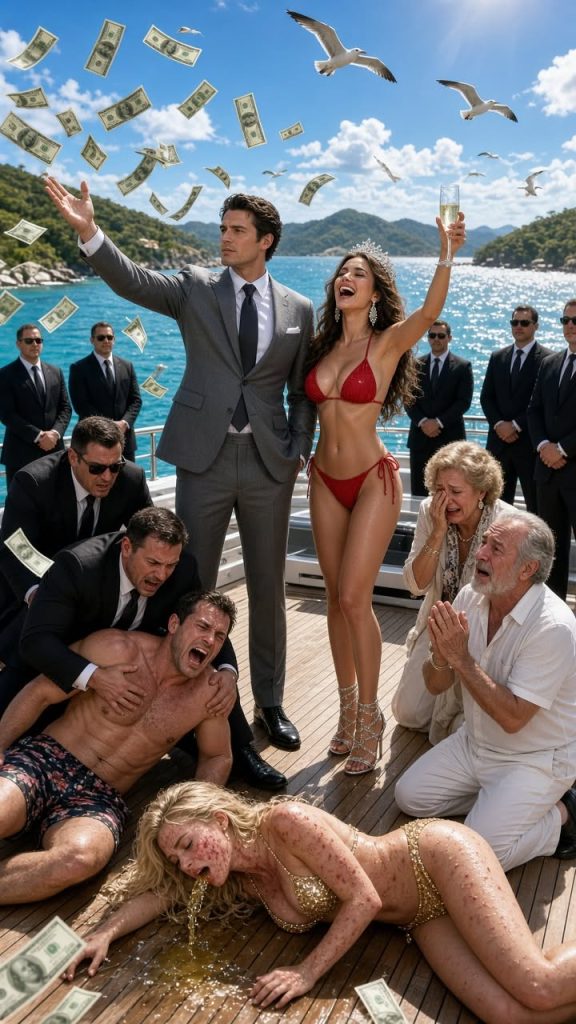
I waited for the defense that a wife expects from her husband. Instead, Richard didn’t even look up from his prime rib. He sliced a piece of meat with surgical precision. “Don’t worry, Victoria,” he replied, his tone as cold as the silver knife in his hand. “I’m handling it this weekend. We’re taking the yacht out. She’ll sign it.”
I remained perfectly silent. I kept my eyes fixed on the porcelain plate in front of me, my shoulders slumped in a posture of practiced submission. Beneath the table, my nails dug into my palms, leaving deep crescent moons in the skin. The cold calculation that I had buried ten years ago was beginning to thaw, a quiet, terrifying drumbeat starting in my chest.
As Richard abruptly stood up to take a call, brushing past the waitstaff, a young busboy accidentally bumped his shoulder. Richard snapped a vicious insult at the boy, oblivious to the fact that the collision had dislodged a small, unlabeled glass vial from his tuxedo pocket.
It hit the thick Persian rug without a sound and rolled directly beneath my chair.
I carefully dropped my napkin, bending down to retrieve it. My fingers closed around the cold glass. The liquid inside was perfectly clear. I slipped it into my clutch, my heart turning into a block of ice as I stared at the undeniable physical proof that my husband’s plans for our weekend yacht trip didn’t end with a simple signature.