The whispers had already started before my name was announced. By the time I walked onto the graduation stage with newborn Noah sleeping against my chest, most of the audience seemed to have decided exactly what kind of person I was.
Someone behind me spoke just loudly enough for me to hear.
“Just like its mother.”
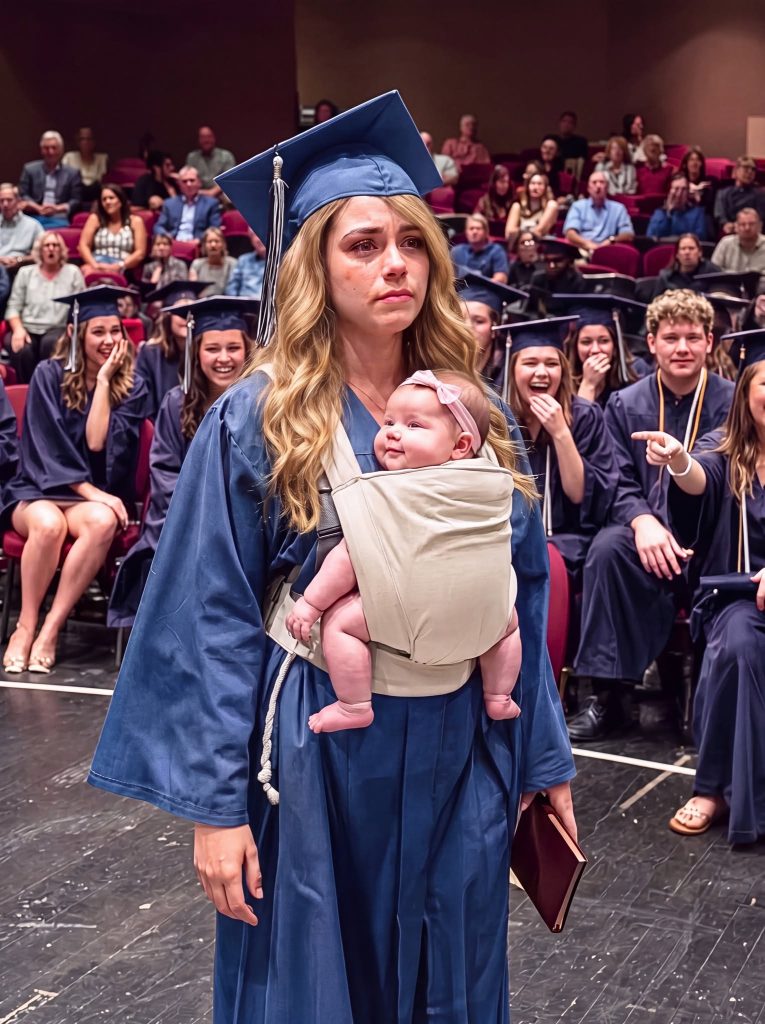
I tightened my hold on Noah and kept walking. At twenty-two, I was graduating at the top of my class, but I had spent most of my life learning that people were often more interested in deciding who you were than discovering the truth.
The loudest laughter came from my aunt Marlene, the woman who had taken me in after my parents died. She had spent my entire childhood reminding me that every meal, every bedroom, and every piece of clothing she provided was something I should remain permanently grateful for.
Beside her sat her daughter Vanessa, proudly wearing the white honor stole that should have belonged to me. Only weeks earlier, Vanessa had helped trigger a disciplinary investigation that temporarily stripped me of that recognition and placed my graduation eligibility under review.
Three weeks before the ceremony, my life had changed in a completely different way. Outside St. Catherine’s Clinic, I found a newborn inside a cardboard carrier, wrapped in a hospital blanket and left without anyone willing or able to claim him.
A social worker later explained that his mother had died shortly after giving birth and that no father or relatives had come forward.
“He’ll probably enter the foster system.”
Looking down at his tiny hand wrapped around my finger brought back a memory I had spent years trying to bury. At six years old, I had sat inside a county office listening while adults argued about who would be responsible for me after my parents were gone.
“No. He comes home with me.”
Because my social-work studies had already required foster-care certification, temporary guardianship moved surprisingly quickly. Marlene mocked the decision as another attempt to attract attention, while Vanessa was even crueler.
“She’s basically trash collecting trash.”
Their contempt did not stop there. Soon afterward, a formal complaint appeared accusing me of cheating on my final research project and behaving irresponsibly by bringing an unrelated infant onto campus.
Vanessa’s boyfriend Caleb worked inside the registrar’s office. Not long after the complaint surfaced, my scholarship was frozen and my academic status was placed under formal investigation.
Marlene looked almost pleased when she heard.
“You should skip graduation. Save yourself the humiliation.”
She believed the investigation had already defeated me. What she did not understand was that my years volunteering at a legal-aid clinic had taught me to pay attention to signatures, timestamps, financial records, and document histories.
My final project had never been an ordinary thesis. For months, I had been documenting irregular scholarship decisions, falsified academic records, and donor funds that appeared to be disappearing through channels no one wanted examined too closely.
Eventually, the evidence began pointing toward the same people.
Caleb. Vanessa. And an administrator who had been protecting them.
That was why I still walked onto the stage with Noah in my arms despite the whispers and laughter. I wanted everyone watching when the story they had written about me finally collapsed.
Then Principal Everett rose from his seat and approached the microphone.
“Before Miss Clara Hayes receives her diploma, this institution owes her a public apology.”
The auditorium went completely silent.
Part 2: The Truth They Couldn’t Bury
Principal Everett stepped closer to the microphone while I remained beneath the stage lights with Noah sleeping against my graduation robe. The entire auditorium had gone quiet, and for the first time that afternoon, nobody was laughing.
“Miss Hayes has not been found guilty of academic misconduct. She has been found responsible for exposing it.”
A wave of shocked whispers moved through the room. Vanessa’s confident expression disappeared almost instantly as Principal Everett explained that my final project had uncovered manipulated scholarship rankings, fabricated disciplinary complaints, and more than $200,000 in donor money that had been redirected through fraudulent channels.
Caleb stood up so quickly that his chair struck the floor behind him.
“This is insane!”
Two campus security officers immediately moved into the aisle. Marlene grabbed Vanessa by the wrist and ordered her to stay seated, but by then the situation had already moved beyond anything they could control.
Six months earlier, I had begun noticing that foster students with excellent grades were repeatedly losing scholarships to applicants with weaker academic records but wealthier families. Because I worked nights in the university archive office, I had access to document histories, authorization logs, and timestamps, and the deeper I looked, the more inconsistencies I found.
Recommendation letters had disappeared, committee records had been altered, and financial transfers did not match the university’s official reports. Eventually, the pattern became too consistent to dismiss as clerical mistakes.
When my own scholarship was suddenly frozen and a disciplinary complaint appeared against me, I understood exactly what was happening. They had realized I was getting too close.
What they did not know was that I had already protected the evidence. Long before graduation, encrypted copies of every record had been sent to Principal Everett, the state education inspector, and the financial crimes division, while an attorney I knew from the legal-aid clinic helped secure the documents through a formal chain of custody.
Vanessa finally stood, pale with anger.
“She’s obsessed with me! She fabricated everything because she’s jealous!”
I turned toward her.
“Jealous of what? The grades you changed or the money Caleb moved?”
She opened her mouth, but nothing came out.
Principal Everett lifted a thick folder and continued.
“We also recovered security footage showing Caleb Dunn accessing Clara Hayes’s academic record after midnight using Assistant Dean Mercer’s credentials.”
At that moment, Assistant Dean Mercer tried to slip through a side exit. Police officers intercepted him before he reached the door, and the auditorium erupted into chaos as parents stood, students raised their phones, and donors began demanding explanations.