Part 1: The Signature They Expected Me to Surrender
My mother had five lawyers waiting when she tried to make me give away my father’s estate.
“Sign the papers, Naomi,” she said, pushing a folder toward me. “Stop pretending your father intended you to have more than the rest of us.”
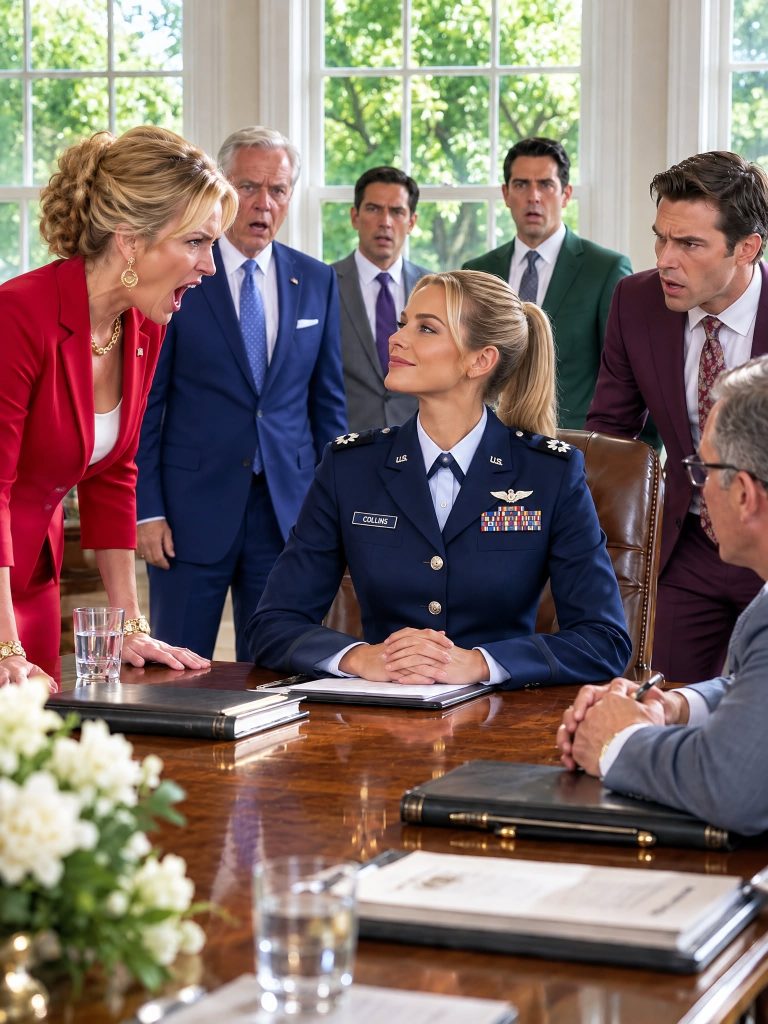
Three weeks had passed since my father’s funeral. I had come directly from Washington, still carrying the exhaustion of a long briefing and the grief I had postponed because work had required me to function. I expected a tense conversation about probate. I did not expect to walk into my childhood home and find strangers arranged around the dining table like a tribunal.
My mother, Celeste, stood at the head of the table in a pale gray suit. Beside her was her husband, Grant, watching the doorway. My younger half-brother, Owen, sat with his phone in his hand, refusing to meet my eyes.
The folder in front of me was labeled: RELINQUISHMENT OF INHERITANCE AND ESTATE CLAIMS.
I did not sit down.
“What exactly am I being asked to sign?” I asked.
Celeste gave an impatient sigh. “Your father’s will was unfair. Owen is trying to expand his business. You have a secure government job and no need for property or investment accounts.”
My father, Daniel Hart, had spent forty years building a construction company. He had also left behind commercial buildings, a historic house in Philadelphia, company shares, and investments worth far more than anyone in that room wanted to acknowledge.
“Owen’s business is not my responsibility,” I said.
“It is family,” Grant replied.
“So was Dad.”
The room went quiet.
For most of my life, my family had treated my career as an inconvenience they could not explain at dinner parties. They knew I worked for the government. They knew I traveled often. They knew I wore a uniform on formal occasions.
But they had never asked enough questions to understand that I was Colonel Naomi Hart, commander of a military intelligence unit. They did not know that I had spent years assessing people who believed confidence could replace evidence.
They thought five attorneys would intimidate me.
Instead, I counted them.
One had opened the folder but never touched it again. Another kept looking at my mother before answering even simple questions. A third appeared uncomfortable enough that he had already packed his legal pad away.
Then the oldest attorney stood.
“Colonel Hart,” he said carefully. “Perhaps you should review the documents.”
My mother’s smile tightened at the sound of my rank. “She is not here as a colonel. She is here as my daughter.”
“No,” I said. “I’m here as the person you asked to sign away her father’s property.”
I opened the folder. It offered me $300,000 in exchange for every right my father had left me. The Philadelphia house. His shares in Hartson Construction. Two office buildings. Several accounts.
The estate was worth more than $25 million.
Owen finally looked up. “You don’t even care about money.”
“That is usually what people say when they want mine.”
I turned another page and noticed a yellow divider tucked near the back. In the lower corner, someone had handwritten four numbers: 1022.
My father’s birthday.
He used those digits only for one thing: the indexing system for his private records.
I looked at the older attorney. “Where did this come from?”
Before he could answer, my mother said, “From your father’s files. It is none of your concern.”
But the attorney had already given her away. His expression changed for less than a second.
Fear.
Then he removed his glasses and looked directly at me.
“Your father asked me to be present if this meeting ever happened,” he said.
Grant shifted near the doorway. Owen lowered his phone.
My mother’s voice became dangerously quiet. “Martin, do not make this complicated.”
The attorney reached into his briefcase and placed a sealed envelope on the table.
My name was written across the front in my father’s unmistakable handwriting.
For the first time that night, my anger gave way to grief.
Then Martin said the words that changed everything.
“Your father believed someone was trying to take control of his estate before he died.”
Part 2: The Letter My Father Left Behind
I picked up the envelope slowly, but my mother reached for it before I could break the seal.
“No,” Celeste said. “That was not meant for you.”
Martin Hale, the older attorney, rose from his chair. “Mrs. Hart, the envelope is addressed to Colonel Naomi Hart and was placed in my custody by her father. You have no authority to withhold it.”
Grant moved away from the doorway, and Owen finally put his phone down. My mother looked around the room as if she had just realized that the five lawyers she had assembled were not all there to protect her.
I opened the envelope. Inside was a letter written on my father’s cream stationery, the handwriting shaky but familiar.
Naomi, if you are reading this while someone is urging you to give up what I left you, then I was right to be concerned. Do not sign anything concerning my estate until Martin Hale has completed the review I asked him to conduct.
My throat tightened as I read the next paragraph. Dad had anticipated every argument waiting for me: that Owen needed support, that my career made me independent, that I should prove my love for the family by giving away something I had never requested.
Owen stood abruptly. “What review?”
My mother answered before Martin could. “Your father was ill. He became suspicious of everyone and started inventing problems.”
Martin’s expression remained calm. “Daniel Hart was not inventing anything. He contacted my firm ten months ago after noticing activity in accounts he had not authorized.”
Grant’s face hardened. “You are discussing confidential business matters in front of the family.”
“The family is exactly why Mr. Hart was worried,” Martin replied.
I kept reading Dad’s letter. He wrote that Celeste had asked him to transfer the Philadelphia house to Owen, and that Grant had proposed using one of the commercial buildings as security for a private loan. Dad had refused both requests.
After that, he wrote, financial documents began appearing with signatures and instructions he had never approved.
Owen looked directly at our mother. “What is he talking about?”
Celeste’s eyes stayed fixed on me. “Your father favored you. He always did. This is one more way for him to punish the rest of us.”
For years, she had used that accusation whenever Dad showed me affection. When he attended my military graduation, I was selfish. When he called me during deployments, I was taking him away from the family. She had turned every act of love into proof that I had done something wrong.
But the letter in my hands told a different story. Dad had not been choosing a favorite child. He had been trying to protect his work from people he no longer trusted.
Martin reached into his briefcase and placed several pages in front of me. “Your father wanted you to see these if anyone attempted to challenge the will.”
The documents were emails from a luxury real-estate broker. Seven months earlier, someone had requested a valuation for the Philadelphia house, then prepared a draft purchase agreement.
The seller listed on the document was my father.
The person claiming authority to act for him was my mother.
I looked at Celeste. “You tried to sell Grandma’s house.”
“It was only an evaluation,” she said too quickly.