The Papers on the Coffee Table
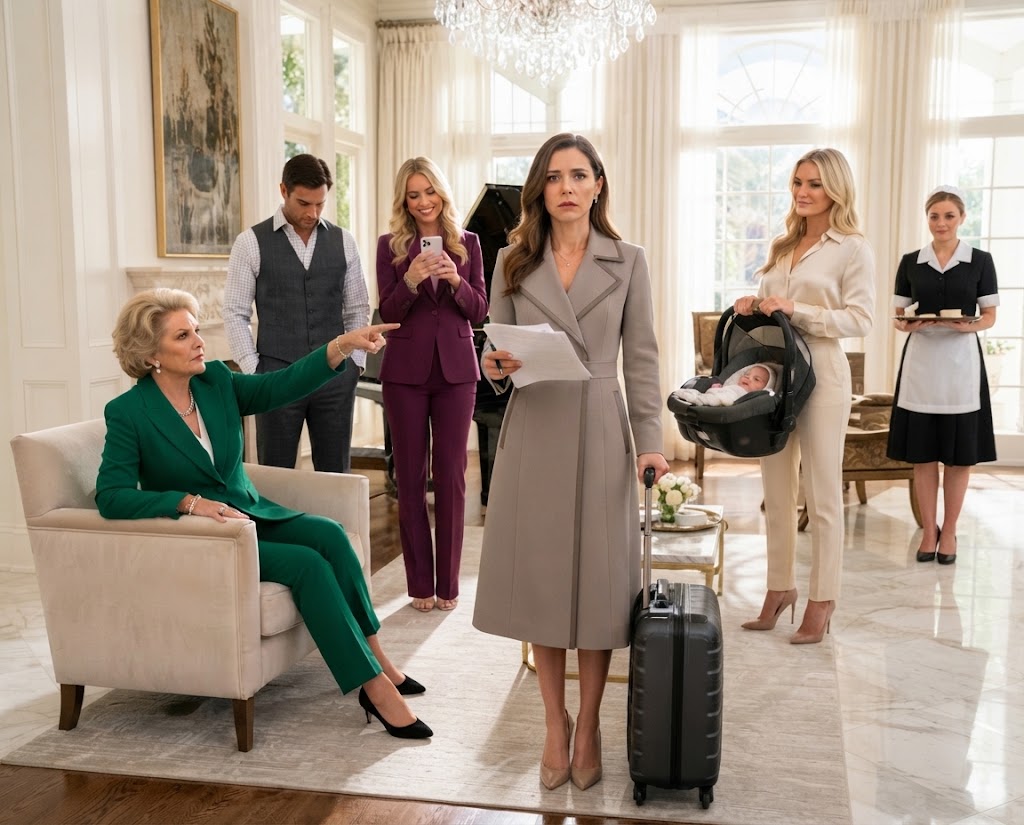
“Sign it, Evelyn, and stop dragging this out. This house finally needs a woman who can give my brother a child.”
Brooke Kessler said it while standing beside the marble fireplace in our living room, one hand resting on her narrow waist, her pale blond hair swept back as if she had prepared herself for a photograph rather than a family disgrace. Her voice moved through the room with the confidence of someone who had never once considered that cruelty might sound ugly when spoken out loud.
The housekeeper, Mrs. Palmer, had been gathering water glasses from the sideboard, and when Brooke spoke, she froze for the smallest moment, her fingers still around a crystal tumbler, her eyes lowered in that polite way working people learn when wealthy families begin tearing each other apart in front of them.
My mother-in-law, Marjorie Kessler, sat in the largest chair in the room, a high-backed cream linen armchair she had claimed as hers three weeks after I married her son. She wore pearls, a navy dress, and the expression of a woman presiding over a verdict. A manila folder rested on her lap, and my husband, Parker, sat beside her, quiet as a boy waiting for someone else to explain what he had done.
For six years, I had been Parker’s wife. For six years, I had taken his family’s comments with a smile that grew thinner every season. They called me cold when I asked for privacy. They called me selfish when I said adoption should be a conversation between husband and wife. They called me unlucky when another appointment ended with me sitting in the parking lot of a clinic outside Atlanta, holding medical papers in one hand and my dignity in the other.
Advertisements
No one in that family ever asked what the doctors had found. No one asked why Parker always changed the subject when results came back. No one asked why I was the only one expected to carry the blame like a purse I had chosen myself.
Marjorie tapped the folder with one manicured finger.
“You have embarrassed this family long enough,” she said. “My grandson should not have to grow up in whispers because you refuse to let go.”
I looked up from the pen in my hand.
“Your grandson?”
Parker closed his eyes.
And in that one small gesture, everything I had tried not to understand finally arranged itself into the truth. The unfamiliar perfume on his shirts. The phone calls he ended when I came into the kitchen. The weekend trips to Jacksonville that he said were for client meetings. The hotel charges he insisted were billing mistakes. The nervous kindness that came and went from him in short, guilty flashes.
There was another woman.
And there was a baby.
Brooke gave a little laugh, soft and sharp around the edges.
“Don’t look so surprised. Tessa is already staying outside Savannah, waiting for Parker to bring her home. She is a real woman, Evelyn. She gave this family what you never could.”
A real woman.
For a moment, those words pressed against my ribs harder than I expected, not because I believed them, but because I had spent too many years trying to be gentle with people who had mistaken my kindness for permission.
I did not cry. That disappointed them, I think. They had prepared for tears, for pleading, for the satisfaction of watching me fall apart in the same room where I had once hosted Thanksgiving dinners and Christmas breakfasts and Sunday suppers with too many candles and too much hope.
Instead, I signed.
The pen moved across the paper with a sound so small no one else could have heard it, but to me, it felt like the closing of a door I should have shut years earlier.
Marjorie took the papers from me before the ink had fully settled, smiling as if she had won something precious.
“Finally,” she said. “Go upstairs and get your things. And do not take anything my son paid for.”
I looked around the room at the wide oak floors, the antique mirror over the fireplace, the blue-and-white china I had collected one piece at a time, the piano I had tuned every spring though Parker never learned to play, and the kitchen beyond the archway where I had spent evenings making dinner for a man who came home smelling like another life.
None of it belonged to Parker.
The house had been mine before the wedding. I had bought it with the inheritance my father left me and the money I earned from my historic-home design firm, long before Parker Kessler arrived in my life with student loans, a repossession notice he begged me to help with, and a family that spoke endlessly about values while making themselves comfortable in rooms they had not earned.
But I had never said that out loud.
I had protected Parker’s pride because I thought that was what love did. I had let his mother believe what she wanted because correcting her felt petty. I had let Brooke call me spoiled, useless, difficult, and empty because some part of me believed that keeping peace was more noble than keeping record.
That was the mistake that cost me the most.
I went upstairs and packed one suitcase. I took clothes, legal documents, my laptop, my grandmother’s watch, and a small cedar box filled with photographs of my father standing beside houses he had restored with his own hands. I left behind the furniture, the dishes, the rugs, the framed wedding portrait in which Parker looked proud and I looked young enough to believe pride was the same thing as love.
When I came back down, Brooke had her phone raised.
“Look at this,” she said, her voice bright for the camera. “This is what it looks like when a kept woman finally runs out of luck.”
Parker did not tell her to stop.
That, more than anything, settled the last restless thing inside me.
Marjorie stepped close enough that I could smell her gardenia perfume.
“Tomorrow, Tessa and the baby are coming home,” she said. “This house needs joy, not a bitter woman wandering through it like a cloud.”
I picked up my purse, adjusted the strap on my shoulder, and walked to the front door. Before I stepped outside, I turned back one last time.
“Enjoy tonight,” I said.
Brooke lowered the phone just enough to smirk.
“What are you going to do, Evelyn? Cry in some guest room until Parker feels sorry for you?”
I smiled, but only a little.
“No,” I said. “I am going to let you finish what you started.”
I closed the door behind me while they were still laughing, and none of them understood that it would be their last night sleeping under my roof.
The Riverfront Hotel
I did not go to a friend’s house. I did not call my mother. I did not sit in my car and ask the sky why people who knew your softest places were often the ones most willing to press their thumbs against them.
I checked into a quiet hotel near the Savannah riverfront, the kind with brass lamps, dark wood, and a front desk clerk who did not ask why a woman arrived alone with one suitcase and eyes that looked too calm for midnight. I ordered black coffee, opened my laptop, and watched the living room of my own house appear on the screen.
Before I left, I had turned on two small security cameras, both of them legal, both of them installed months earlier after a series of package thefts in the neighborhood. One faced the living room. The other captured the dining room and part of the kitchen. I had not left them on out of curiosity. I had left them on because by then I understood that people who rewrite the truth in private often perform it beautifully in public.
On my screen, Marjorie poured champagne into the crystal flutes I had bought in Charleston. Brooke raised her glass and said something about removing bad energy from the house. Parker smiled, though not fully. Even from a hotel room miles away, I could see the tension in his jaw.
He knew me well enough to be uneasy.
That was one small comfort.
Marjorie leaned back in the chair she had always treated like a throne.
“She signed,” she said. “She will not fight. Women like Evelyn crumble when they are left alone.”
I turned off the audio.
There was nothing more I needed to hear that night.