Part 1: The Key My Grandfather Left Behind
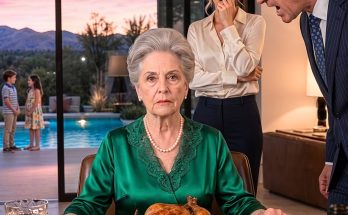
My father struck me with a wooden chair while my four-year-old son watched from the doorway.
Then he pointed at my child and said, “Take your boy and get out of my house.”
I lay on the living-room carpet in my diner uniform, stunned by the ringing in my ears and the blood on my sleeve. My mother did not come near me. She looked down with disgust and muttered, “You brought this on yourself.”
My sister, Brielle, stood beside the fireplace holding a wineglass. She did not call for help. She only watched me as though my pain had settled an argument she had already won.
It had begun with a phone call that afternoon.
Brielle wanted me to cancel my evening shift and babysit her daughter. She did not ask. She told me what time to arrive, then became furious when I reminded her that I needed the money for Noah’s preschool tuition.
“You really think you can say no?” she snapped. “I’ll call Dad.”
Twenty minutes later, my father was at the door of the cramped apartment above his garage where Noah and I had lived for three years.
“Come downstairs,” he ordered.
I should have refused. I should have locked the door and called someone. But I had spent my whole life learning that refusing my father only made the punishment worse.
Downstairs, he did not ask for my side of the story.
“You made your sister look foolish,” he said.
“I have to work,” I replied.
“She has plans.”
“Her plans are not my responsibility.”
The room became completely quiet. Noah pressed himself against my leg, his little fingers twisted in the fabric of my apron.
My father stepped closer. “Everything you have is because I allow it. Your room, your food, the heat that keeps your child warm. When this family tells you to help, you help.”
“We pay rent,” I said.
My mother laughed bitterly. “Those few dollars? You should be grateful we take pity on you.”
For three years, I had handed them nearly half of every paycheck. They called it rent when they wanted money and charity when they wanted control.
Then my father demanded my car keys so Brielle could use my vehicle. When I said she was not insured, he told me to quit my job.
That was when I said the one word they hated most.
“No.”
The chair was beside the dining table. I saw my father grab it, saw the wood flash beneath the ceiling light, and then felt the impact.
Noah screamed as I fell.
My father stood over me holding one broken piece of the chair. “Get your bastard kid out of my house.”
Something inside me went silent.
I did not plead. I did not argue. I went upstairs, packed Noah’s clothes, and reached beneath my bed for the dented metal box my grandfather had given me before he died.
“For the day someone tells you that you have nowhere to go,” he had said.
Inside were an old photograph, a brass key, and a sealed legal document.
My hands shook as I unfolded it.
It was a deed for my parents’ house.
The grantee named on the document was me.
Downstairs, my father shouted that he was changing the locks.
I took Noah’s hand, held the deed against my chest, and walked past them without another word.
Brielle laughed. “Where do you think you’re going?”
I looked at the brass key in my palm.
“Somewhere safe,” I said.
At the hospital, a nurse documented my injuries while Noah sat wrapped in a blue blanket. Before dawn, I called the attorney listed in my grandfather’s letter.
She listened quietly, then asked one question.
“Do your parents know you have the original deed?”
“No.”
Her voice turned firm.
“Then don’t tell them yet.”
Part 2: The House They Never Owned
Attorney Marisol Vega asked me to meet her at her office before I spoke to anyone in my family.
I arrived wearing borrowed sweatpants and a loose sweatshirt from the hospital gift shop. The cut above my eyebrow had been cleaned and closed, but my cheek still throbbed every time I moved my jaw. Noah sat beside me at the conference table with crayons and a coloring book, quietly drawing a house with a bright red door.
Marisol studied the deed for several minutes.
Then she unfolded the letter my grandfather had sealed with it.
“He anticipated this,” she said.
My throat tightened. “What does that mean?”
“It means your grandfather knew your father might challenge the transfer.” She tapped the letter. “He left detailed instructions, copies of the notarized documents, and the contact information for the attorney who prepared everything.”
The house had never belonged to my father.
My grandfather had bought it decades earlier and allowed my parents to live there. They paid the bills, hosted holidays, and treated it as their kingdom, but the legal ownership had remained with him until he transferred it to me shortly after Noah was born.
I stared at the document again.
All those years, Dad had told me every room belonged to him. He had used the garage apartment, the lights, and even the food in the kitchen as proof that I owed him obedience.
But he had been threatening me from inside a house that was legally mine.
Marisol explained that the deed had been validly delivered, even though it had not been recorded until now. Grandpa had included a signed receipt from the day he gave me the metal box, a notarized ledger entry, and a recorded statement to be released if my parents ever disputed his wishes.
“Your father has no ownership claim,” she said. “But we need to act carefully. You are dealing with a violent man, and he is currently living on your property.”
The police report gave us a starting point.
The officer who took my statement had photographed the broken chair and noted that Noah had witnessed the assault. The hospital had documented every injury. Most importantly, the living-room security camera had recorded the entire confrontation.
Dad had installed it to protect his expensive television.
He never imagined it would protect me.
By that afternoon, Marisol had filed for an emergency protective order and delivered a formal notice ending my parents’ permission to occupy the property. We did not try to force them out overnight. The law required a process, and I wanted every step to be clean enough that they could not twist it later.
Dad’s first response was a voicemail.
“You think a piece of paper makes you powerful?” he snarled. “You’re still nothing without this family.”
My mother left three messages after him.
One said I had ruined Dad’s life. Another said I was confusing Grandpa because he had been sick. The third was quieter.
“Come home,” she whispered. “We can forget this happened.”
I listened to it twice.
Then I saved it in the evidence folder.
Brielle took the fight online. She posted that I had attacked my father, stolen an old man’s paperwork, and was trying to throw “an elderly couple” into the street. Relatives began sending messages demanding I apologize.
None of them asked why I had spent the night in the hospital with my son.