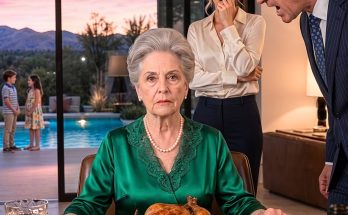
“Your child is not an excuse. Rent tonight or your father changes the garage lock.”
My mother’s face drained of color.
Dad’s attorney asked the court to consider the repairs he had made to the property. Marisol agreed that he had paid for work on the house, but she pointed out that maintaining a home did not make someone its owner.
“A valid deed names Ms. Parker as the owner,” she said. “His expenses gave him no right to threaten, control, or assault her.”
The judge ruled in my favor.
The house belonged to me. My parents’ right to live there had ended with the notice Marisol served. They were given thirty days to leave.
Outside the courthouse, Brielle stopped me beside the elevators.
“Mia stays in that house every weekend,” she said, referring to her daughter. “You’re punishing a child.”
For one second, I felt the old guilt return.
Then I thought of Noah shaking beside me on the carpet.
“My child watched Dad hit me,” I said. “You used your daughter to demand my time, and now you’re using her to avoid responsibility.”
Brielle’s eyes filled with anger.
“You’re enjoying this.”
“No,” I said. “I’m ending it.”
The final day came faster than I expected.
My parents ignored the deadline, so two sheriff’s deputies arrived with the court order. Marisol stood beside me beneath the maple tree Grandpa had planted when I was born while movers carried boxes out of the house.
Dad shouted that I was stealing his home.
Mom cried loudly for the neighbors.
Brielle filmed on her phone until a deputy told her to step back.
Noah held my hand and watched the last truck pull away.
“Are we going to live there now?” he asked.
I looked at the house where I had learned to be afraid.
“Not yet,” I told him.
Then I looked down at the brass key Grandpa had left me.
Because owning a house did not mean I had to keep living inside its memories.
Part 5: The Door I Could Finally Close
I sold the house six months after the deputies carried my parents’ last boxes to the curb.
Some relatives called me heartless for it. They said I should keep the property because Grandpa had wanted me to have it, as though his gift had been a command to remain surrounded by rooms where I had learned to be afraid.
But Grandpa had given me ownership, not another obligation.
The sale paid my legal expenses, cleared the medical bills from the assault, and started a college fund for Noah. With what remained, I bought a modest home near his preschool—a small place with sunlight in the kitchen, a backyard just large enough for a swing set, and a bright blue front door.
Noah chose the color himself.
“It looks happy,” he said.
For the first few weeks, he slept with his shoes beside the bed. When I asked why, he looked embarrassed.
“In case we have to leave fast,” he whispered.
I sat beside him until he fell asleep.
No child should have to plan an escape from home. So every night, I told him the same thing: no one was coming to pound on our door, no one could take his things, and no one had to earn the right to stay safe.
Slowly, he began leaving his shoes in the closet.
I returned to the diner part-time while taking classes for my nursing certification. It was not an easy road, but it was mine. For the first time, every dollar I earned went toward our future instead of disappearing into envelopes labeled rent by people who did not own the roof above us.
Brielle sent one message after the court case ended.
She wrote that she had been scared of Dad too, that she knew she had done wrong, and that she hoped I would forgive her someday. I read it twice before saving it in a folder.
I did not answer.
Understanding what she had done was not the same as repairing it.
My mother did not contact me for several months. Dad could not because the no-contact order remained in place. Then, one rainy afternoon, someone knocked on my blue front door.
Through the glass, I saw my mother and father standing on the porch.
Mom held a suitcase. Dad stood beside her in the same dark coat he had worn to court, his jaw already tense with anger. They had been staying with Brielle, but her landlord had discovered the extra occupants and threatened her lease.
For the first time, they had nowhere to go.
I kept the security chain fastened.
Mom pressed her hands together. “We made mistakes. Families are supposed to forgive.”
Dad looked over her shoulder into my hallway. “We only need a room for a few weeks.”
Not remorse.
A demand wearing the mask of desperation.
“When I was bleeding,” I said, “you told me I deserved it.”
Mom looked down. “I was upset.”
“When Noah was crying, neither of you helped him.”
Dad’s expression hardened. “You’re really going to leave us outside?”
Behind me, Noah was building a block tower on the living-room rug. He looked safe. He looked like a child instead of someone waiting for the next disaster.
“Yes,” I said.
Dad took a step toward the door, but I raised my phone where he could see it.
“The protective order is still active. Leave.”
For one second, he looked like he might shout. Then he noticed the camera above the porch and stepped back.
Mom whispered my childhood nickname.
I closed the door.
My hands trembled after the lock clicked, but I did not open it again. Noah came into the hallway holding two wooden blocks and looked up at me.
“Who was that?”
“People who cannot stay here,” I said.
He nodded, then placed one block in my hand.
“You can help with my tower.”
So I sat beside my son while sunlight moved across the floor.
For years, my family taught me that power was loud—that it sounded like threats, slammed doors, and cruel words. Grandpa left me a different lesson.
Sometimes power is a deed inside a metal box.
And sometimes it is simply knowing you can close your own front door—and no one can force it open again.