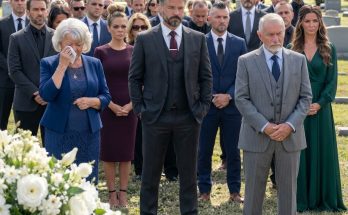
Part 1: The Stakes in My Meadow
Three weeks after my husband’s funeral, his older brother came to our Montana cabin with a surveyor, a-thousand-dollar check, and papers he wanted me to sign. He said I had thirty days to leave the seventy acres Luke and I had called home.
The folder Dale Tolliver placed on my kitchen table was labeled Property Transfer. Behind him, my mother-in-law, Arlene, looked around the room while I read it. Her eyes rested on the cabinets Luke had built and the cast-iron skillet he always left hanging beside the stove.
Outside the window, a white pickup idled at the end of the driveway. A man in an orange vest sat inside with a tripod case beside him.
“You brought a surveyor?” I asked.
“We’re trying to make this easy,” Dale said. He tapped the folder. “There’s a relocation check in there. Ten thousand dollars.”
Luke had been gone twenty-three days. I still woke in the morning expecting to hear him making coffee. His boots stood by the back door because I wasn’t ready to put them away, and now his family had brought someone to measure the land.
“What are you asking me to sign?”
Dale sat across from me and opened the folder to a quitclaim deed. “The original acreage came through Dad’s family. Mom and I want it returned to the Tolliver trust. You take the check and find somewhere easier to manage.”
I turned to the last page. My name had been typed beneath the signature line as Sloane Tolliver. I had never changed my last name when Luke and I married.
“You know I’m Sloane Mercer,” I said.
Dale waved a hand. “That can be corrected.”
“It needs to be correct before you ask me to sign anything.”
Arlene stepped closer to the table. “Luke should have sorted this out while he was here. He was always too sentimental about the place.”
I looked toward the window. Luke and I had repaired fences out there together, cleared the road after storms, and saved for years to buy the meadow along the creek. Arlene had visited often enough to see the work, though she had never asked how we paid for it.
“Luke wanted to live here,” I said.
“And you can’t maintain it alone,” Dale replied. “The roads, the equipment, the taxes—it’s a lot for someone who spends her days behind a laptop.”
I did work behind a laptop. Dale had never shown much interest in what I did there, and I wasn’t going to explain it while he waited with a pen in his hand.
“When did you have this deed prepared?” I asked.
He glanced at Arlene. “That doesn’t matter.”
“It matters to me.”
Dale closed the folder. He said I was too upset to discuss practical decisions and that he would return when I’d had time to think. I told him he could take the check and the unsigned deed with him.
After they drove away, I pulled on my coat and followed the tire tracks left by the surveyor’s pickup. They ran past the barn, across the lower pasture, and toward the bend in the creek. The grass was stiff with frost under my boots.
In the far meadow, four wooden stakes marked a line I had never agreed to survey. Pink ribbons moved in the cold wind. I crouched beside the nearest stake and read the tag attached to it.
It listed the survey company, a job number, and the date the work had been done. I checked it twice to be sure.
The surveyor had marked our land nineteen days before Luke died.
Part 2: What the Deed Actually Said
I photographed the survey stakes before touching anything. Each tag showed the same job number, and the date was clear. Someone had sent a surveyor into our meadow while Luke was still alive.
That night, I sat at the kitchen table with my laptop and opened the Park County property records. Dale had been right about one detail: Luke inherited forty acres from his grandfather. The other thirty—the creek meadow and timbered slope—Luke and I had purchased together with our savings.
The next record mattered more. A year after buying the additional land, we signed a deed placing all seventy acres in both our names as joint tenants with right of survivorship. I remembered the afternoon at the title office. Luke had squeezed my hand while we waited for the documents to be copied and joked that neither of us was allowed to leave the other with all the fence repairs.
I read the recorded deed again. After Luke’s death, his interest in the land passed to me under its terms. I still wanted an attorney to review everything, but Dale’s claim that his mother’s trust owned the acreage didn’t match the county record.
The papers he had brought me would have transferred my interest away. His ten-thousand-dollar check was payment for a home and land he had no right to demand.
I closed the record and looked at the survey photographs. Dale had arranged that work before Luke’s accident. I searched the Montana business registry next and found Tolliver Land Partners, a company Dale had formed nine weeks earlier. It listed him as its manager, with a mailing address at his car dealership in Bozeman.
Why create a land company when he didn’t own our land?
A search for the survey company led me to an article about a proposed luxury ranch development nearby. Its map showed plans reaching almost to our creek. The article didn’t say Dale was involved, but the timing made me uneasy. I saved copies of the company filing, the article, and every property record I had opened.
As I laid them out on the table, I remembered a Sunday afternoon a few weeks before Luke died. He had walked the far meadow and returned quieter than usual. At dinner, he asked if we could finish the conservation easement we had discussed for years.
“I don’t want anyone dividing that meadow after we’re gone,” he said.
We signed the documents at a notary’s office in Livingston. The following morning, Luke put the envelope on the passenger seat of his truck. He was going to deliver it to the land trust on his way into town.
He never arrived.
The highway patrol told me black ice had sent his truck off the road. In the days afterward, I could think only about Luke. I assumed the envelope had been lost with the other things damaged in the crash.