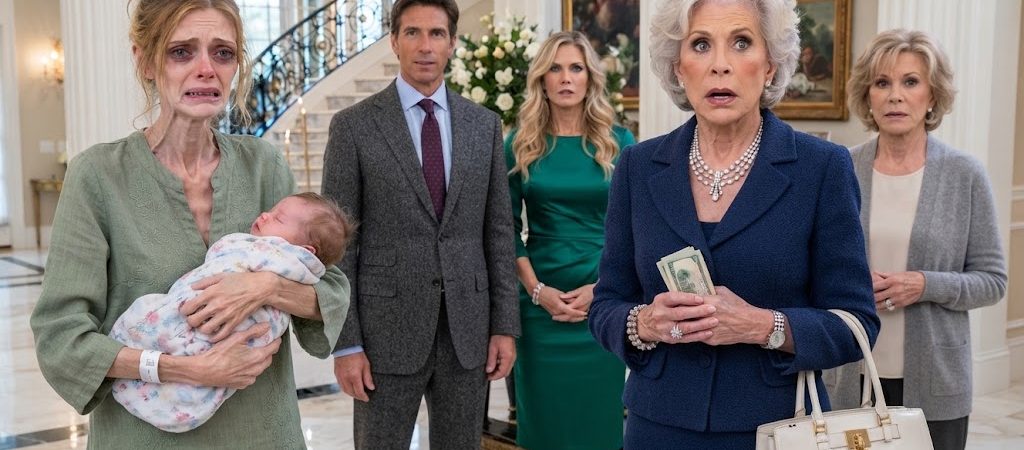
Chapter 1: The Brass Safety Pin
The moment my grandmother caught sight of me clutching my newborn daughter inside a frayed, secondhand coat, the warmth vanished from her weathered face.
“Wasn’t the inheritance your father left you enough for a proper jacket?” she asked, her brow furrowing into a map of deep, concerned lines.
“I’ve never seen a single dollar of it,” I replied, the words tasting like old ash in my mouth.
Nonna didn’t blink. She slowly lowered her heavy, black leather purse to the floor and asked me for my mother’s phone number.
It was the safety pin that had betrayed my poverty. The nurse at Henrico Doctors’ Hospital had shown me how to zip little Marigold securely against my chest to keep her body temperature up. But the olive-green canvas jacket—a men’s size medium I’d found on the clearance rack—was a fraction too small to encapsulate both of us. Out of sheer necessity, I had bridged the gaping zipper with a massive, brass safety pin salvaged from the dusty depths of my diaper bag.
I was secretly proud of that brass pin. I thought it gave me an air of rugged maternal determination, a metallic badge proving I was doing whatever it took. But Nonna spotted it from across the linen-draped table, and the joy of her birthday celebration extinguished as swiftly as a blown-out candle.
It was a brisk Sunday, March 8th, her seventy-eighth birthday. We were gathered at Trattoria Rossi, an old-school Italian joint in Short Pump famous for the plastic grapevines woven through the ceiling lattice and a greying waiter named Gianni, who had reverently addressed my grandmother as Principessa for three decades. My two aunts were there, alongside a pair of cousins, chatting loudly over a sheet cake aggressively frosted with a photograph of Nonna’s face—a gaudy gesture she secretly adored but publicly complained about.
I had arrived forty minutes late because Marigold, barely five weeks old, had demanded to be fed twice in the icy front seat of my beat-up Corolla. When I finally reached the table, Nonna wordlessly extended her arms. I unfastened the brass pin, peeled back the canvas, and lifted my daughter into the restaurant’s warm air. Marigold was furious and squirming, bundled in a pill-covered gray fleece bunting that had undoubtedly belonged to three other infants before finding its way to me. I’d scored it at a Broad Street church thrift store for exactly four dollars. It harbored a stubborn bleach stain near the left cuff, which I had meticulously rolled inward to hide.
My grandmother cradled Marigold with practiced grace, resting the tiny head against her silk shoulder. As she rhythmically patted my daughter’s back, her dark, sharp eyes locked onto mine. She saw everything. She saw the frayed cuffs of the men’s jacket. She saw the concealed bleach stain. She saw the exhaustion bruising the skin beneath my eyes.
Leaning forward, she pitched her voice just beneath the chaotic chatter of my aunts. “Jana, wasn’t the trust your father left you enough?”
I honestly thought the years were finally catching up to her. I assumed she was confusing me with someone else. “Nonna,” I whispered, leaning in close, “I’ve never seen a dollar of any trust.”
Silence descended over her side of the table. She didn’t gasp. She didn’t argue. For a long, terrifying moment, she just stared at me. Then, with agonizing gentleness, she handed Marigold back into my arms.
She retrieved her black leather purse—an armored vault of a handbag she had carried to every baptism, graduation, and funeral since the decade I was born. She placed it squarely beside her bread plate, folded her manicured hands upon the clasp, and said, “Give me your mother’s phone number.”
My grandmother had possessed my mother’s cell phone number for twenty-eight years. She had it memorized. She wasn’t asking for the digits; she was issuing a terrifying warning that she was about to weaponize them.
I had absolutely no idea that fourteen years prior, Nonna had been sitting rigid in a mahogany-paneled law office when a staggering sum of money was spoken aloud. Nor did I know that for my entire adolescence, my mother had been banking on the silent hope that everyone in that room would simply forget it existed.
My name is Jana Kersey. I am twenty-six years old, and I navigate the grueling existence of a pharmacy cashier in Glen Allen, a sprawling suburb just north of Richmond, Virginia. I spend my days ringing up generic antibiotics, scanning flu shot vouchers, and watching the subtle micro-expressions of elderly men to deduce whether the Russell Stover chocolates they are purchasing are an apology for their wives or a treat for themselves.
I inhabit a cramped, drafty one-bedroom apartment off Staples Mill Road with my daughter, Marigold, who arrived on Groundhog Day and possesses militant opinions about the temperature of her milk. Her biological father concluded somewhere near the end of my second trimester that the concept of fatherhood was a garment that didn’t quite fit his lifestyle, and promptly relocated to Charlotte. I rarely waste breath discussing him. He is a ghost who left nothing behind.
My own father, Declan Kersey, was a ghost of a different caliber. He was a commercial HVAC technician, a blue-collar magician who could resurrect any humming, metallic beast in your basement. He chronically kept butterscotch discs in the breast pocket of his uniform, distributing them to toddlers at every residential job site. He referred to me exclusively as “Bug,” right up until the grim afternoon of March 19th, 2012.
A congenital blood vessel violently ruptured in his brain while he was wedged in a sweltering attic in Mechanicsville, trying to coax life back into a broken air handler. He was forty years old. I was twelve.
My memories of the funeral are a blur of damp tissues and the overwhelming scent of lilies. I vividly recall my mother, Renata, sobbing elegantly in a black sheath dress she had borrowed from her sister. A few weeks later, I remember sitting in a cavernous law office downtown. I was swallowed by a tufted leather wingback chair, blissfully eating butterscotch candies from a crystal dish on the attorney’s desk, while the solemn adults murmured about life insurance policies.
Nonna was in that room. Renata was in that room. I was twelve, deeply traumatized, and vastly more invested in the candy.
What my adolescent brain absorbed, and what I believed as gospel for the next fourteen years, was a simplified fairy tale: My father had left a modest cushion of money for me in a legal vehicle called a trust. My mother was the guardian of this treasure. It was meant to cover my essential needs as I matured, and whatever crumbs remained would be handed over to me on my twenty-fifth birthday.
No one ever mentioned a specific number.
But secrets, I was about to learn, have a specific gravity. And the heavier the secret, the louder it crashes when it finally falls.