Chapter 5: The Price of a Soul
The psychological warfare escalated instantly.
Renata severed all direct communication. She stopped replying to my desperate texts containing photos of Marigold’s milestones. For months, she had reliably attached a red heart emoji to every picture I sent; now, the digital silence was deafening. She quietly unfriended me on Facebook. When I called her on Easter Sunday, the phone rolled directly to a generic voicemail.
Then, she deployed her flying monkeys.
My aunt—Renata’s older sister—called me at the pharmacy. “I have no idea what kind of demonic influence has possessed you,” she hissed into the receiver, bypassing any greeting. “Your mother sacrificed her youth, her sanity, and her entire life to care for you after Declan died. And now you are allowing that bitter old Italian woman to poison you against your own flesh and blood over money?”
“Aunt Carol—” I tried to interject.
“Over money, Jana!” she shrieked. “You have a newborn child! You should be on your knees thanking Renata, not dragging her through the mud! You are a disgrace to this family.”
“Did she happen to mention exactly how much money we are discussing?” I asked, my voice deadly calm.
My aunt scoffed. “She told me everything I need to know. Drop this, Jana, before you destroy the only family you have left.”
When she hung up, a wave of profound nausea washed over me. I nearly abandoned the crusade right then and there.
That evening in April, I strapped a sleeping Marigold into her car seat and drove out to Glen Allen. I parked my Corolla in the shadows across the street from the Busby fortress. I was utterly defeated. I planned to march up to the mahogany front door, beg for forgiveness, and declare that the money was meaningless if it meant losing my mother. I was starved for maternal affection. I wanted my mom far more than I wanted justice.
I sat in the dark, gathering my courage. Through the slats of the pristine white privacy fence, the underwater pool lights suddenly ignited. The water glowed a radioactive blue, seamlessly morphing into neon pink, then an eerie emerald green, before cycling back to blue. Parked aggressively in the driveway were Royal’s two monstrous, chrome-accented trucks, boasting his name in giant decals.
I sat there with the engine idling, hypnotized by the changing lights for twenty full minutes.
Four hundred thousand dollars.
I shifted the car into drive and drove back to my drafty apartment. I was done begging for scraps of love from a woman who had dined like a queen on my inheritance.
By this time, I had returned to my purgatory behind the pharmacy register. I had been forced back to work a mere six weeks postpartum because corporate policy didn’t believe in paid maternity leave, and six weeks of zero income was the absolute limit my bank account could absorb before I faced eviction.
I was forced to pump breast milk in a squalid, windowless breakroom wedged between the chemical storage closet and the public restrooms. I sat on a rusty metal folding chair, relying on a handwritten sign taped to the door that read: DO NOT ENTER – PUMPING in Wava’s distinct cursive.
Wava is a sixty-one-year-old pharmacy technician who has survived the retail trenches for three decades. She wears her bifocals on a homemade chain constructed entirely of linked paper clips. Every two hours, without a word of complaint, Wava would aggressively commandeer my cash register, loudly informing impatient customers that I was on a “critical consultation call with a physician.”
Childcare for Marigold was bleeding me dry at $1,380 a month. My rent was $1,250.
I did that brutal arithmetic, too, scribbling on the back of yet another CVS receipt. When Nonna discovered my financial hemorrhaging, she immediately offered to cover the daycare tuition indefinitely.
“No, Nonna,” I refused, my pride flaring.
“Jana, do not play the proud martyr with me,” she scolded.
“I’m not being proud,” I told her, my voice hard as flint. “I do not want a dime of your money. I want mine.”
In late April, Mr. Duca formally filed a petition in the Henrico County Circuit Court. It was a legal sledgehammer designed to compel the trustee to produce the accounting.
Because I was the legal beneficiary, my name was emblazoned at the top of the petition as the primary plaintiff. Nonna, legally speaking, was a ghost in this fight; she was forbidden from being a named party. Her only role was to finance the war, which she did with terrifying enthusiasm.
The petition demanded the court force my mother to account for every cent since 2012 and begged the judge to investigate whether the trust had been managed with a shred of fiduciary duty.
I stood in the sweltering asphalt parking lot outside Mr. Duca’s office, reading the bold black letters of Jana Kersey v. Renata Busby, while Marigold wailed for a bottle in the backseat. It felt as though I was filing a lawsuit against my own childhood.
The initial hearing took place on a rainy Tuesday in May. The courtroom was aggressively air-conditioned, so frigid that I kept Marigold cocooned in her thrift-store bunting for the duration.
Renata didn’t even bother to appear.
She sent a slick, young junior associate clutching a rolling leather briefcase. The lawyer confidently argued that the adult beneficiary had legally waived all accounting rights, and assured the court that the trustee had impeccably exhausted the funds providing for the petitioner’s welfare.
The judge was a severe woman who had presided over the circuit court for eleven years. She didn’t suffer fools. She silently reviewed the purple-inked waiver. She read Mr. Duca’s petition. She lowered her reading glasses to the bridge of her nose and pinned Renata’s lawyer with a stare that could freeze water.
“Counselor,” the judge said, her voice echoing in the cavernous room. “If the trust funds were, in fact, properly dispersed for the beneficiary’s support, a forensic accounting will clearly demonstrate that, and your client will be gloriously vindicated. I am hereby ordering a full, itemized accounting from the date of funding to the present day, to be filed directly with this court within sixty days.”
The gavel cracked. It was over in eleven minutes.
Nine days after the judge’s decree, the pharmacy phone rang. I was currently ringing up a frail gentleman purchasing a birthday card and three boxes of cherry cough drops.
Wava leaned over the pharmacy counter, her paper clip chain swinging. “Honey, there’s a ‘Royal’ holding on line one for you. He claims it’s a family emergency.”
My stomach tightened. I excused myself and retreated to the dim quiet of the stockroom, leaning against a towering pallet of adult diapers.
“Hello?”
“Hey there, kiddo! How’s that beautiful grandbaby?” Royal’s voice boomed through the receiver. He possessed the greasy, aggressive charm of a used car salesman working a church picnic—loud, overly familiar, acting as though every conversation was a shared inside joke.
“Marigold is fine, Royal,” I said, my voice flat. “What exactly do you want?”
“Listen, kiddo,” he shifted gears, his tone adopting a fake, conspiratorial warmth. “I’m calling to play the peacemaker here. This whole legal circus? It’s tearing your mother apart. She is absolutely devastated.”
Devastated. The word hung in the air, dripping with irony.
“So, I was thinking,” Royal continued smoothly, “what’s it gonna take to make this headache go away? Let’s put on our adult pants. How about I write you a personal check right now for a few thousand bucks? Buy some nice things for the baby. We shake hands, drop the lawyers, and everybody goes back to enjoying Sunday dinners together like none of this ugliness ever happened.”
I pressed the phone against my ear, entirely speechless at the sheer audacity.
“I’ll make it five thousand dollars, Jana. Cash. Come on, be smart. Lawyers charge by the hour. Your grandmother’s bank account isn’t bottomless, and frankly, the old bird isn’t going to live forever.”
I pulled the phone away from my face and pressed the red END button.
When I relayed the conversation to Mr. Duca later that afternoon, the old attorney slowly removed his glasses and polished the lenses with the tail of his silk tie.
“Miss Kersey,” he murmured, a dangerous smile playing on his lips. “In thirty years of litigating fraud, I have never once had a guilty party offer me thousands of dollars to make ‘nothing’ stop.”
Two days after Royal’s failed bribery attempt, Renata brought the war to my front door.
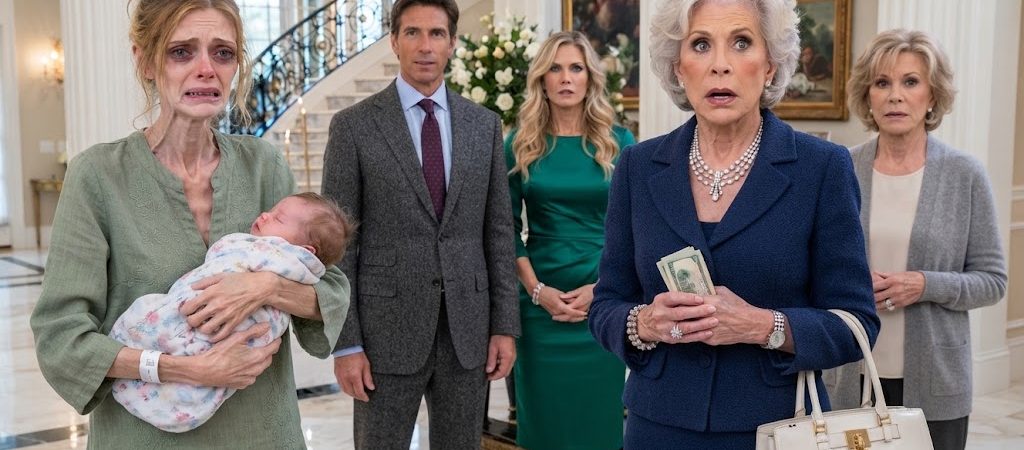
It was the first time I had laid eyes on her since the afternoon Marigold was born—a visit where she had breezed into my hospital room, complained about the cafeteria coffee for twenty minutes, snapped a selfie for Facebook, and vanished.
She marched into the pharmacy at four o’clock on a bustling Friday afternoon, dressed immaculately in crisp white tennis whites. She joined my checkout line, standing rigidly behind a man purchasing bulk antacids.
When he shuffled away, she stepped up to my register. She placed absolutely nothing on the counter. She simply stood there, gripping her BMW keys so tightly her knuckles were white.
“You are humiliating me,” she hissed, pitching her voice low to evade Wava’s radar. “You are dragging my name through the mud in front of the entire family. In front of my congregation. Do you comprehend the damage you are causing?”
My hands shook as I rested them on the scanner. “Hi, Mom. Did you want to see a picture of the baby? She’s at daycare right now, but she has your nose.”
Renata’s eyes narrowed into slits. “Drop the lawsuit, Jana. Call that fossil of a lawyer today and tell him you’re withdrawing the petition. Do that, and I will find it in my heart to forgive you, and we can go back to normal.”
I looked her dead in the eye. All the fear I had harbored for twenty-six years evaporated under the harsh fluorescent lights of the CVS.
“Show me the binder, Mom,” I said, my voice steady and loud enough for the next customer in line to hear. “If you spent my father’s money on me, just show me the receipts. That is literally all I have ever asked.”
She stared at me for three agonizing seconds. I watched her mouth tighten into the familiar, vicious line—the physical prelude to her favorite catchphrase. I watched the gears grind in her head as she actively suppressed the urge to scream ‘After everything I spent on you!’
Realizing she had lost her power, she spun on her heel and marched out of the automatic sliding doors, her tennis shoes squeaking against the linoleum.
Wava leaned far over the elevated pharmacy counter, her eyebrows practically touching her hairline. “Lord have mercy, honey. Who was that?”
“That,” I breathed, my heart pounding in my throat, “was my mother.”
Wava offered a slow, solemn nod, retreated behind the counter, and thirty seconds later, silently slid a wrapped peppermint patty across the scanner to me.
That night, wired on adrenaline and insomnia, I committed an act of digital masochism I had avoided for years. I opened the Instagram app, navigated to Kirsten’s heavily curated profile, and scrolled all the way back to the dawn of her account.
The evidence was all there, preserved in digital amber.
There was twelve-year-old Kirsten, beaming in her tailored, plaid Holy Rosary skirt on the first day of seventh grade, sporting a custom-monogrammed LL Bean backpack.
Swipe.
There was the pristine silver Honda Civic, crowned with the red bow.
Swipe.
There was the time-lapse video of the swimming pool being filled with hundreds of gallons of water, captioned #PoolsOpen! with Renata lingering in the background, clutching her margarita in her straw hat.
Swipe.
There were the action shots of the elite rowing team slicing through the river. The graduation portrait on the manicured lawns of the Holy Rosary chapel, Kirsten resplendent in a designer white dress.
I sat in the dark and scrolled for two solid hours.
The strangest part was that I felt no malice toward Kirsten. She was a child when she was handed that plaid skirt. Society doesn’t hand a twelve-year-old the tuition invoice; they just expect them to smile for the camera.
But as I stared at the glowing screen, the horrific puzzle pieces snapped together. I finally understood exactly whose blood had paid for the water in that pool.
The ledger was about to be opened.