PART 1 — THE ENVELOPE I NEVER GAVE HIM
There are some envelopes you keep for years because you cannot bring yourself to send them.
Mine was cream-colored, folded carefully at the corners, and hidden inside the back pocket of an old recipe book I had not opened in nearly a decade.
On the front, in black ink, I had written:
DAVID.
Underneath that, I had added one sentence.
You have a son.
I had written the words ten years earlier, three days after our divorce became final.
I never mailed it.
Not because I was afraid of David.
I was afraid of what his answer might do to my unborn child.
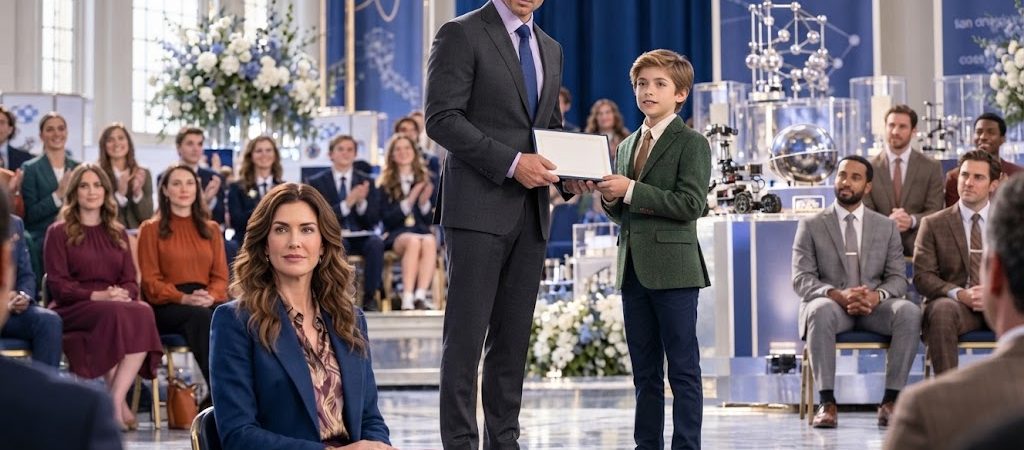
Nine years later, that same child stood beneath bright school auditorium lights wearing a navy blazer two sizes too big, waiting to receive a regional science award.
His name was Noah.
And standing on the stage with the medal in his hand was the man I had once loved enough to believe would never leave me.
David.
For a few seconds, neither of us moved.
Then Noah smiled up at him.
“Thank you, Mr. Carter.”
David smiled professionally, the way adults do when there are cameras watching.
“You earned it, young man.”
Noah adjusted his glasses.
“My mom says I worked too hard.”
David laughed.
“She’s probably right.”
I watched David pin the silver medal to my son’s blazer.
Then Noah said, completely innocently, “I’m nine years old.”
David froze.
It was such a small sentence.
A harmless fact.
But I saw the exact moment the number entered his mind.
Nine.
His eyes dropped to Noah’s face.
Noah had dark brown hair, slightly wavy at the front. A narrow scar near his left eyebrow from falling off his bicycle at six. Long fingers. Gray-green eyes that people had always said were unusual.
I had always known those eyes.
I had looked into them across breakfast tables, movie nights, hospital rooms, homework sessions, and countless moments when my son had fallen asleep against my shoulder.
But David was seeing them for the first time.
And suddenly his smile disappeared.
Noah looked at him curiously.
“Are you okay?”
David did not answer.
His fingers were still resting against the medal ribbon.
He looked from Noah to me.
Then back to Noah.
And I knew.
He had finally begun counting backward.
Nine years.
Ten years since our divorce.
Ten years since he signed papers I had begged him to reconsider.
Ten years since he told me he wanted a clean start.
Ten years since he packed two suitcases, kissed my forehead, and walked out of our apartment without knowing that four weeks before that day, I had stared at two pink lines on a pregnancy test.
I had planned to tell him that night.
But David had come home carrying divorce papers.
“I’ve already talked to my attorney,” he said.
I remember standing in our kitchen with my hand pressed against my stomach.
“You’re serious?”
“Yes.”
“David, we can fix this.”
“I don’t want to.”
I had never forgotten how calmly he said it.
He said he was tired.
Tired of arguments.
Tired of the uncertainty.
Tired of feeling trapped.
He said there was no point dragging things out.
The pregnancy test was still hidden in my purse.
I never showed it to him.
I thought I would have another chance.
I didn’t.
David wanted everything finalized quickly, and I agreed because a strange numbness had taken over me.
At the courthouse, I signed the final papers with shaking hands.
He didn’t look at me.
He never asked if there was someone else.
He never asked why I kept one hand pressed against my stomach.
He never asked why I suddenly stopped drinking coffee.
He simply wanted the marriage over.
And I let him have what he wanted.
That night, alone in my apartment, I unfolded the pregnancy test from the tissue where I had wrapped it.
I cried until morning.
At first, I promised myself I would tell him.
Then I remembered the way he had looked at me when he said he wanted freedom.
So I made another promise.
I would raise the baby myself.
No begging.
No chasing.
No forcing a man to become a father who did not want to stay.
Three months later, I gave birth to Noah.
The first time the nurse placed him in my arms, I stared at his tiny face and began to laugh through my tears.
He had David’s eyes.
I knew immediately.
The nurses told me newborns changed so quickly that parents often imagined similarities.
I knew better.
I had memorized that face for four years.
There was no mistaking it.
Over the years, I watched Noah grow into that resemblance.
At three, he had David’s smile.
At five, David’s stubborn little chin.
At seven, the same habit of tapping his finger against his cheek when he was thinking.
At nine, it was impossible to ignore.
Especially for the man standing three feet away from him.
After the ceremony, David approached me.
His expression was carefully controlled.
“I need to talk to you.”
“No.”
“Just five minutes.”
“You had ten years.”
His jaw tightened.
“This is about the boy.”
I looked at Noah, who was standing nearby showing his science medal to his teacher.
“His name is Noah.”
David swallowed.
“How old did you say he was?”
“I didn’t say anything.”
“He did.”
I said nothing.
David looked at Noah again.
“Who is his father?”
My heart pounded.
But my voice remained calm.
“You know the answer.”
David’s face changed.
Not dramatically.
There was no shouting.
No collapse.
Just a slow, terrible realization.
His lips parted.
“No.”
I held his gaze.
“Yes.”
He looked at Noah again.
Our son was laughing with two classmates, completely unaware that the man who had just handed him a medal was standing there realizing he had missed nine birthdays.
Nine Christmas mornings.
Nine first days of school.
Nine years of scraped knees, fevers, science projects, lost teeth, nightmares, soccer games, report cards, and bedtime stories.
David whispered one word.
“My son?”
I reached into my purse.
For a moment, my fingers touched the corner of the envelope I had carried with me for years.
Then I pulled my hand away.
“No,” I said quietly.
“Not anymore.”
And I walked toward my child.
For the first time in ten years, I wondered whether that envelope should finally be opened.