PART 3 — THE FACE IN THE MIRROR
David hired a private attorney.
Not to fight me.
Not yet.
He wanted answers.
He requested copies of the divorce documents and began reviewing every detail.
Then he discovered something that changed everything.
The original divorce file contained a handwritten notation from my attorney:
Client reports possible pregnancy. Client has declined to establish paternity at this time.
David stared at the line for several minutes.
Then he called his lawyer.
“Why wasn’t I told?”
His attorney answered carefully.
“The paperwork indicates the possibility was known to your former wife’s counsel.”
“Not to me.”
“No.”
David slammed the folder shut.
The next day, he came to my workplace.
I met him outside.
“You knew,” he said.
“I knew I was pregnant.”
“You could have told me.”
“Yes.”
“You deliberately didn’t.”
“Yes.”
He looked wounded.
I understood that.
But understanding someone’s pain does not erase your own.
“I made a choice,” I said.
“You made it for me.”
“No. You made yours first.”
He was silent.
Then he asked, “Did you ever consider contacting me after Noah was born?”
“Hundreds of times.”
“What stopped you?”
I looked down.
“Every time I imagined telling you, I imagined you asking whether you could see him.”
“And?”
“And then I imagined Noah waiting by the window every weekend for a father who might not come.”
David’s eyes closed.
“I would have come.”
“You don’t know that.”
“I would’ve.”
“You don’t get to rewrite ten years because you wish you had behaved differently.”
He had no answer.
A week later, David asked for one afternoon with Noah.
I agreed, but only in a public place.
They met at the science museum.
I sat several tables away.
Noah showed him an interactive electricity exhibit.
David listened.
Really listened.
He asked questions.
Noah answered every one.
Then David took a photograph of Noah holding a model circuit.
Noah noticed.
“Why are you taking pictures?”
“Because I want to remember today.”
Noah looked at him.
“You forgot the other days?”
David’s expression collapsed.
“I didn’t know about the other days.”
Noah nodded.
“My mom did.”
David looked toward me.
I could see the question in his face.
Did you do this?
But I didn’t have to answer.
Noah took another exhibit card.
“Mom says science is about evidence.”
David smiled sadly.
“Your mom is right.”
Noah pointed to a display about DNA.
“What does DNA do?”
David crouched beside him.
“It carries information about what makes you, you.”
Noah frowned.
“Like what color your eyes are?”
“Sometimes.”
“Or what your face looks like?”
David stared at him.
“Yes.”
Noah looked at David’s eyes.
Then at his own reflection in the glass.
“That’s why we look alike?”
David’s voice became very quiet.
“Yes.”
Noah thought about it.
Then he asked, “Did you always know?”
“No.”
“Did Mom?”
“Yes.”
Noah looked at me.
“Why didn’t she tell you?”
I walked over.
“Because I thought I was protecting you.”
David spoke gently.
“Your mom was protecting you from something she was afraid I might do.”
Noah crossed his arms.
“Would you have left me?”
David couldn’t answer immediately.
That hesitation mattered.
Finally, he said, “I don’t know.”
Noah nodded slowly.
“That is an honest answer.”
David looked at me.
For the first time in years, there was no anger in his expression.
Only regret.
That evening, David asked me for the envelope.
I stared at him.
“How do you know about it?”
“Your attorney told mine you had documents from the pregnancy.”
I nodded.
“I never opened them.”
“Then let me.”
“No.”
“Why?”
“Because those letters were written by a woman you don’t know anymore.”
He looked at me.
“I’d like to know her.”
I almost laughed.
“You knew her.”
“Apparently I didn’t.”
That sentence stayed with me.
That night, I placed the envelope on the kitchen table.
Noah was asleep upstairs.
I opened it.
Inside was the photograph of Noah as a newborn.
David’s hands trembled when he saw it.
He turned the photograph over.
On the back, I had written:
He has your eyes.
David sat down.
Then he found the first letter.
I had written it three days after Noah’s birth.
Today your son opened his eyes for the first time and looked directly at me. I wanted to tell you. I didn’t. I was afraid you would think I was trying to pull you back into my life.
David’s breathing changed.
He read another.
Today he laughed. His first laugh. I wanted to call you. I didn’t.
Another.
Today he called me Mom. He has your stubborn chin.
Then another.
Today he asked where his father was. I told him his father didn’t know how lucky he was.
David stopped reading.
His eyes filled.
“You wrote all these?”
“Yes.”
“How many?”
“Twenty-three.”
He placed the letters down.
“Why did you never send them?”
I looked at him.
“Because I was afraid you would read one and decide you wanted to meet him—and then decide you didn’t.”
David covered his face with both hands.
For nearly a minute, he said nothing.
Then he whispered:
“I missed everything.”
“Yes.”
“His first word?”
“Yes.”
“First steps?”
“Yes.”
“First day of school?”
“Yes.”
“His first award?”
I looked toward the photograph on the table.
“The one you just gave him was not his first.”
David looked up.
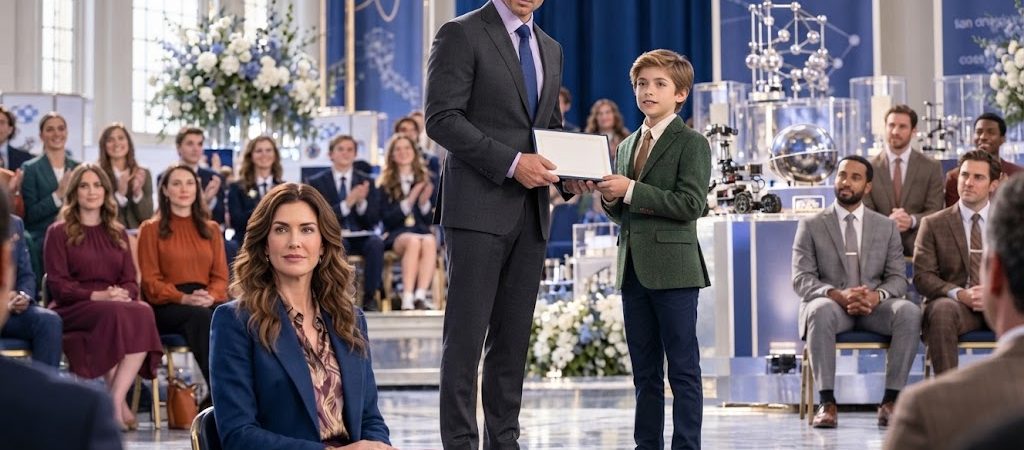
He had misunderstood what the medal meant.
It wasn’t proof that he had finally become his father.
It was proof that my son had grown into someone wonderful without him.
And that realization hurt more than any accusation I could have made.