PART 4 — THE FATHER WHO ARRIVED LATE
David did not ask for custody.
He did not threaten court.
He did not demand that Noah call him Dad.
Instead, he did something I never expected.
He asked Noah what he wanted.
The answer was simple.
“I want to know you.”
That was all.
So they started slowly.
A Saturday breakfast.
A science museum visit.
A trip to the library.
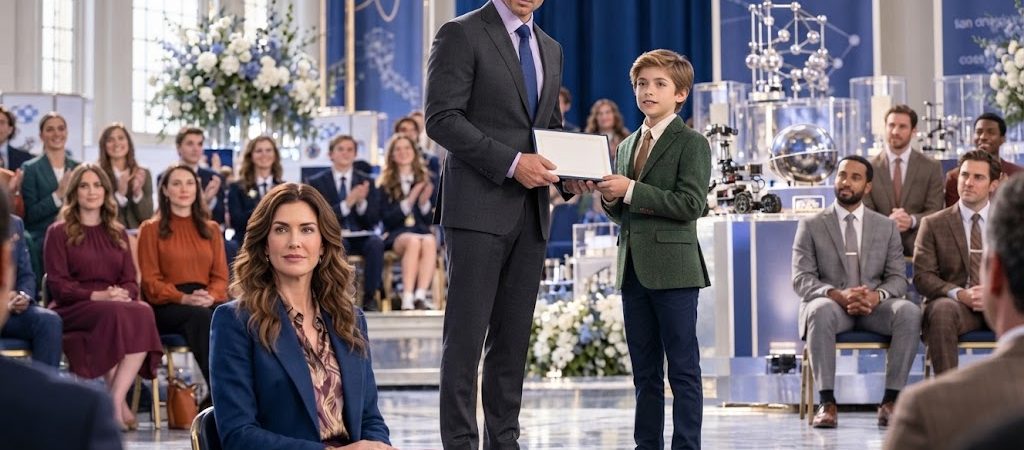
A robotics competition.
David began learning which cereal Noah liked, which books made him laugh, which homework assignments frustrated him, and why he insisted on sleeping with a flashlight beneath his pillow.
He learned that Noah hated tomatoes.
That he loved astronomy.
That he kept broken mechanical parts because “they might be useful later.”
That he became quiet when hurt and sarcastic when nervous.
One afternoon, David bought him an expensive telescope.
Noah stared at the box.
“It’s too much.”
David smiled.
“It’s not a payment.”
“What is it?”
“A present.”
Noah looked at me.
I nodded.
He accepted it.
But he added one condition.
“You have to help me build it.”
David laughed.
“I’d like that.”
Watching them together was complicated.
There were moments I wanted to smile.
There were others when resentment rose like a tide.
Once, I saw David teach Noah how to tighten a small metal screw.
His hand rested over Noah’s.
The gesture was ordinary.
Yet it hit me with a strange sadness.
He looked natural beside him.
As though these ten years had been an interruption rather than a missing lifetime.
I hated that thought.
Then I realized something.
The past did not need to become less painful just because the present was getting better.
I could allow Noah to love his father without erasing what David had done to me.
One evening, David asked to meet me alone.
“I want to apologize,” he said.
“You’ve apologized before.”
“Not properly.”
He looked at me for a long moment.
“I thought divorce was paperwork. I thought leaving was a single decision. I never understood that when I walked away, I was creating thousands of moments I could never get back.”
I said nothing.
“I don’t expect forgiveness.”
“That helps.”
He smiled faintly.
“I also don’t expect you to forget.”
“I won’t.”
“I know.”
He reached into his pocket.
It was my old envelope.
I had given it to him months earlier.
He handed it back.
“You keep it.”
I frowned.
“Why?”
“Because it belongs to the woman who raised my son.”
I looked at the envelope.
“I don’t need it anymore.”
“Maybe not.”
He stepped away.
“But you kept it for ten years for a reason.”
The next morning, Noah came downstairs holding his telescope catalog.
“Mom?”
“Yeah?”
“Can Dad come to my birthday?”
I froze.
It was the first time Noah had called David Dad.
I looked at my son.
“You want him there?”
Noah nodded.
“I think he’s late.”
I smiled.
“Yes.”
“He can still come.”
That birthday was the first one David attended.
He arrived early.
He helped decorate.
He burned the first batch of pancakes.
He laughed when Noah made fun of him.
At the end of the night, David gave Noah a small wooden box.
Inside was a photograph.
Not of David.
Not of me.
It was a photograph of all three of us at the science museum.
Noah looked at it.
“What’s this for?”
David smiled.
“So you know that family can start in complicated places.”
Noah looked at the photo.
Then he hugged him.
I turned away because tears had suddenly filled my eyes.
For years, I thought the greatest injustice was that David had missed his son’s childhood.
I was wrong.
The greatest danger was believing that because he had missed it, the future had to remain broken.
Some things could not be repaired.
But people could still choose what to build from the pieces.