Chapter 1: The Triangle Fold
My name is Karen Nelson, and I am twenty-eight years old.
The hospital room smelled like a bleak cocktail of industrial antiseptic, sour bleach, and the metallic tang of day-old coffee. Above my bed, a single fluorescent tube flickered behind a plastic grate, emitting a low, electric hum. It was the kind of noise you only really notice when the world has been stripped of every other sound. I had nothing else to listen to. I was utterly, profoundly alone.
My husband, Bennett, had been lowered into the freezing Carolina earth exactly seventy-two hours earlier.
I had spent those three days suspended in a surreal, agonizing purgatory, forced into doing the one thing no human being is ever trained to endure: grieving a catastrophic loss while simultaneously laboring to bring new life into the world. My traitorous body was violently pushing forward, expanding, contracting, fighting to deliver our child, while my mind and my heart remained stubbornly folded around a closed mahogany casket.
Bennett was an Army Staff Sergeant. He didn’t die on a battlefield halfway across the globe. He died in a routine training exercise, crushed in a vehicular rollover on a muddy proving ground a mere four hundred miles from where I now lay sweating into thin, starchy sheets.
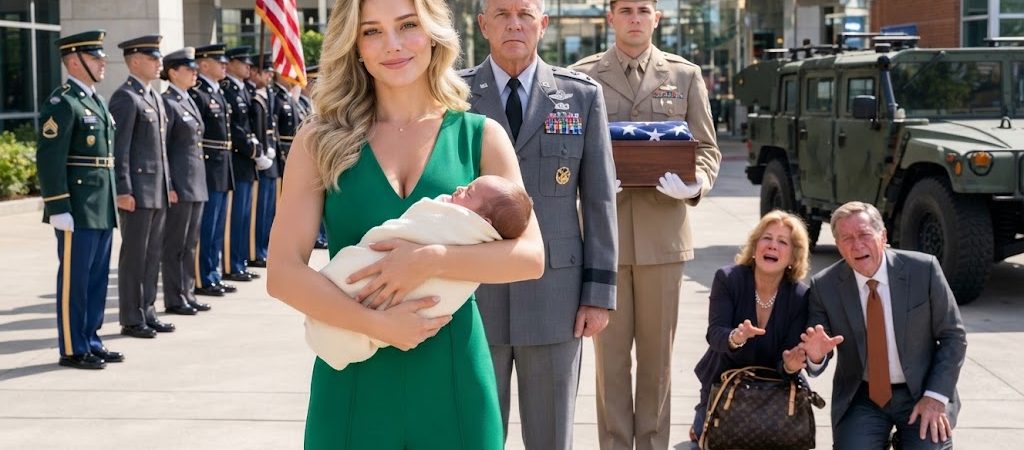
The heavy, woolen American flag they had pressed into my hands at the cemetery was currently sitting untouched, still locked in its crisp triangle fold, on the passenger seat of my beat-up Honda Civic in the parking garage five floors below. I hadn’t been able to look at it, let alone touch it, since the honor guard solemnly passed it to me. I kept telling myself I would deal with it later. But later was a horizon that kept receding.
I went into active labor the night after the funeral. I had no one to drive me. I called a cab, leaning heavily against the damp brick of my apartment building at two in the morning, because my own mother and father hadn’t bothered to stay after the service. Bennett’s family, who lived two states over, had made it abundantly clear during the solemn reception that they viewed my entire marriage, and my subsequent pregnancy, as a tragic lapse in their son’s judgment. They viewed me as an unfortunate administrative error.
I labored for eleven agonizing hours. The pain was blinding, a physical tearing that matched the emotional rupture in my chest. A night-shift nurse named Dolores, a woman with tired eyes and remarkably soft hands, stood by the rail and held my fingers. I had practically begged her to stay. I simply could not stomach the idea of screaming into the sterile void without a single human anchor.
My daughter was born at 4:12 in the morning, right as the sky turned the color of bruised iron.
I named her Ren. Bennett had told me once, lying in bed with his hands resting on my swelling stomach, that if we ever had a little girl, he wanted her named after something small and fierce. Something that could still fly, even in terrible weather.
For two days, it was just Ren and me suspended in that quiet, humming room. The world outside had ceased to spin. I held her tiny, fragile weight against my collarbone, memorizing the rhythm of her breathing. For forty-eight hours, wrapped in the protective cocoon of maternity ward monitors and postpartum exhaustion, I almost convinced myself that the two of us would be enough. We would survive this.
But then the morning of the third day broke. The heavy wooden door to my room clicked unlatched. I looked up, expecting the morning rotation nurse. Instead, a wave of cold dread washed over my chest. I want to say I felt a surge of relief when I saw my father’s face step into the frame. I want to say I felt the comforting embrace of family. But what I actually felt was a sudden, violent bracing. It was the involuntary tightening of muscles you experience right before a wave you already know is too massive crashes over your head.
My father, Walter, stood in the doorway. He was wearing his good wool overcoat—the charcoal one reserved strictly for Sunday service and burials. Behind his left shoulder hovered my mother, Diane. She had both hands clamped tightly around the leather strap of her designer purse, holding it against her sternum like a Kevlar shield.
Neither of them glanced at the plastic bassinet. Neither of them looked at Ren.
They looked directly at me.
“We grabbed your discharge paperwork from the front desk,” Walter said.
No hello. No how are you holding up, sweetheart? No let me see my granddaughter.
“I know,” I rasped, my throat still raw from the screaming two days prior. “They said I’m cleared by noon. I was actually hoping you could help me carry the bags down to the garage. I haven’t figured out how to install the car seat yet, and my stitches—”
Walter stepped fully into the room. He reached out and picked up my canvas duffel bag and the diaper bag sitting by the closet. He didn’t lift them gently. He hoisted them with a rigid stiffness, as if he were handling hazardous waste, and dropped them heavily at the foot of my bed.
“Take the baby and go,” he said, his voice completely devoid of inflection. “You’re not coming home.”