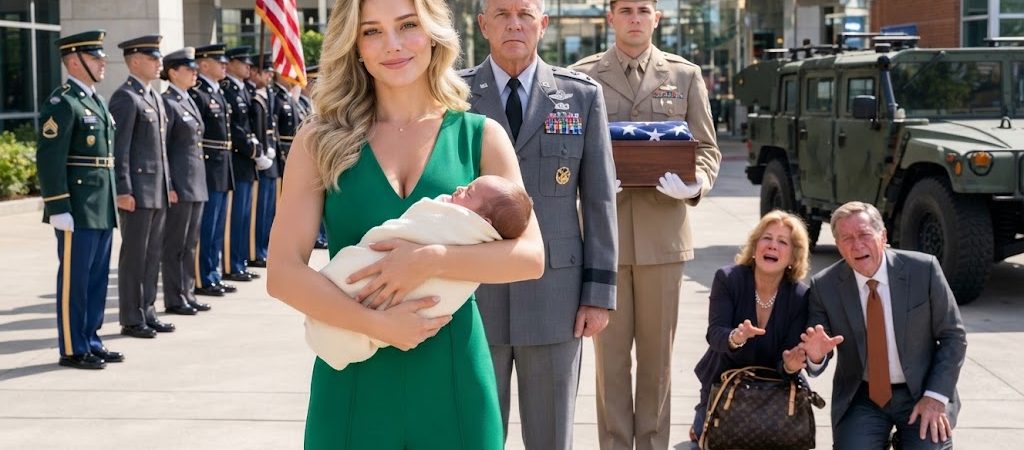
Chapter 3: The Fortress of Paperwork
Colonel Reeves did not raise his voice. Men of his caliber rarely need to. He possessed the innate, terrifying gravity of a man who had spent twenty-two years looking wide-eyed, terrified eighteen-year-olds in the face and telling them hard, unvarnished truths. He commanded the space simply by occupying it.
He ignored my father completely. He looked directly at me, his sharp eyes dropping to the tiny bundle resting against my heart. For a fraction of a second, the hardened lines around his mouth softened. A profound, shared grief flashed in his eyes before the steel shutters slammed back down.
“Mrs. Nelson,” he said, his baritone voice rumbling in the small room. “I sincerely apologize for the intrusion on a morning like this. But this situation could not wait.”
Walter finally located his missing spine. “Excuse me,” he barked, puffing up his chest beneath his Sunday coat. “Who exactly are you people, and why are you barging into my daughter’s private medical room?”
Reeves slowly turned his head. He didn’t angle his body; he just locked his eyes onto my father like radar acquiring a target.
“I am Colonel Marian Reeves. I had the privilege of serving with your son-in-law for nine years.” He paused, letting the silence stretch just long enough to make my father squirm. “And you, sir, are the reason I am here.”
Reeves looked back to me. “Sergeant Nelson came into my private office six weeks ago, Karen. He scheduled the appointment off the books. He wanted to officially update his DD Form 93—his record of emergency data. It’s the military paperwork that legally dictates who is authorized to make medical decisions, handle his remains, and access his federal survivor benefits in the event of a catastrophic casualty.”
My breath hitched. I hadn’t known any of this. Bennett had never breathed a word of it over dinner.
“He sat in the chair across from my desk,” the Colonel continued softly, “and he looked me dead in the eye. He told me that he did not trust his in-laws to look out for his wife, or his unborn child. He asked me, as a personal favor, to make damn sure that if the worst ever happened, someone from the unit was watching the perimeter. He wanted to ensure his family was taken care of, and not taken advantage of.”
A hot, stinging tear finally broke free and tracked down my cheek. I pictured Bennett—my strong, laughing Bennett—sitting in a sterile command office six weeks before his lungs stopped taking in air. I pictured him quietly, meticulously building a fortress of paperwork around me, brick by brick, because his instincts had already detected the predators circling his camp. He knew what my parents were capable of long before I was willing to admit it to myself.
“Well, that is just deeply touching,” my mother interjected. Her voice had lost its crisp, authoritarian edge. It was thinner now, trembling slightly at the edges. “Truly, it’s a lovely sentiment. But I fail to see what some paranoid paperwork has to do with us being here this morning. We are just leaving.”
“You aren’t leaving just yet, ma’am,” the taller of the two military police officers spoke up.
The MP stepped forward, unclipped a snap on his vest, and produced a thin, manila file folder. He flipped it open, scanning a printed log.
“Three days ago,” the MP stated, his voice ringing with the detached precision of law enforcement reading a rap sheet, “exactly six hours after Sergeant Nelson’s casualty notification was processed, our installation’s Casualty Assistance Center received a phone call. The caller identified himself as Walter Nelson.”
The temperature in the room plummeted. My blood turned to ice water.
“The caller,” the MP continued, “claimed to be the legally appointed representative for Mrs. Karen Nelson. He formally requested that the Department of Defense death gratuity payment—a sum of one hundred thousand dollars—be immediately redirected to a separate, external trust account, pending the quote, ‘resolution of a family guardianship matter.’“
The MP slowly looked up from the file, his eyes locking onto my father.
“Sergeant Nelson listed absolutely no legal representative on his DD-93. Mrs. Karen Nelson is the sole surviving spouse, and the sole beneficiary. Impersonating a beneficiary’s legal representative in an attempt to redirect federal military survivor benefits across state lines…” The MP closed the folder with a sharp thwack. “…is federal wire fraud.”