Chapter 5: The Vanguard
“You won’t have to manage a damn thing today,” Reeves continued, a small, sad smile finally breaking through his stoic expression. “My wife, Josephine, practically raised three kids single-handedly while I was deployed in Kandahar. She is sitting in the lobby downstairs right now. She has a rear-facing infant car seat already locked into her SUV, she has a tray of baked ziti in the passenger seat, and she is just waiting for me to give her the green light to come up here.”
He reached out and gently tapped the plastic edge of Ren’s bassinet.
“The United States Army takes care of its own, Mrs. Nelson. And as far as I’m concerned, that perimeter includes you and that little girl.”
Behind him, the military police officers gripped my parents by their elbows. They escorted them out of the room first. Walter was still pathetically stammering something about a massive misunderstanding, begging the officers to let him call his attorney.
Diane walked stiffly out the door. She stared straight ahead at the linoleum hallway. She refused to turn her head. She refused to meet my eyes.
And neither of them looked back at the baby.
As the heavy wooden door clicked shut behind them, I realized with a profound, settling peace that I didn’t care. I didn’t think either of them realized that as they walked out of that hospital room, it would be the very last time they would ever lay eyes on either of us.
I stayed one more night in the maternity ward, just for observation. But the room didn’t feel like a sensory deprivation tank anymore. It didn’t hum with isolation.
Josephine Reeves came upstairs ten minutes later. She was a warm, vibrant woman with a no-nonsense laugh and a grip like a vise. She pulled a plastic chair right up to my bed and sat with me for hours while Ren slept. She didn’t offer empty platitudes. Instead, she fed me pasta out of Tupperware and told me hilarious, embarrassing stories about Bennett that I had never heard—the kind of behind-the-scenes stories that only the tight-knit network of fellow soldiers’ families ever collect and trade.
By the time the sun rose the next morning and the doctor officially signed my discharge papers, I was no longer drifting in the void.
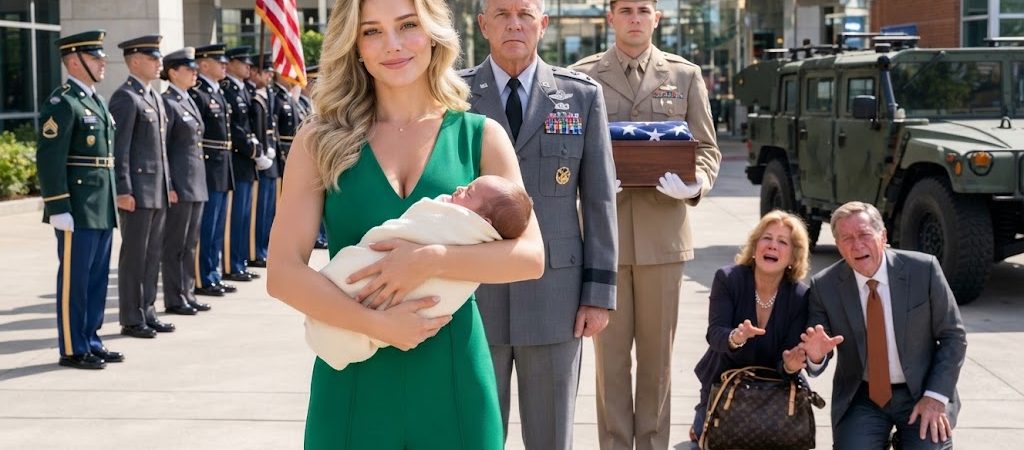
I had somewhere safe to go. I had a small army of spouses ready to help me carry my bags. And as Josephine wheeled me out to her SUV, I held the heavy, folded American flag tight against my chest, right beneath my sleeping daughter, instead of hiding it in the dark of a parking garage.
My parents attempted to call me twice in the weeks that followed, likely advised by a panicked defense attorney trying to mitigate their fraud charges.
I let both calls ring through to the void of voicemail.
I learned something vital in that sterile hospital room. Some doors in your life don’t need to be violently slammed, locked, and barricaded to keep the monsters out. Sometimes, they just need to never, ever be opened again. Blood is just an accident of biology. True family isn’t about shared DNA; it is about who actually stands in the doorway and holds the line when the sky finally falls.