PART 1 — SEAT 2A
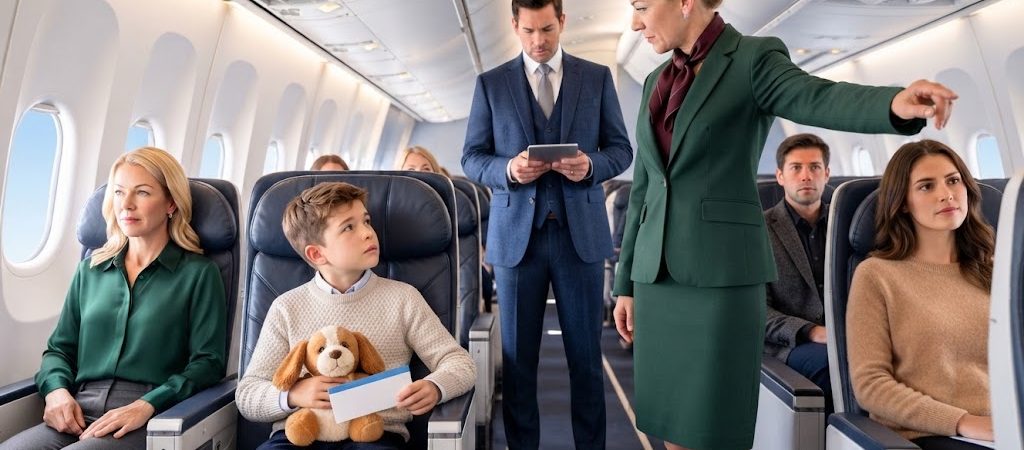
The first thing nine-year-old Noah Reed noticed about First Class was that nobody smiled.
He had expected velvet seats, warm cookies, and people speaking in low, friendly voices.
Instead, the cabin felt like a place where everyone had somewhere more important to be.
Noah stood in the aisle with a small navy-blue backpack over one shoulder and a plastic envelope hanging from his neck.
Inside the envelope were the documents his father had given him that morning.
Passport.
Boarding pass.
Unaccompanied-minor paperwork.
Emergency contacts.
And one handwritten note from his father that Noah had read three times before boarding.
Be calm. Be polite. Trust the paperwork. I’ll see you soon.
Seat 2A was next to the window.
Noah checked the number above the seat, then looked at his boarding pass again.
2A.
He sat down carefully.
His feet did not touch the floor.
He placed his backpack between his shoes and buckled his seat belt.
A few seconds later, a flight attendant stopped beside him.
She was in her early forties, perfectly dressed, with blond hair pulled into a tight bun and a name badge that read M. HARRIS.
She looked at Noah.
Then at his backpack.
Then at his boarding pass.
Her smile never appeared.
“Excuse me,” she said.
Noah looked up.
“Yes?”
“This is First Class.”
“I know.”
“You need to move.”
Noah blinked.
“I’m in 2A.”
“I can see that.”
She held out her hand.
“Give me your boarding pass.”
Noah hesitated.
His father had told him not to hand important documents to strangers unless they were airport employees and asked him directly.
She was an airport employee.
So he handed it over.
She examined it for barely two seconds.
“You’re supposed to be in the back.”
Noah frowned.
“My dad bought this seat.”
“I understand what you think happened.”
“I’m not thinking anything.”
The passenger across the aisle glanced over.
The attendant sighed.
“Listen, sweetheart. There are procedures. Children traveling alone don’t sit here.”
Noah calmly pointed at the plastic envelope against his chest.
“The airline gave me this.”
The attendant’s jaw tightened.
“You still need to move.”
Noah did not raise his voice.
“But the boarding pass says 2A.”
The attendant leaned closer.
“Do not make this difficult.”
For the first time, Noah felt afraid.
Not because she was loud.
Because she was not.
She spoke as if the decision had already been made.
A passenger in 2C finally intervened.
“He has the seat assignment,” the man said. “What seems to be the problem?”
The attendant turned.
“Sir, please stay out of it.”
Then another flight attendant approached.
Her name badge read JULIA.
“What’s going on?”
“Megan” lowered her voice.
“Unaccompanied minor in the wrong cabin.”
Julia looked at Noah.
“Can I see his paperwork?”
Noah handed her the envelope.
Julia opened it.
She checked the boarding pass.
Then the minor-assistance form.
Then the emergency contact page.
Her expression changed.
“Where is the special handling page?”
“It should be there.”
Julia flipped another sheet.
Stopped.
Read it again.
Her face went pale.
“What?”
Megan reached for the file.
Julia pulled it closer.
At the bottom of the page was a bold red notice.
PROTECTED MINOR — DO NOT ALTER SEAT ASSIGNMENT.
Underneath it was a handwritten instruction from the airline’s Family Assistance Desk.
Passenger Noah Reed must remain in 2A until delivery to authorized guardian.
Megan stared at the words.
“That can’t be right.”
Julia looked at the computer tablet.
“It is.”
“Who authorized it?”
Julia scrolled.
Then stopped again.
There was a name in the security notes.
One name.
A name both women knew.
ELIAS REED.
Noah’s father.
Megan’s face lost what little color it had left.
Julia looked toward the cockpit.
“Captain needs to know.”
“About what?”
Julia lowered her voice.
“The name.”
“What about it?”
“You remember last month?”
Megan did.
The internal security briefing.
The missing corporate documents.
The employee who had disappeared.
The police questions.
The sealed investigation.
And one sentence that had been repeated twice:
If Elias Reed’s name appears on any passenger-protection alert, contact flight operations immediately.
Julia was already moving.
She went into the galley and contacted the cockpit.
Noah watched her speak.
He couldn’t hear the words.
But he could see the captain’s face through the open cockpit door.
The captain looked down.
Then at the first officer.
Then at Julia.
The cockpit door closed.
Ten minutes later, the captain made an announcement.
“Ladies and gentlemen, due to an operational security matter, we will be making an unscheduled landing.”
A murmur moved through the cabin.
Noah gripped the armrest.
A woman behind him whispered:
“Are we in danger?”
No one answered.
The plane descended.
Noah stared through the window at the clouds.
His father’s note was still in his pocket.
Be calm. Be polite. Trust the paperwork. I’ll see you soon.
But his father had never mentioned a security alert.
And he had never mentioned why the sound of his own name seemed to frighten adults.
When the aircraft finally touched down, emergency vehicles surrounded the runway.
Passengers were told to remain seated.
Two officers boarded.
Then three more.
One walked directly toward Noah.
“Are you Noah Reed?”
Noah nodded.
“Yes.”
The officer looked at the name on the paperwork.
Then at the child.
“Your father is on his way.”
Noah swallowed.
“My dad?”
“Yes.”
The officer looked toward the rear of the plane.
“He asked us to keep you right where you are.”
Noah waited.
But the officer’s next words made his stomach tighten.
“He also asked us to make sure one specific person does not leave this aircraft.”
Noah slowly looked toward the front.
Flight attendant Megan Harris was standing perfectly still.
And for the first time since boarding,
she looked terrified.