PART 1 — THE WOMAN THEY THOUGHT WAS ALREADY DEFEATED
The courthouse doors were heavier than I remembered.
Maybe everything feels heavier when you walk into a place knowing that someone you once held in your arms is trying to take your life apart piece by piece.
My right hand tightened around the wooden cane.
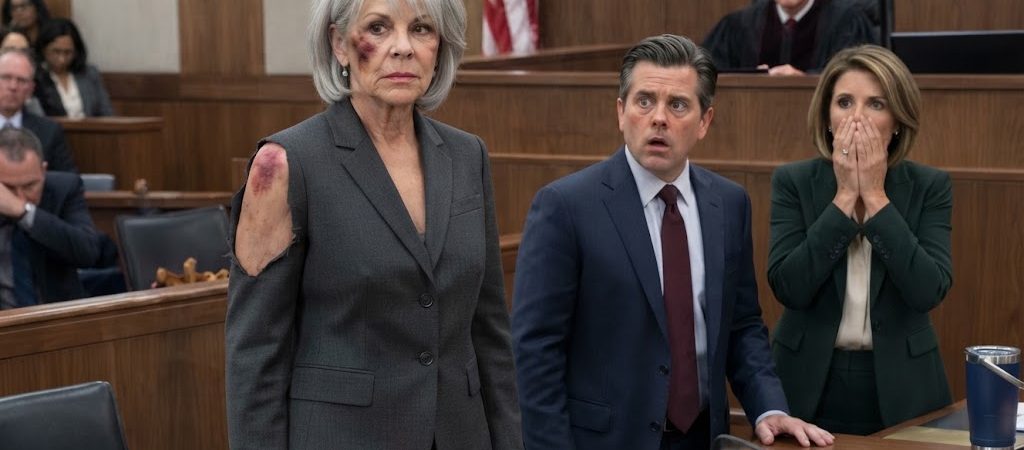
My left shoulder still throbbed beneath my cardigan, and every step sent a dull ache through my ribs. The bruises along my cheek had faded from purple to yellow, but I had left them uncovered on purpose.
I wanted the judge to see them.
More importantly, I wanted my son to see them.
Daniel was standing across the marble lobby beside his wife, Melissa.
He looked immaculate.
Navy suit.
Silver watch.
Perfectly tied blue tie.
Melissa wore a cream-colored dress beneath a tailored coat, her blond hair swept into a smooth bun. She was holding a leather folder against her chest, probably filled with everything they intended to say about me.
They looked like a successful couple attending an important business meeting.
I looked like an old woman who had survived a storm.
Daniel saw me first.
His mouth curled into a faint smile.
Melissa leaned toward him.
He whispered something into her ear.
She laughed quietly.
I didn’t have to hear the words.
I knew them.
For three months, they had spoken about me as though I were already gone.
Daniel believed he was going to inherit my house.
Melissa wanted my jewelry.
Their lawyer wanted control of my bank accounts.
And I?
According to them, I was a confused sixty-eight-year-old widow who had become “unsafe living alone.”
The official petition called it a request for temporary guardianship.
But I knew what it really meant.
They wanted me declared incapable of managing my own life.
And once that happened, my son would control everything.
My house.
My investments.
My retirement accounts.
My late husband’s life insurance.
Even the small charitable foundation I had created after his death.
Daniel had told the neighbors that I was “forgetting things.”
Melissa had told my doctor that I had “episodes of confusion.”
And three weeks earlier, they had told the police that I had fallen down my own staircase because I was “becoming unstable.”
Only one problem.
I hadn’t fallen.
Someone had pushed me.
And I knew exactly who.
I reached the elevator.
Daniel approached before the doors opened.
“Mom.”
His voice was warm.
Too warm.
“You really shouldn’t have come.”
I looked at him.
“Why?”
He sighed dramatically.
“Because this is going to be difficult for you.”
Melissa stepped closer.
“We’re trying to protect you.”
I glanced at her hand.
She was wearing the diamond bracelet I had given her five Christmases earlier.
The same bracelet she had called “too old-fashioned” at the time.
“Protect me from what?” I asked.
She smiled.
“From yourself.”
The elevator arrived.
The doors opened.
I stepped inside.
Daniel followed.
“Mom,” he said quietly, “please don’t make this ugly.”
I looked at his reflection in the mirrored wall.
“You already made it ugly.”
His smile disappeared.
Then the elevator doors closed.
The courtroom was packed.
Not with reporters.
Not with strangers.
With people from my life.
My old neighbor, Mrs. Collins.
The pastor from St. Andrew’s.
My husband’s former business partner.
Two women from the assisted-living center where I had volunteered for seventeen years.
And at the back sat someone Daniel hadn’t expected.
My attorney.
Margaret Avery.
She was seventy-two years old, shorter than me, with silver hair, sharp green eyes, and the patience of a steel trap.
I had hired Margaret six days after the staircase incident.
She had been my lawyer for almost twenty-five years.
Daniel had never met her.
That was deliberate.
The judge entered.
Everyone stood.
“Please be seated.”
Judge Samuel Whitmore was in his late fifties, calm and expressionless.
He reviewed the file in front of him.
Then he looked at me.
“Mrs. Hart?”
“Yes, Your Honor.”
“You’re here voluntarily?”
“Yes.”
“And you understand the nature of today’s hearing?”
“I understand that my son is asking the court to decide that I am no longer capable of managing my own affairs.”
Daniel shifted in his seat.
His lawyer, Robert Keene, stood.
“Your Honor, that’s an unfair characterization.”
The judge looked over his glasses.
“Then counsel may characterize it accurately when it is your turn.”
A few people in the gallery lowered their heads to hide smiles.
Daniel did not smile.
Robert cleared his throat.
“Mrs. Hart has demonstrated significant cognitive decline. She has become increasingly suspicious. She has accused family members of stealing from her. She has reportedly forgotten appointments and medications.”
Margaret stood.
“We object to hearsay.”
“Sustained.”
Robert continued.
“We have medical records documenting memory impairment.”
Margaret glanced at me.
I nodded.
She stood.
“Your Honor, the medical records will show that Mrs. Hart had one abnormal screening result during a period of severe dehydration and was subsequently cleared by a neurologist.”
Robert shook his head.
“That is not the entire story.”
“No,” Margaret replied. “It’s only the true part.”
The judge raised a hand.
“Enough.”
He turned to me.
“Mrs. Hart, I want to hear from you directly.”
I stood.
My knees trembled.
The cane pressed into the floor.
“Can you tell me why you believe you do not need a guardian?”
“Because I am not incapable.”
“How do you manage your finances?”
“I pay my own bills. I file my taxes. I maintain two investment accounts and a charitable trust.”
Robert interrupted.
“Your Honor, she claims to manage accounts, but we have evidence that her financial judgment has deteriorated.”
The judge nodded.
“That will be addressed.”
He looked back at me.
“Mrs. Hart, do you know what year it is?”
“2026.”
“Month?”
“October.”
“Date?”
“Fourth.”
He nodded.
“Do you know where you are?”
“The county courthouse.”
“And who is seated beside you?”
“My attorney, Margaret Avery.”
“And who is sitting at the table across from you?”
I looked at Daniel.
“My son.”
“His full name?”
“Daniel Michael Hart.”
Daniel’s jaw tightened.
“His wife’s name?”
“Melissa Grace Hart.”
The judge paused.
Then he looked down at the file.
“Mrs. Hart, do you remember the date your husband died?”
“May 18, 2017.”
Daniel shifted again.
“Do you remember the name of the first bank where you opened an account after his death?”
“First National.”
“And your previous occupation?”
“Before retirement?”
“Yes.”
I took a breath.
“I was a court-certified financial investigator.”
The courtroom went silent.
Robert looked at Daniel.
Daniel looked confused.
The judge lifted his eyes.
“You were?”
“Yes.”
“For how long?”
“Twenty-three years.”
The judge leaned back.
“That is not mentioned anywhere in the petition.”
Margaret smiled slightly.
“No, Your Honor.”
Robert stood.
“Mrs. Hart worked in a clerical financial position decades ago. I don’t believe—”
The judge interrupted him.
“I didn’t ask what you believed.”
Then he looked at me again.
“And Mrs. Hart…”
His expression changed.
Not dramatically.
Just enough for me to notice.
“Did you ever work on the Bellweather case?”
My fingers tightened around the cane.
I looked at Daniel.
He had gone completely still.
Melissa whispered something.
He shook his head.
“No.”
The judge repeated the question.
“Mrs. Hart, did you ever work on the Bellweather case?”
I slowly nodded.
“Yes, Your Honor.”
Daniel stared at me.
“I thought you said you were an accountant,” he whispered.
I looked at my son.
“I was.”
Then I added quietly:
“I was also the person who helped put six men in prison.”
The courtroom seemed to lose all its air.
And for the first time that morning, Daniel looked afraid.
The Bellweather case had happened thirty-one years earlier.
It was the reason my name had been sealed in several court documents.
It was the reason Daniel had grown up believing his mother had merely been a bookkeeper.
And it was the reason I had never told him exactly where the money for our family home had come from.
I had promised myself I would only tell him if he truly needed to know.
I never imagined the day would come when I would have to reveal it in front of a judge.
But Daniel had made his choice.
And now I would make mine.
The judge closed the file.
“Mrs. Hart, I’m going to recess for thirty minutes.”
Robert looked startled.
“Your Honor—”
“I said recess.”
He turned to his clerk.
“And I want the sealed Bellweather records brought to chambers.”
Then he looked directly at me.
“Mrs. Hart, don’t leave the courthouse.”
I nodded.
Daniel stared at me.
“What did you do back then?”
I met his eyes.
“I survived.”