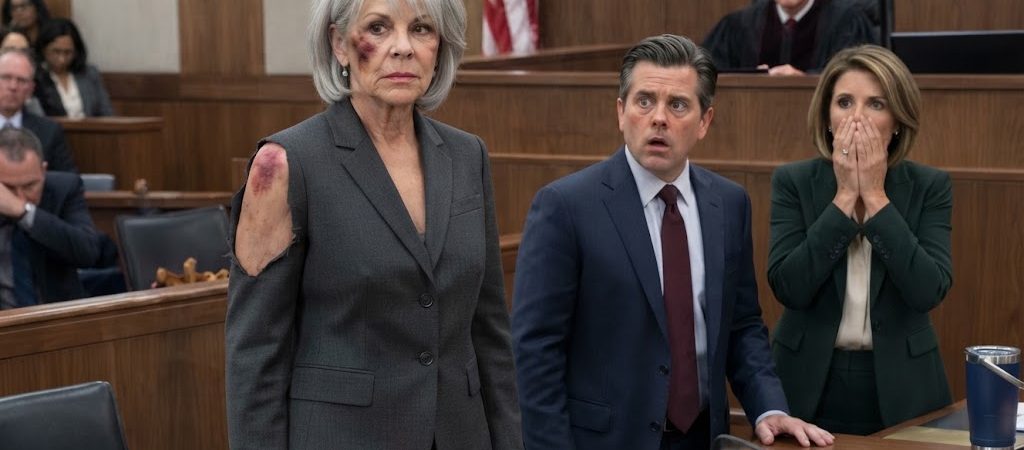
PART 4 — WHAT HAPPENED AFTER THE COURTROOM DOORS CLOSED
The investigation lasted four months.
I learned that while Daniel and Melissa had been planning my guardianship, they had also been building a financial trap around me.
Melissa’s brother had significant gambling debts.
Daniel had guaranteed several loans.
They had been counting on my house.
The plan was simple.
Declare me incapable.
Have Daniel appointed guardian.
Move my investments into accounts controlled by a professional management company.
Sell my house.
Pay off their debts.
And keep the remainder.
They had created medical appointments I never requested.
They had selectively photographed my paperwork to make it appear disorganized.
They had even asked a neighbor to record me forgetting the day of the week.
The day they failed to mention was that the neighbor’s recording began after Melissa had spent twelve minutes confusing me on purpose.
Every piece of the puzzle eventually came together.
But one discovery stunned me.
The police found a hidden folder in Melissa’s office.
Inside was a photocopy of my original trust.
And written across the top in red ink were five words:
BREAK THE TRUST BEFORE SHE DIES.
I stared at the photograph for a long time.
Margaret put her hand on my shoulder.
“You don’t have to carry this alone.”
“I already carried it for thirty years.”
“You shouldn’t have had to.”
She was right.
Daniel eventually admitted almost everything.
Not everything Melissa had done.
Not everything I suspected.
But enough.
He confessed that he had participated in the first attempt to transfer money from one of my accounts.
He confessed that he had lied to doctors.
He confessed that he knew about the guardianship strategy.
And he confessed that he had been on the staircase that night.
“I shoved you,” he said during his statement.
I sat across from him.
We were separated by a thick glass partition.
“I know.”
He cried.
“I didn’t think you’d hit the stairs that hard.”
That sentence hurt more than the bruises.
“I didn’t think you’d become someone who could say that.”
He looked at the floor.
“I’m sorry.”
I waited.
Then I said:
“Sorry doesn’t erase what you did.”
“I know.”
“But it can be the beginning of what you do next.”
He looked up.
“Do I still have a mother?”
I felt tears burn my eyes.
“That depends on whether you’re willing to become a son again.”
He nodded.
Melissa was different.
She never apologized.
She claimed everything had been my fault.
She said I had “manipulated” Daniel.
She said I had “brainwashed” him.
She insisted the trust was unfair.
Her lawyer fought every allegation.
But the evidence was too strong.
The financial records were clear.
The email to the realtor was clear.
The recording was clear.
And the trust was legally valid.
Within months, the criminal case against her and her brother moved forward.
Daniel received a plea agreement that included restitution and probation.
He lost his business.
He lost the comfortable life he had built.
But he did not go to prison.
And perhaps that was the hardest sentence of all.
He had to live with what he had done.
Meanwhile, I moved.
Not because I was afraid.
Because I wanted a new beginning.
I sold the house.
The house where Peter had lied.
The staircase where Daniel had pushed me.
The kitchen where Christmas dinners had turned into conversations about inheritance.
I sold everything.
Except one thing.
The small wooden height chart nailed to the kitchen wall.
It showed Daniel at six.
Eight.
Ten.
Twelve.
Sixteen.
Each line had his name beside it in my handwriting.
I took it with me.
My new home was smaller.
One floor.
No staircase.
Bright windows.
A tiny garden.
I hired a gardener.
Bought a new sofa.
Painted the kitchen yellow.
And for the first time since my husband died, I slept through the night.
Three months after the hearing, I received a letter.
No return address.
I almost threw it away.
Then I saw the handwriting.
Daniel.
I opened it.
There were only two pages.
The first page was an apology.
The second was a list.
Not of money.
Not of property.
Not of things he wanted.
It was a list titled:
Things I Need to Fix.
He had written:
I need to repay the money.
I need to tell my children the truth without blaming you.
I need to stop thinking of your house as mine.
I need to understand that being your son is not the same as owning your life.
The final line said:
I don’t expect forgiveness. I hope one day I deserve a conversation.
I put the letter down.
I didn’t answer immediately.
Instead, I went into my garden.
I sat in the sunshine.
And I remembered the first time Daniel had called me “Mom.”
He had been three.
He had fallen while learning to ride a bicycle.
He’d scraped his knee.
He ran to me crying.
I held him.
He buried his face in my shoulder.
“Mommy fixes.”
He used to say that whenever he was hurt.
Mommy fixes.
For thirty years, I had believed that meant my job was to fix everything for him.
The courthouse taught me something different.
A mother can love her child without rescuing him from the consequences of his choices.
So I wrote back.