PART 5 — THE LAST SECRET I KEPT FOR MYSELF
A year after the hearing, Daniel came to my house.
Alone.
He stood outside my gate for almost five minutes before knocking.
He looked older.
Thinner.
Not weak.
Just humbled.
I opened the door.
He held something behind his back.
“What is that?” I asked.
He brought it forward.
The wooden height chart.
The one I had left at my old house before the sale.
I stared at it.
“I thought you’d thrown it away,” I said.
“I went back.”
He swallowed.
“The buyer let me take it.”
I touched the old marks.
“Why?”
He shrugged.
“Because I remembered what you once taught me.”
“What?”
He looked at me.
“Some things are worth more than money.”
I didn’t answer.
He stepped back.
“I brought it because I thought you should have it.”
I took it.
For a moment, neither of us spoke.
Then he said:
“Mom, can I come inside?”
I looked at him.
And I moved aside.
We sat at the kitchen table.
The same kind of table where I had helped him with homework when he was seven.
He looked around.
“I like this place.”
“So do I.”
“It’s peaceful.”
“It is.”
He took a breath.
“Melissa and I are getting divorced.”
I nodded.
“I heard.”
“I haven’t spoken to her in months.”
I didn’t ask why.
“Your grandchildren?”
“They’re okay.”
“Do they know what happened?”
“Enough.”
“Do they hate me?”
His eyes lowered.
“They’re disappointed.”
He nodded.
“That’s fair.”
We sat silently.
Then he asked the question I had known was coming.
“Why didn’t you tell me about the Bellweather case?”
I looked toward the window.
“Because you were six.”
“I was older later.”
“I know.”
“So why not then?”
“Because every time I looked at you, I saw the child I had promised to protect.”
He frowned.
“From what?”
“From becoming afraid.”
“Afraid of what?”
I smiled sadly.
“Of losing everything.”
He looked down.
“You were afraid I’d become like Dad.”
“I was afraid the world would teach you that money was the measure of whether you mattered.”
He nodded slowly.
“I guess I learned it anyway.”
“Yes.”
The honesty hurt.
But it was necessary.
He looked at the cane beside my chair.
“Does your leg still hurt?”
“Sometimes.”
He looked ashamed.
“Every time you see that cane…”
“I remember.”
“I’m sorry.”
“I know.”
He reached across the table.
Then stopped before touching my hand.
I made the decision for him.
I placed my hand over his.
He started crying.
Not the loud kind.
The quiet kind.
The kind that comes when a person finally understands how much they almost destroyed.
“I don’t want your money,” he said.
I smiled.
“That’s the first thing you’ve said that made me believe you.”
He laughed through his tears.
“Can I still be your son?”
I squeezed his hand.
“You never stopped being my son.”
He looked relieved.
“That doesn’t mean I trust you.”
“I know.”
“It doesn’t mean the trust gets restored.”
“I know.”
“It doesn’t mean I forget.”
“I know.”
I took a breath.
“But it means there is a road back.”
He nodded.
“I’ll walk it.”
Six months later, I received another letter from the courthouse.
It was a copy of the final ruling in my civil matter.
The judge had formally recognized that I had retained full capacity throughout the guardianship dispute.
The fraudulent transfers had been reversed.
The property sale attempt had been dismissed.
My trust remained intact.
And the assets I had intended for charity were now being redirected into a foundation for elderly people who were being financially abused by relatives.
I named it the Eleanor Hart Independence Fund.
Margaret laughed when she saw the name.
“You never wanted your name on anything.”
“I changed my mind.”
“Why?”
“Because people should know the truth.”
The foundation helped elderly victims find attorneys, secure emergency housing, and protect their savings from predatory relatives.
The first person we helped was an eighty-one-year-old woman whose nephew had tried to take her house.
When she thanked me, I held her hand.
“You don’t have to thank me.”
“But why did you help me?”
I thought about the courthouse.
My cane.
The bruises.
Daniel’s whisper.
The judge opening that sealed file.
And the secret I had buried for decades.
“Because someone helped me once.”
A few months later, Judge Whitmore retired.
At his retirement gathering, I received an invitation.
I almost didn’t go.
But I did.
When the room quieted, he approached me.
“Mrs. Hart.”
“Judge.”
He smiled.
“I’ve always wondered whether you knew what I recognized that morning.”
“I suspected.”
He laughed.
“You looked completely different thirty years ago.”
“So did you.”
“Fair enough.”
He looked thoughtful.
“Do you know what struck me most?”
“What?”
“You walked into that courtroom bent over a cane, covered in bruises.”
I nodded.
“You looked like the weaker person in the room.”
“I was in pain.”
“I know.”
He smiled.
“But you were never helpless.”
I looked down.
“No.”
“You know what finally convinced me?”
I raised an eyebrow.
“The way you answered every question.”
He chuckled.
“Not one hesitation.”
I laughed.
“I had spent twenty-three years investigating people who lied for a living.”
“And your son?”
“He wasn’t very good at it.”
The judge smiled.
Then he became serious.
“You saved a lot of people thirty years ago.”
“I tried.”
“And you saved yourself that day.”
I thought about that.
Then I smiled.
“Yes.”
Years later, Daniel brought his children to my house.
The older one had a basketball tucked under his arm.
The younger one carried a drawing she’d made for me.
“Grandma!”
They ran through the garden.
Daniel stood at the gate, watching.
I noticed something.
He didn’t look at the house.
He didn’t look at the garden.
He didn’t look at my car.
He looked at me.
That was enough.
I called him inside.
At dinner, his daughter asked:
“Grandma, is it true you worked on a giant court case?”
Daniel froze.
I looked at him.
He smiled.
“She did.”
“Was it scary?”
“Very.”
“Did you win?”
I thought for a second.
“We survived.”
The little girl frowned.
“That’s not the same as winning.”
I laughed.
“Maybe you’re right.”
She reached across the table.
“Then did you win too?”
I looked at Daniel.
Then at my grandchildren.
Then at the wooden height chart hanging on my kitchen wall.
Every mark was still there.
Every year.
Every memory.
Every mistake.
Everything I had fought to protect.
“Yes,” I said.
“I won the day I stopped letting people decide what my life was worth.”
Daniel looked down.
His eyes were wet.
No one said anything.
We didn’t need to.
Because some victories do not arrive with applause.
They arrive quietly.
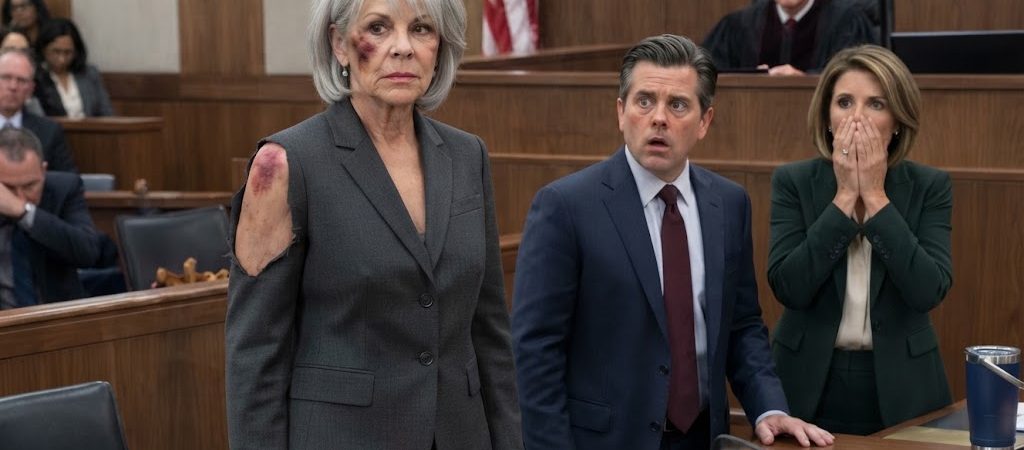
They look like walking into court with a cane when everyone expects you to crawl.
They look like refusing to sign away your dignity.
They look like telling the truth after decades of silence.
And sometimes…
They look like giving someone a second chance without giving them the power to hurt you again.
That was the secret my son had forgotten.
He thought my greatest asset was the money.
He thought the house was my power.
He thought the trust was the thing protecting me.
He was wrong.
The greatest thing I had ever owned was the courage to start over.
The trust protected my money.
My past protected my evidence.
The court protected my rights.
But I protected myself.
And when my son finally understood that, the inheritance he had spent years chasing became the least important thing I could ever give him.
I gave him the truth.
And then, carefully, slowly, I gave him the chance to become worthy of being my son again.
The cane stayed by my chair.
The bruises faded.
The house became a home.
And the secret from my past?
It stopped being a secret.
It became proof that sometimes the person everyone underestimates is the only person in the room who remembered everything.