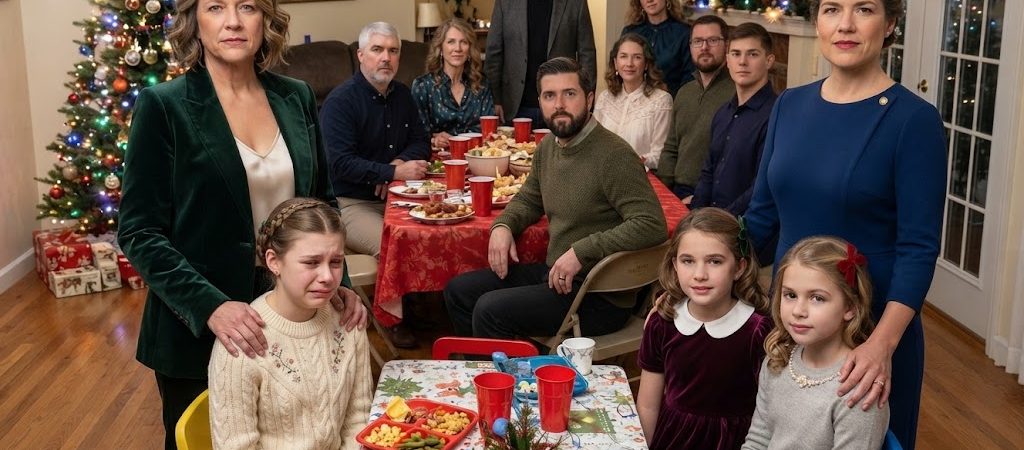
PART 1 — THE CHRISTMAS TABLE
The first thing my daughter noticed about Christmas dinner was the silverware.
Not the roast.
Not the towering Christmas tree in the corner.
Not the cinnamon candles burning in red glass holders.
The silverware.
“They’re real silver, aren’t they, Mom?” eleven-year-old Emma whispered beside me.
I smiled.
“They’re plated silver, sweetheart.”
She nodded as if I had told her something important.
My daughter had always been like that. She noticed little things. The pattern on a napkin. The shape of a cloud. The way someone’s voice changed when they were pretending to be happy.
That evening, she was wearing a simple dark-green dress I had bought for twenty-two dollars.
It had belonged to a small boutique that was closing down.
Emma loved it.
She had twirled in front of the mirror for fifteen minutes before we left our apartment.
“I look like a Christmas princess,” she had said.
And to me, she did.
We arrived at my younger sister Claire’s house at six in the evening.
Claire had lived there for five years.
Five years.
Long enough to repaint the walls, replace the kitchen cabinets, plant rose bushes along the driveway, and tell everyone in the family that it was “our family home.”
She had always said those words with such confidence that people eventually stopped questioning them.
I never corrected her.
Not because I agreed.
Because I had a reason for keeping quiet.
Five years earlier, after our mother passed away, Claire had needed somewhere to live. She had recently divorced, had two young boys, and was struggling financially.
I had offered her the house.
Not sold it.
Not transferred it.
Not gifted it.
I had simply told her she could live there.
“Until you get back on your feet,” I said.
Claire cried.
She hugged me.
“You’re the best sister in the world.”
I believed her.
For a while.
The house was legally mine because I had bought it three years before our mother died. Our mother had known about the arrangement, and after her death, Claire assumed the house had somehow become part of the family inheritance.
I never corrected that assumption.
I paid the property taxes.
I paid the homeowners insurance.
I maintained the mortgage.
Claire paid the utilities and groceries.
That was the arrangement.
Quiet.
Simple.
Until that Christmas Eve.
The dining room was crowded with relatives.
Aunts.
Uncles.
Cousins.
Neighbors.
Claire’s husband’s parents.
Her friends from church.
There were twenty-two people around the table.
Emma sat quietly beside me.
At first, everything seemed normal.
Then Claire’s mother-in-law, Patricia, looked at Emma’s dress.
“Oh,” she said.
Emma stopped cutting her bread.
Patricia smiled.
“What a sweet little dress.”
“Thank you,” Emma said.
“How much did it cost?”
I looked up.
“Patricia.”
She laughed.
“Oh, don’t be so sensitive. I’m just asking.”
Claire laughed too.
That was the moment I should have understood what kind of night it was going to be.
“I got it on sale,” Emma answered.
“On sale?”
Patricia raised an eyebrow.
“Yes.”
Claire’s eldest son, Ryan, snorted.
“Mom, don’t you remember? Emma’s mom likes cheap stuff.”
A few people laughed.
Emma’s face turned pink.
I put my fork down.
“That’s enough.”
Claire waved her hand.
“Oh, come on. They’re just teasing.”
“She’s eleven.”
Claire shrugged.
“And she’s old enough to learn how to take a joke.”
My daughter looked down at her plate.
I reached under the table and held her hand.
She squeezed my fingers.
Then came the gifts.
Claire had arranged them under the tree.
Emma had made a homemade card for every person in the room.
She had spent three evenings drawing little pictures on them.
She handed Claire hers first.
Claire opened it.
Inside was a drawing of the house.
The same house where we were sitting.
In front of it, Emma had drawn Claire, her sons, me, and herself.
At the top she had written:
Merry Christmas. Thank you for always making room for us. Love, Emma.
Claire looked at it.
Then she laughed.
“Aww. That’s cute.”
She held it up.
“Everyone, look! Emma drew the house.”
Everyone leaned forward.
Ryan laughed.
“You even drew the fancy porch!”
Emma smiled nervously.
“Yes.”
Patricia looked at the picture.
“How sweet.”
Then she looked at Emma.
“Too bad a drawing doesn’t pay for the electricity.”
Silence.
A few people chuckled.
Emma’s smile disappeared.
I stared at Patricia.
“What exactly is that supposed to mean?”
Before she could answer, Claire spoke.
“She means you’re still living off your family.”
I turned toward my sister.
Claire was smiling.
“What?”
She took a sip of wine.
“I’m just saying, Emma should understand that not everybody gets everything handed to them.”
My daughter’s eyes filled with tears.
She had heard enough.
But the adults hadn’t.
One of Claire’s friends leaned across the table.
“Honestly, Claire, you’re too generous. If I had someone staying in my house, I’d expect them to contribute.”
I looked at her.
“Emma and I don’t live here.”
She blinked.
“Oh. I thought you did.”
Claire laughed.
“Please. Let her have her fantasy.”
That was when I understood.
This wasn’t teasing.
This had been planned.
My sister had invited twenty-two people to dinner and turned my eleven-year-old daughter into the evening’s entertainment.
She looked toward Emma.
“Why are you crying?”
Emma quickly wiped her cheek.
“I’m not.”
Claire smiled.
“Sweetheart, if you want expensive Christmas gifts, maybe you should ask your mother for a richer life.”
The room went quiet.
My daughter stared at her plate.
Something inside me went completely still.
I didn’t shout.
I didn’t argue.
I didn’t threaten anyone.
I simply stood.
Claire looked up.
“Where are you going?”
I picked up Emma’s coat.
“Home.”
She smiled smugly.
“Fine.”
I helped Emma into her coat.
My daughter whispered, “I’m sorry.”
I bent down.
“You have nothing to apologize for.”
We walked through the dining room.
Past the Christmas tree.
Past the fireplace.
Past the framed family photographs.
At the door, I stopped.
I looked back once.
Claire was still sitting at the head of the table.
She had no idea that the deed to the house was in my safe.
She had no idea that the property taxes were paid from my account.
She had no idea that her five years of calling it “her home” had never made it hers.
And she certainly had no idea that the woman she had just humiliated in front of the entire family owned the roof over her head.
I closed the door quietly.
No dramatic speech.
No slammed door.
Just silence.
Because I had finally decided that silence wasn’t weakness.
It was patience.
And I was done being patient.