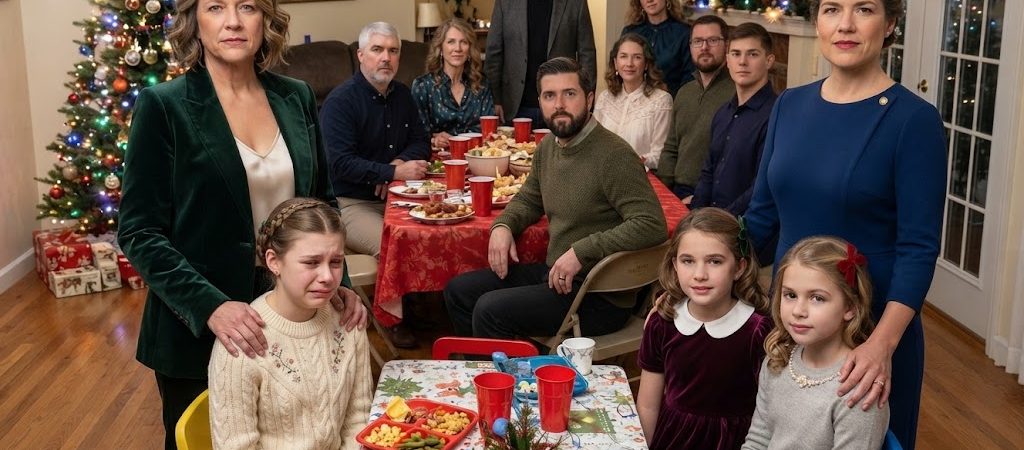
PART 2 — WHAT MY DAUGHTER DIDN’T KNOW
The drive home was quiet.
Emma stared out the window.
Snowflakes drifted through the headlights.
After ten minutes, she asked, “Mom?”
“Yes?”
“Do you think I’m embarrassing?”
My heart cracked.
I pulled the car to the side of the road.
I turned toward her.
“Look at me.”
She did.
“You are not embarrassing.”
“But Aunt Claire said—”
“Aunt Claire was wrong.”
“What about the dress?”
I smiled.
“I love that dress.”
“You really do?”
“I really do.”
She wiped her eyes.
“Then why did everyone laugh?”
I didn’t answer immediately.
Because the honest answer was ugly.
People laughed because they were allowed to.
My sister had created a room where cruelty was disguised as humor.
And everyone wanted to belong badly enough to join in.
I took Emma’s hand.
“You know what?”
“What?”
“Sometimes people are cruel because they think there won’t be consequences.”
Emma stared at me.
“Are there going to be consequences?”
I smiled gently.
“Yes.”
“But you’re not going to yell at Aunt Claire?”
“No.”
“Why?”
“Because I’m not interested in giving her a story where she’s the victim.”
Emma nodded slowly.
We continued driving.
When we arrived home, she changed into pajamas and went straight to bed.
I sat alone in my kitchen.
At eleven forty-five, my phone rang.
Claire.
I almost didn’t answer.
I did.
“You really left?”
Her voice sounded more offended than surprised.
“Yes.”
“You embarrassed me.”
I actually laughed.
“Claire, I didn’t say a word.”
“That was worse!”
“How?”
“Everyone noticed.”
“They noticed what?”
“That you were angry.”
“I was.”
“You made the whole evening uncomfortable.”
I stared at the Christmas tree in our living room.
“Claire, you let twenty-two people make fun of my daughter.”
“They were joking!”
“She cried.”
“She’ll get over it.”
I closed my eyes.
There it was.
The sentence that ended whatever remained between us.
“She’ll get over it.”
Claire continued.
“You’re always making everything dramatic. You know Emma needs thicker skin.”
“She needs adults who protect her.”
“She needs to stop being so sensitive.”
“No,” I said quietly. “She needs to stop being taught that cruelty is normal.”
Claire sighed.
“Are you coming tomorrow morning?”
“No.”
“What?”
“I don’t think we’ll be joining the family brunch.”
“It’s Christmas.”
“I know.”
“You’re really going to ruin Christmas over one little joke?”
I looked toward the hallway where my daughter slept.
“You ruined it.”
I hung up.
Then I opened my laptop.
Five years.
Five years of letting Claire live in that house.
Five years of listening to relatives call it hers.
Five years of paying the mortgage quietly.
Five years of being told I was “lucky” because I had a successful career and didn’t need the property.
I opened the folder marked Property — Willow Creek House.
Inside was the original purchase agreement.
The deed.
The insurance records.
The tax statements.
And a signed occupancy agreement.
Claire had signed it five years earlier.
I read the final paragraph again.
Occupancy is granted by permission of the owner. No ownership interest is created by residence, renovation, contribution to household expenses, or length of occupancy.
Claire had signed every page.
She probably hadn’t read it.
She’d been crying that day.
She’d been grateful.
She’d promised she would get stable.
Then stability became entitlement.
Entitlement became arrogance.
And arrogance became cruelty.
I called my attorney, Daniel, the next morning.
He answered on the second ring.
“Merry Christmas.”
“Not anymore.”
He laughed softly.
“What happened?”
I told him everything.
When I finished, he was silent.
Then he asked, “Do you want her out?”
I looked at the Christmas card Emma had made for Claire.
“No.”
Daniel sounded surprised.
“Then what do you want?”
“I want her to understand exactly what she did.”
He paused.
“That’s not a legal remedy.”
“I know.”
“So what is?”
I looked through the window at the snow-covered street.
“Give me until tomorrow.”
“What are you thinking?”
“I’m thinking she should receive the truth in writing.”
Daniel understood immediately.
“Do you want me to prepare the ownership file?”
“Yes.”
“And the occupancy agreement?”
“Yes.”
“And a formal notice?”
I hesitated.
“Yes.”
“For what date?”
“Thirty days.”
Daniel was silent for a moment.
“You’re giving her thirty days?”
“I don’t want her children displaced because their mother behaved badly.”
“That sounds like you.”
“I don’t know if that’s a compliment anymore.”
“It is.”
After we hung up, I sat at the kitchen table for a long time.
I realized something.
The house had never been the real secret.
The real secret was why I had never told Claire she didn’t own it.
Five years earlier, our mother had made me promise something.
I had been at her bedside during her final week.
Claire had been fighting with everyone.
She believed nobody understood her.
Mom had squeezed my hand.
“Don’t let Claire lose the house.”
“I won’t.”
“She needs time.”
“I know.”
“She’ll grow up.”
I had believed that.
I had confused giving someone time with giving them permission to hurt others.
I had protected my sister so long that I had forgotten who else I was supposed to protect.
My daughter.
That was the line I would not cross again.
On December twenty-sixth, Daniel sent the first letter.
It wasn’t dramatic.
It didn’t insult Claire.
It simply stated the facts.
The property located at 184 Willow Creek Lane is legally owned by me. Your occupancy has always been by permission under the attached agreement. That permission is hereby terminated, effective thirty days from the date of this notice.
Below that was a copy of the deed.
My name was highlighted.
Claire’s name wasn’t anywhere.
Then he attached the agreement.
Claire’s signature appeared on page five.
I sent it.
And waited.
The phone rang three minutes later.
Claire.
I didn’t answer.
Then came a message.
What is this?
Another.
Call me immediately.
Then another.
You don’t own that house.
I stared at the screen.
I typed four words.
Read the deed, Claire.
Then I turned off my phone.