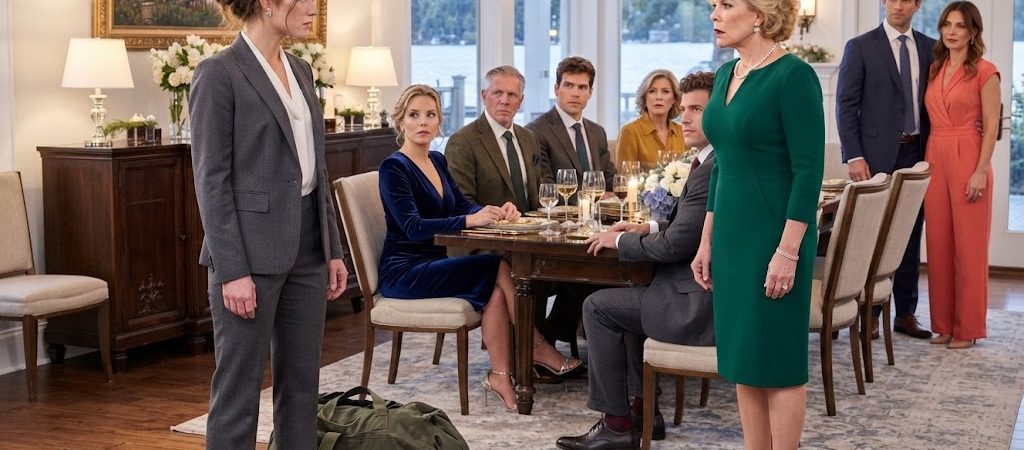
PART 1 — THE DAUGHTER THEY KEPT OUT OF THE PHOTOS
The first thing my mother said when she saw me standing at the dock was not hello.
She looked at my plain navy dress, my old leather shoes, and the canvas bag hanging from my shoulder, then glanced toward the enormous lake house behind her.
“You actually came.”
I smiled carefully.
“You invited me.”
My mother folded her arms.
“Yes, but I didn’t think you’d take it literally.”
Behind her, the $17 million house rose above Lake Geneva like something from a luxury magazine. Three stories of limestone and glass. A private boathouse. A long cedar deck reaching almost to the water. Ten bedrooms, a heated pool, a wine cellar, and enough land around it to make the property feel like a private kingdom.
I had seen photographs of it before.
I had never been invited inside.
Not until that weekend.
My mother turned toward the house.
“Well, since you’re here, try not to make things uncomfortable.”
I almost laughed.
I had spent twenty-four years learning how not to make things uncomfortable for the people who had adopted me.
My name is Clara Bennett.
At least, that was the name on my birth certificate after the adoption.
I had been six years old when Richard and Elaine Bennett took me into their family.
They already had one biological child, their son Julian, who was eight years older than me.
They liked to call our family “a perfect blend.”
That phrase appeared in newspapers when my adoptive father founded Bennett Ridge Capital.
It appeared in charity brochures.
It appeared under photographs of the family at galas.
But in the house itself, I learned quickly that there was a difference between being included and being displayed.
Julian was their son.
I was their adopted daughter.
He received the best schools, summer internships, cars, trust-fund distributions, and eventually a position at the family investment company.
I received an allowance and constant reminders to be grateful.
When I wanted to study architecture, my father said it was impractical.
When I received a scholarship to a prestigious university, my mother told relatives that “Clara is finally learning to stand on her own.”
When I graduated near the top of my class, no one from my family attended.
They were in Monaco for Julian’s engagement party.
Still, I never hated them.
That was the strange thing.
I kept hoping that eventually they would see me as their daughter without the adjective.
Adopted.
That word followed me like a shadow.
“Are you planning to stand there all afternoon?”
My mother snapped me back to reality.
I followed her toward the house.
As soon as the front doors opened, I could hear laughter.
A dozen expensive voices floated through the foyer.
My mother leaned toward me.
“Tonight is important.”
“I can tell.”
“We have guests from New York, Chicago, London—people who matter.”
She lowered her voice.
“So please don’t talk about money.”
I blinked.
“I wasn’t going to.”
“Good.”
She looked at my bag.
“And don’t mention your work.”
“My work?”
“Yes. The little freelance restoration projects.”
I tightened my fingers around the strap.
“I work as an architectural conservator.”
“I know what you call it.”
She smiled as if she had done me a favor.
“To everyone else, you’re between jobs.”
Before I could answer, she walked away.
I stood in the foyer alone.
Then I saw him.
Julian.
He was leaning against the staircase with a beautiful woman in a silver dress.
My brother had aged well.
Perfectly tailored suit. Expensive watch. The same effortless confidence he had possessed since childhood.
He looked at me and smiled.
Not warmly.
Amused.
“Clara.”
“Hi, Julian.”
He kissed the air near my cheek.
“You came.”
“Apparently that’s a popular surprise.”
He chuckled.
“You always did have a sense of humor.”
His fiancée, Madison, stared at me.
“This is Clara?”
Julian nodded.
“My adopted sister.”
The emphasis was subtle.
But deliberate.
Madison extended her hand.
“Nice to meet you.”
“You too.”
Before I could say anything else, Julian’s eyes moved toward my shoes.
“Still wearing those?”
I glanced down.
“They’re comfortable.”
He laughed.
“This weekend is going to be interesting.”
Then he turned away.
I walked into the living room.
The room was filled with people whose names I recognized from financial magazines.
Investors.
Developers.
A former senator.
Two billion-dollar fund managers.
An art collector.
And a man I had never expected to see.
Mr. Thomas Avery.
He was seventy-two, silver-haired, quiet, and extraordinarily wealthy.
More importantly, he was the chairman of Avery Holdings.
And he was standing beside my father.
When he saw me, he stopped talking.
His eyes narrowed.
Then he looked at my father.
“Who is that?”
My father smiled.
“That is Clara. Elaine and I adopted her years ago.”
Mr. Avery stared at me for several seconds.
Something about his expression made the room suddenly feel colder.
“You adopted her?”
“Yes.”
He stepped closer.
I felt uncomfortable under his gaze.
Then he said something that made my heart stop.
“Clara?”
“Yes.”
His face had gone pale.
“What’s your full name?”
“Clara Bennett.”
He shook his head.
“No.”
Everyone around us became quiet.
My father frowned.
“Thomas?”
Mr. Avery ignored him.
He looked directly at me.
“Do you have a birthmark?”
I stared at him.
“What?”
“On your left shoulder.”
My mouth went dry.
“Yes.”
My father stepped forward.
“Thomas, I don’t understand.”
Mr. Avery whispered:
“Neither do I.”
He turned to me.
“Where did you get that?”
“A scar?”
“No. The birthmark.”
I swallowed.
“My adoption papers said it was there when I was found.”
Mr. Avery’s expression changed completely.
“You were found?”
My mother rushed toward us.
“Clara’s background is complicated.”
Thomas looked at her.
“Where?”
She froze.
“Where was she found?”
My mother glanced at my father.
Neither answered.
Thomas stepped closer.
“The little girl disappeared in 2002.”
The silence became absolute.
I felt like the floor had shifted beneath me.
My father said carefully, “Thomas, you must be mistaken.”
“No.”
Thomas looked at me.
“I have spent twenty-four years looking for a child.”
His eyes filled with tears.
“A little girl named Claire Morgan.”
I stopped breathing.
“My birth name was never Claire.”
“That’s because your records were changed.”
My mother suddenly grabbed my arm.
“Clara, upstairs. Now.”
Thomas’s voice hardened.
“Don’t touch her.”
My mother released me.
The entire room was staring.
Then Thomas pulled a photograph from his jacket.
An old photograph.
A little girl stood beside a wooden sign near a lakeside cabin.
She was six years old.
Dark curls.
Hazel eyes.
A small white mark on her left shoulder.
And around her neck was a silver necklace shaped like a tiny compass.
I looked down.
My fingers instinctively moved to the necklace I had worn since childhood.
The same compass.
Thomas whispered:
“That necklace belonged to my daughter.”
I touched it.
My hands started shaking.
“What did you say?”
My father suddenly stepped between us.
“Enough.”
Thomas looked at him with something approaching fury.
“Richard, where did you get that child?”
My father didn’t answer.
And for the first time in my entire life, I saw fear in my father’s eyes.
Not irritation.
Not anger.
Fear.
That night, while everyone celebrated downstairs, I sat alone in the guest room and stared at the necklace.
At 1:17 a.m., someone slipped a folded envelope beneath my door.
There was no name on it.
Inside was one handwritten sentence.
You were not adopted by the Bennetts. You were placed with them. There is a difference.
Underneath it was an address.
And a warning.
Do not trust your father.