Chapter 1: The Anatomy of an Ordinary Morning
Before the water swallowed them whole, my existence was defined by the chaotic, beautiful noise of a sprawling family. My husband, Daniel, and I shared six children—three fiercely energetic boys and three observant girls. We were a loud, messy, entirely ordinary ecosystem.
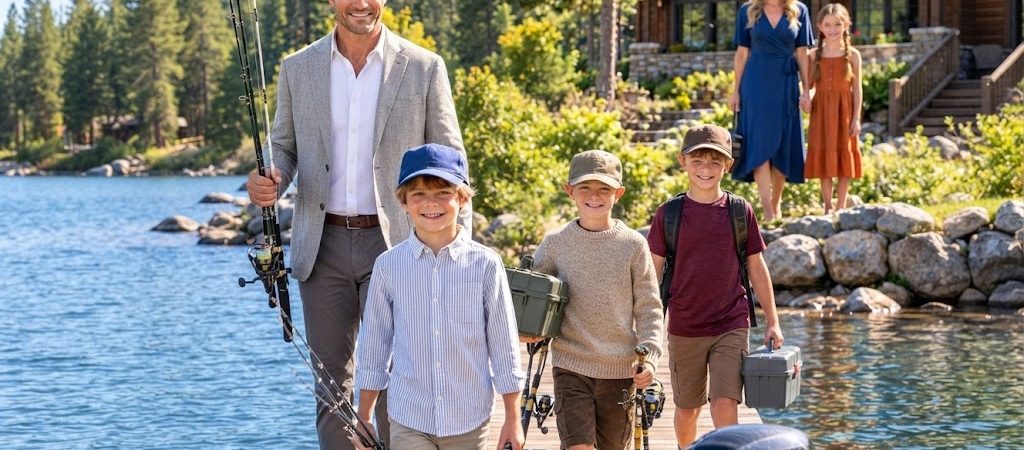
Every August, as the suffocating summer heat began to fracture into the cooler breezes of impending autumn, Daniel observed a sacred tradition. He would load our three sons—Leo, Max, and Sam—into his battered Ford F-150 for a weekend fishing expedition at Lake Oakhaven. It was their ritual, a masculine pilgrimage of tangled lines, sunburns, and exaggerated stories.
I remember that final Saturday morning with a crystalline, agonizing clarity. The driveway smelled of damp pine needles and heavy diesel exhaust. I stood on the cracked concrete, a mug of lukewarm coffee in my hand, watching my boys aggressively shove insulated coolers and carbon-fiber fishing rods into the truck bed. The sun was just cresting the horizon, painting the sky in bruised shades of apricot and lavender.
Daniel leaned against the driver’s side door, double-checking the trailer hitch securing his sleek aluminum fishing boat. He was a man built of careful habits. He was the sort of husband who obsessively monitored tire pressure, who kept emergency flares in every glovebox, who analyzed meteorological radar loops a dozen times before pulling out of the driveway.
“Smile, you heathens,” I called out, raising my phone.
The boys piled onto the tailgate, tossing sarcastic peace signs and crooked grins toward the lens. Daniel stepped into the frame at the last second, wrapping a thick, calloused arm around Leo’s neck. The shutter clicked.
I had absolutely no way of knowing it would be the final visual proof that my family existed intact.
They were scheduled to pull back into the driveway by Sunday at dusk. The sun dipped below the tree line. The driveway remained empty. The crickets began their rhythmic chirping, and a cold dread slowly coiled tight in my lower abdomen.
I dialed Daniel’s number. It rang out to voicemail. I called Leo, our eldest. The automated operator mechanically informed me the phone was out of the service area. The younger boys didn’t possess cell phones yet. By 10:00 PM, the silence in the house had turned predatory. I picked up the receiver and dialed the local police.
The following forty-eight hours shattered my reality into unrecognizable fragments.
On Monday morning, patrol officers located Daniel’s truck and the empty boat trailer abandoned near the isolated northern dock of the lake. Six agonizing hours later, a volunteer search-and-rescue team discovered the fractured remains of Daniel’s beloved boat washed up against a jagged line of rocks on the opposite shore. The fiberglass hull was violently split.
Weeks bled into a month. Dive teams scoured the murky, freezing depths of Lake Oakhaven. Search helicopters burned through thousands of gallons of aviation fuel. They found a floating cooler. They found a single, water-logged life jacket. But they never found my husband. They never found my boys.
The county authorities eventually concluded their investigation with a sterile, bureaucratic finality. A catastrophic, high-speed boating accident. The four bodies, they hypothesized, had been pulled under by the aggressive, unseasonably strong undertow and carried deep into the subterranean caverns of the lake bed.
I was left completely hollowed out, a ghost haunting my own home, tasked with raising my three surviving daughters. How does a human heart continue to pump blood after sustaining that level of structural damage? The simple answer is: it doesn’t. You merely learn to function around the crater in your chest.
Six years evaporated into the ether.
There was not a single sunrise where I didn’t aggressively interrogate the universe about what had truly transpired on that water. Daniel’s inherent caution haunted me. He had navigated the treacherous shoals of that specific lake for nearly a decade. The math of the accident simply never aligned in my head.
During those dark, suffocating years, Daniel’s younger brother, Dean, became the mortar holding the crumbling bricks of our family together. He was a constant, stabilizing presence. He stepped over the threshold within hours of the police calling off the search, his own eyes red and swollen, and effectively refused to leave. He helped me organize a memorial service without caskets. He fixed the leaking gutters. He patiently tutored the girls in mathematics. He quietly absorbed Daniel’s modest marine supply business into his own sprawling boat maintenance empire, handling the complex financial paperwork while I was too heavily medicated on grief to read the fine print.
“You have to let the current take them, Claire,” Dean had whispered to me one evening, pouring me a glass of Merlot in my kitchen. “Daniel wouldn’t want you drowning out here with them. You have to move forward for the girls.”
I leaned on him. I trusted him with the absolute, blind faith of a drowning woman clinging to a raft.
And then came the Tuesday afternoon in October, six years after the memorial, when my eldest daughter, Sophie, finally summoned the emotional fortitude to descend into the basement. We had collectively agreed it was time to pack up her father’s and brothers’ remaining clothing to donate to the parish charity drive. I had preserved their belongings perfectly untouched, functioning as a macabre museum exhibit, secretly harboring an insane, microscopic hope that they might one day walk through the front door, shivering and asking for dry towels.
I was at the stove, stirring a pot of marinara, when Sophie walked into the kitchen.
She looked as though all the blood had been violently siphoned from her veins. Her skin was the color of old parchment. In her trembling, pale hands, she held a thick, rectangular object sheathed in an outdated, cracked otter-box case.
It was Daniel’s old smartphone. The one he had distinctly told me he had dropped off a pier and permanently lost three weeks before the fishing trip.
“Sophie?” I asked, wiping my hands on a dish towel. “Why do you have that? Where did you find it?”
Her jaw trembled. She couldn’t seem to force air through her vocal cords.
“Mom,” she finally choked out, her voice a brittle, unnatural rasp. “Mom, you need to see this.”
“See what, honey? It’s just a broken phone.”
She slowly raised her eyes to meet mine. They were wide, frantic, and entirely devoid of childish innocence. “There’s a video in the gallery. The battery… it was completely dead, but I plugged it in just to see if it worked. Mom… it’s the last video Dad ever recorded. It’s timestamped the night before they left. I know what happened to them.”
My hands went completely numb. The wooden spoon slipped from my fingers, clattering loudly onto the linoleum. Six years of compounded, suffocating grief and a thousand unanswered questions violently rushed up my throat, filling my chest with the precise sensation of drowning.
“Show me,” I whispered.