PART 1 — THE GIRL WHO WOULDN’T LET GO OF HER BACKPACK
By eight-fifteen on Monday morning, Room 12 was usually loud enough to shake the windows.
Seven- and eight-year-olds never entered a classroom quietly. They arrived carrying half-finished breakfast, untied shoelaces, playground arguments, missing homework, and stories that somehow involved dinosaurs, broken tablets, mysterious bruises, and somebody’s older brother being “basically a professional wrestler.”
That morning was different.
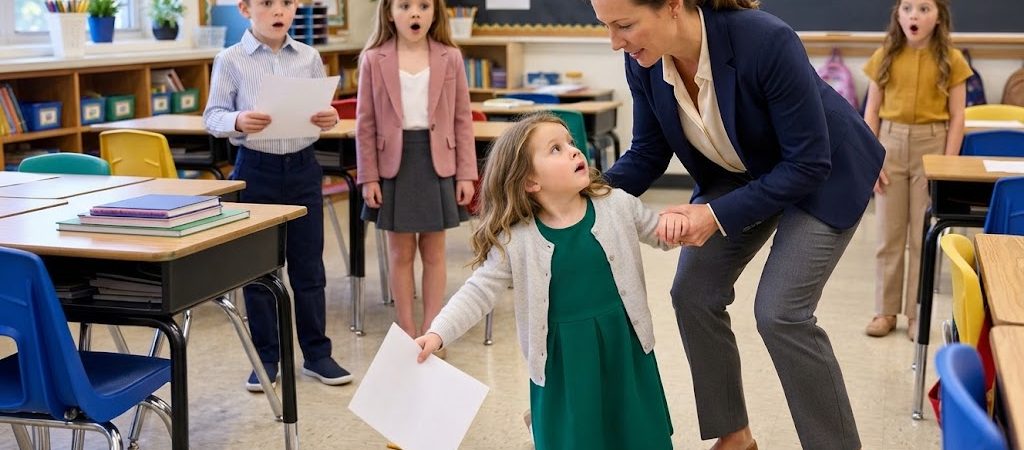
Lily Carter stood just inside my classroom door with both hands wrapped around the straps of her pink backpack.
She wasn’t crying.
That was what frightened me.
Children cried when they were scared. They complained when they were tired. They became loud when they were embarrassed.
Lily had become silent.
“Good morning, Lily,” I said gently.
She looked at me.
Her eyes were enormous.
“Good morning, Mrs. Bennett.”
Her voice was so quiet I almost didn’t hear her.
Behind her, her father stood beside a dark blue SUV in the drop-off lane.
Daniel Carter gave me a quick wave.
“She’s just tired,” he called.
I smiled politely.
“Of course.”
Lily didn’t look back at him.
She walked toward me.
As she passed, I noticed something so small I almost ignored it.
A tiny strip of clear medical tape was stuck to the inside of her left wrist.
Not a bandage.
Not covering an injury.
Just a narrow piece of translucent tape, as though someone had placed it there and removed whatever had been under it.
I noticed because Lily normally hated stickers, tape, anything sticky.
“Did you hurt your wrist?” I asked.
She immediately pulled her sleeve over it.
“No.”
Daniel called from outside.
“Lily! Come on, kiddo. Say goodbye.”
Lily turned toward the door.
“Bye, Dad.”
Daniel smiled.
“Have a good day, sweetheart.”
He waited until she was inside before walking back to the SUV.
I watched him leave.
Then I looked at Lily.
“Why don’t you put your backpack away?”
She nodded.
She took three steps.
Stopped.
Turned around.
Walked back to me.
Then she whispered something that changed the entire week.
“Dad said it wouldn’t hurt.”
I crouched beside her.
“What wouldn’t hurt, Lily?”
She stared at the floor.
“The little test.”
“What test?”
She squeezed the zipper of her backpack.
“I don’t know.”
“Did somebody hurt you?”
“No.”
“Are you scared of somebody?”
Her lips trembled.
“No.”
Then she looked at me.
“Dad said I wasn’t supposed to tell.”
Every instinct I had as a teacher told me not to interrogate her.
Children could become confused when adults asked too many questions. They could change details simply because they wanted to please the person asking.
So I didn’t press.
Instead, I said, “You don’t have to tell me everything right now. But you should know something very important.”
She looked up.
“If somebody tells you to keep a secret that makes you scared, you can always tell a safe grown-up.”
Lily stared at me for several seconds.
Then she nodded.
During morning attendance, Lily sat perfectly still.
She didn’t talk to the girl beside her. She didn’t touch her crayons during art. At recess, she sat on the lowest step near the playground fence and watched the other children run.
When I asked whether she wanted to join them, she shook her head.
“I’m okay.”
It was the second time she had said it.
Children who were truly okay usually didn’t need to say it twice.
At ten forty-five, I walked toward her desk to return a worksheet.
That’s when I saw the tiny detail again.
The clear tape was gone.
But a faint pink ring remained on her wrist.
Circular.
Precise.
Almost like something had been strapped tightly around it.
I looked at Lily.
She pulled her hand under the desk.
I didn’t say anything.
I simply continued walking.
At lunch, our school counselor, Mrs. Flores, passed through the cafeteria.
I found her in the hallway afterward.
“Can I talk to you?”
She immediately noticed my expression.
“Of course.”
I explained exactly what Lily had said.
Not what I thought.
Not what I suspected.
Only the words.
A little test.
Dad said it wouldn’t hurt.
Dad said she wasn’t supposed to tell.
Mrs. Flores became serious.
“Did she describe an injury?”
“No.”
“Did she say where it happened?”
“No.”
“Did you observe anything?”
I told her about the wrist.
Mrs. Flores nodded slowly.
“Document everything.”
“I already wrote down the exact words.”
“Good.”
We followed school safeguarding procedure.
The school nurse examined Lily privately.
Lily became visibly tense when the nurse reached for the measuring tape.
“Do I have to?”
The nurse smiled.
“No, sweetheart. I just want to look at your wrist.”
Lily hesitated.
Then slowly extended her arm.
There was no open wound.
But around the inside of her wrist was a faint, perfectly even reddish line.
The nurse looked at me.
I knew what she was thinking.
So did Mrs. Flores.
Someone had restrained that wrist.
The question was who.
And why.
At the end of the school day, Lily’s father arrived five minutes early.
He smiled brightly.
“How was she?”
“Quiet today,” I said.
He laughed.
“She gets that from her mother.”
His smile disappeared for half a second.
Then returned.
“I’m sure she’ll be back to normal tomorrow.”
Lily approached him.
Daniel reached for her hand.
She flinched.
It was tiny.
Almost invisible.
But I saw it.
So did Mrs. Flores.
Daniel noticed us watching.
His expression changed.
“What?”
“Nothing,” I said.
He smiled again.
But there was no warmth in it this time.
That evening, I couldn’t stop thinking about Lily.
At 9:12 p.m., I received an email from her father.
It was short.
Mrs. Bennett,
Lily has a sensitive imagination. Her mother passed away several years ago, and she sometimes confuses dreams with reality. Please don’t encourage strange stories.
Daniel Carter
I read it three times.
Her mother had died two years earlier, according to school records.
Car accident.
No suspicious circumstances had ever been reported to us.
But Daniel’s email raised a question I couldn’t shake.
Why was he so concerned about what Lily might tell her teacher?
The next morning, Lily came to school wearing long sleeves.
It was eighty-three degrees outside.
And when she entered my room, she looked straight at me.
Her lips barely moved.
“Mrs. Bennett…”
“Yes?”
“He said tomorrow is the last one.”
My stomach tightened.
“The last what?”
She looked toward the classroom door.
Then she whispered:
“The last test.”