I walked into my ex-husband’s family funeral with five children beside me, and the whispers began before we even reached the grave. But the moment Grant finally looked at them closely and saw pieces of his own face repeated across all five, the woman who had helped end our marriage stopped smiling.
My name is Savannah Cole, and I had not stepped onto Whitmore property in ten years. The last time I left, I was twenty-eight, newly divorced, pregnant, humiliated, and still trying to understand how a marriage that had once felt solid could collapse in less than a week.
This time, I returned in my Army dress uniform.
A black SUV dropped us near the edge of the cemetery beneath a gray Georgia sky. I stepped out first, adjusted my jacket, then turned as the rear doors opened and my five children climbed out one after another.
Ethan was ten and already nearly tall enough to look me straight in the eyes.
Noah and Luke followed him, then Rose and Emma.
They stayed close because none of them had ever met the Whitmore family before.
That alone felt strange.
They knew Grant’s name.
They knew William Whitmore had been their grandfather.
They knew there were complicated reasons we had never come here.
But I had never turned their childhood into a courtroom where they had to decide which parent was guilty.
For years, when they asked why Grant was not in their lives, I gave them an answer I could live with.
“Your father and I stopped trusting each other before you were born.”
It was true.
It was simply not the whole truth.
The full truth began ten years earlier, when Grant’s family became convinced I had been unfaithful.
Vanessa Hale was at the center of it.
She had known Grant since college and had always hovered near our marriage in ways I tried not to resent.
She remembered his favorite drinks.
Called when he was stressed.
Showed up at family gatherings even when no one had invited her directly.
Whenever I mentioned that her closeness made me uncomfortable, Grant laughed.
“She’s practically family.”
I wanted to trust him.
So I did.
Then, during the final year of our marriage, Grant traveled constantly for work while I was completing military training and preparing for a transfer.
We argued more.
We missed calls.
We became two tired people who kept promising each other that life would calm down next month.
Then Vanessa found exactly the kind of story that could break a marriage already under strain.
She told Grant she had seen me leaving a hotel with another man.
There was a hotel folio.
There was a photograph taken from a distance.
There was even someone willing to swear that I had been there overnight.
The problem was that none of those pieces meant what Vanessa said they meant.
The hotel had been used for a military training event.
The man beside me was part of my unit.
And the overnight record Vanessa waved around belonged to a room reserved under a group booking that included several service members.
I tried to explain all of that.
Grant gave me ten minutes.
I still remember the clock on his father’s study wall because I kept looking at it while my marriage disappeared.
Vanessa was there.
So was Grant’s mother.
William was the only person who asked everyone to slow down.
Grant did not.
He had already decided that defending myself too strongly meant I was hiding something.
“You should have told me about the hotel.”
“I did.”
“No, you told me you were at training.”
“Because I was.”
Vanessa interrupted.
“Then why didn’t you mention staying at a hotel?”
I looked at her.
“Because I didn’t think attending a scheduled Army training event required me to submit a travel report to you.”
Grant hated that answer.
He said I was being defensive.
I said he was letting Vanessa conduct our marriage like an interrogation.
That was the moment everything became worse.
Grant told me he wanted proof.
I told him I could provide it.
He said he did not know whether he would believe documents arranged after the fact.
That sentence changed something in me.
He was not asking for evidence.
He was asking me to prove myself inside a story he had already accepted.
I left that night.
Three days later, the divorce conversation began.
Two weeks after that, I discovered I was pregnant.
Not with one baby.
With five.
The pregnancy was complicated from the beginning.
By the time doctors confirmed all five were developing, Grant and I were already communicating almost entirely through attorneys.
I tried once to tell him.
I called.
Vanessa answered his phone.
She said Grant wanted no more “emotional manipulation.”
I hung up.
The next morning, I sent a message directly to Grant.
I need to tell you something important about the pregnancy.
He replied:
There is nothing left for us to discuss except the divorce.
I saved that message.
For years, I hated myself for not trying harder.
Then I remembered the ten minutes.
The hotel.
The accusation.
The fact that I had already been telling the truth and he had chosen not to hear it.
I decided that I would not spend my pregnancy begging a man to believe the children were his before they had even been born.
The divorce became final while I was still pregnant.
Grant never asked for a paternity test.
He never asked whether I was carrying his child.
As far as I knew, Vanessa had convinced him that any pregnancy appearing after our separation would only prove her accusation.
So I stopped trying.
The Army became the structure around which I rebuilt my life.
I transferred.
I moved.
I learned how to prepare for five newborns with spreadsheets, military precision, borrowed furniture, and more fear than I ever admitted out loud.
Then Ethan, Noah, Luke, Rose, and Emma arrived.
Five premature babies.
Five incubators.
Five names written on hospital bands.
Five reasons I no longer had the energy to spend every night imagining what Grant should have done differently.
My parents helped when they could.
Friends from my unit rotated meals.
A senior NCO once stood in my kitchen at two in the morning holding two crying babies and told me I had clearly misunderstood the concept of “small unit leadership.”
I laughed harder than I had in months.
Life became difficult.
Then ordinary.
Then mine.
Grant faded into the part of my history that hurt less when I stopped touching it.
William did not disappear completely.
Years after the divorce, a Christmas card arrived at my Army post office box.
His handwriting was unmistakable.
Savannah, I hope wherever life has taken you, it has been kinder than we were.
That was all.
No questions.
No demand that I respond.
No attempt to explain his son.
I folded the card and placed it inside my Bible.
William never knew about the children.
At least I did not think he did.
That became harder to live with when Ethan started asking about family trees at school.
Then Noah wanted to know why all five of them had the same unusual dimple in their chin.
By the time the twins began comparing old photographs online, hiding Grant’s identity from them stopped feeling like protection.
So I told them the truth in pieces appropriate for their age.
Grant was their biological father.
Our marriage ended before they were born.
He did not know them.
And I would never force them to hate a man they had never met.
When William died, Ethan found the obituary before I did.
“Mom.”
He turned the laptop toward me.
“Is this Grandpa William?”
I stared at the screen.
For ten years, I had imagined many reasons I might someday return to Georgia.
A funeral had never been one of them.
Rose asked whether we could go.
I hesitated.
Then Emma asked the question that decided it.
“If he was nice to you, shouldn’t we say goodbye?”
So we went.
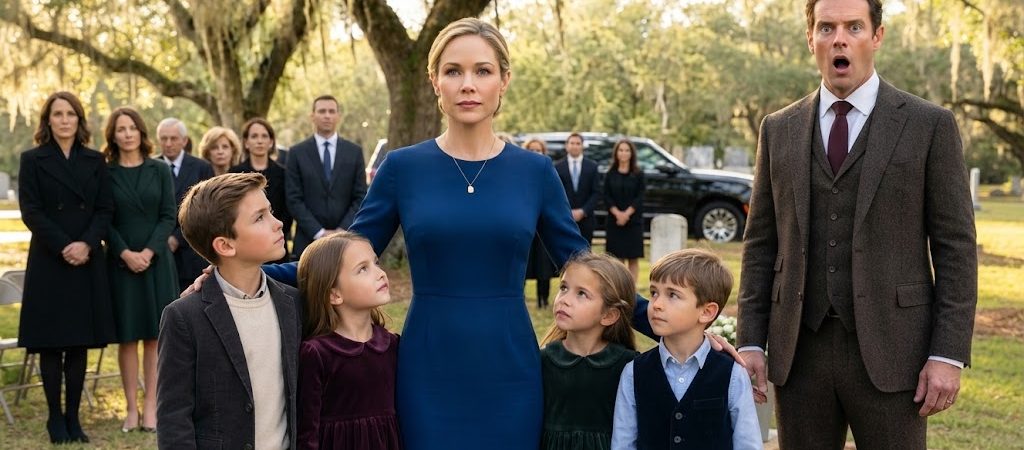
The cemetery was already crowded when we arrived.
Whitmore relatives stood beneath dark umbrellas.
Business associates gathered near the family.
People I had not seen in ten years recognized me slowly, then began looking at the five children beside me.
The whispers started almost immediately.
I kept walking.
I had not come to explain myself.
I had come for William.
Then Vanessa stepped into our path.
She looked older.
So did I.
But some expressions do not change much with time.
Her eyes moved from my uniform to the children.
Then she smiled.
“Well.”
She looked at me.
“I suppose the military still hasn’t taught you when not to make a scene.”
Ethan’s hand tightened around mine.
I stayed calm.
“We’re here for William.”
Vanessa glanced at the children again.
“Why?”
“Because they wanted to say goodbye.”
Her smile became sharper.
“To someone they never knew?”
Rose stepped forward before I could answer.
“He was our grandfather.”
The conversation around us seemed to stop.
Grant turned.
I had not seen him yet.
He was standing near William’s casket in a black suit, older than the man I remembered but unmistakably the same.
His eyes found me first.
Then the children.
He looked at Ethan.
Noah.
Luke.
Rose.
Emma.
Something changed in his face.
At first, it was only confusion.
Then he looked at Ethan again.
My oldest son had Grant’s eyes.
Luke had his jawline.
Rose had the same small crease near her left cheek when she was nervous.
Emma had the Whitmore chin.
Noah looked so much like photographs of Grant at ten that even I had sometimes stopped mid-sentence when he turned his head a certain way.
Grant took one step toward us.
Vanessa noticed.
Her expression changed immediately.
She moved closer to me.
“What exactly are you doing here, Savannah?”
“I told you.”
I looked toward William’s grave.
“Saying goodbye.”
Vanessa reached toward Rose.
I caught her wrist before she touched my daughter.
“Do not touch her.”
I released her immediately.
Grant had already started walking toward us.
His eyes remained fixed on the children.
“Savannah.”
I had heard my name in his voice thousands of times during our marriage.
I had never heard it sound like that.
“What is this?”
I looked at him.
“Five children attending their grandfather’s funeral.”
His face went pale.
“Grandfather?”
I did not answer immediately.
I had promised myself I would not turn the children into evidence.
Grant deserved the truth.
But the children deserved not to become props in an argument between adults.
So I reached into my bag.
I had brought one sealed envelope.
Inside were documents I had kept for ten years.
The old hotel records.
A notarized statement from the officer who had been with me during the training event.
And the paternity report I had obtained privately after the children were born because I never wanted them growing up with uncertainty I could have resolved.
Grant stared at the envelope.
Vanessa looked at it too.
For the first time that morning, she stopped looking confident.
“Savannah.”
Her voice had changed.
“Don’t do this here.”
Grant turned toward her.
He had not asked what was inside.
Neither had she.
Yet somehow Vanessa already knew there was something she did not want him to see.
I noticed Grant realize the same thing.
He looked from her to me.
“What’s in the envelope?”
I held it out.
“The part of the story you never gave me time to finish.”
Grant took it.
His hands were not steady.
Behind him, William’s coffin waited beneath gray clouds while my five children stood silently beside me.
I did not feel victorious.
I felt tired.
Ten years earlier, I would have given almost anything for Grant to read those papers.
Now I needed nothing from him except one thing.
He needed to understand that whatever he discovered inside that envelope did not give him ten years back.
Grant broke the seal.
Vanessa whispered his name.
He ignored her.