Chapter 1: The Inciting Audacity & The Immediate Strike
There is an exact, non-negotiable thermal threshold in clinical endodontics: if an autoclave does not sustain 273 degrees Fahrenheit at thirty pounds of atmospheric pressure for a minimum of twenty minutes, the spore test fails.
The pathogens do not negotiate. The bacteria do not care if you were tired, if you had a migraine, or if your younger sister was having an emotionally turbulent third trimester. You either achieve sterile clearance, or you are circulating necrotic poison through clean tissue.
At precisely 1:14 p.m. on Christmas Day, I opened the unlocked front door of my parents’ brick ranch in Huber Heights, Ohio, and discovered that my entire family was an unsterilized surgical field.
The air in the foyer smelled of roasted sage, melted butter, and thirty-dollar drug-store perfume. Six pairs of adult winter footwear were arranged along the linoleum runner like trophies.
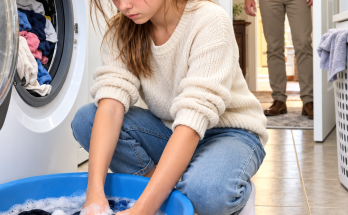
On her knees in the center of the entryway was my ten-year-old daughter, Millie.
She was wearing a faded heather-gray sweatshirt that had belonged to me in 2012, the cuffs rolled back three times to keep them out of a plastic bucket of murky, gray-brown water. Her bare hands were submerged in that water, wringing out an industrial rag with knuckles so raw and split from dry cold they resembled winter radishes. At her knees sat a pair of size-eleven, mud-caked contractor boots belonging to a man I had never laid eyes on in my life.
Directly behind her heels, shoved into the half-inch gap beneath the weather-stripping where the December wind whistled off the driveway, was the yellow velvet pillow.
It was pale buttercup yellow, eight inches square, with a small script M hand-embroidered into the corner. I had bought it for her tenth birthday in March so she would have something soft of her own to rest her head against while she read in bed.
Denise had converted it into a draft-stopper. A dark brown crescent of slush and road salt was already soaking into the M.
Millie did not hear the deadbolt turn because the dining room was roaring with three generations of holiday laughter. When the draft hit her neck, she flinched—a quick, involuntary tuck of the chin that I recognized immediately from my own childhood—and looked up.
Her eyes did not register surprise, relief, or delight.
Her pupils contracted in pure, unadulterated terror.
“Mom,” she whispered, her voice barely carrying over the sound of a gravy ladle hitting porcelain in the next room. Her little hands clamped onto the wet rag. “Mom, you’re not supposed to be here. Nana said you were in Florida until the New Year.”
In the dining room, my twenty-nine-year-old sister, Ashley, raised a stemless glass of pinot grigio toward her new mother-in-law and let out a bright, melodic laugh that had been tuned by thirty years of never once having to clean a baseboard.
“Oh, don’t mind Millie down there, Peggy!” Ashley trilled, her voice carrying cleanly through the drywall archway. “She’s our little seasonal intern! The adults get to eat while the food is hot, and the helpers finish the entryway. It’s good for her character!”
My mother, Denise, sat at the head of the oak table in an emerald-green velour tunic, carving turkey with the rhythmic, ceremonial dignity of an empress overseeing the distribution of grain. She smiled across the cranberries at Peggy Ror. It was not a nervous smile; it was the swollen, tranquil smirk of a woman who had successfully outsourced reality to an inferior species.
I did not drop my duffel bag. Dropping luggage is theatrical, and theatricality is for people who do not have a battle plan.
I set the bag down silently on the rubber floor mat. I walked into the dining room, my wet winter boots leaving dark, deliberate footprints across my mother’s vacuumed cream carpeting.
Nine people sat around the extended table. Nine plates of herb-crusted breast meat, sweet potato casserole, and buttered yeast rolls. At the far end of the room, through the pass-through to the kitchen, I could see an unpainted wooden stool pushed into the dark corner beside the trash can. On the stool sat a single paper plate, covered in tin foil, with two cold crusts of bread and a spoonful of cold green beans.
Nobody looked at my boots until I reached the head of the table.
Denise looked up, her fork suspended two inches from her lipsticked mouth. “Laura? What on earth… your flight wasn’t until Tuesday.”
I did not answer her.
I turned around, walked back to the foyer, slid my hands under Millie’s armpits, and lifted her off the wet tile. Her knees made a faint, sticky sound as they separated from the linoleum. Her fingers were shaking so violently that the wet rag dropped back into the bucket with a dull plop.
I guided her into the dining room.
I kicked the rear leg of Denise’s high-backed captain’s chair with the steel toe of my boot. The chair jerked six inches to the left, the wooden legs shrieking against the baseboard.
“Get up, Denise,” I said.
Denise’s jaw went slack. “I beg your pardon?”
“You heard the command,” I said, my voice dropping into the flat, subterranean register I used when an oral surgeon hit an unexpected arterial bleed. “Vacate the seat.”
Denise stood up, her hand fluttering to the simulated pearls at her collar, looking around the table for the chorus of male defenders she had spent forty years cultivating. “Laura, you are behaving like a psychotic person in front of Cody’s parents—”
I pushed Millie down into the velvet cushion of the head chair.
I picked up Denise’s full plate—the prime breast meat, the loaded sweet potatoes, the steaming roll—and slammed it down on the table directly in front of my daughter. The silver gravy boat rattled on its saucer.
“Eat, Millie,” I said. “Start with the meat.”
Millie looked at the porcelain plate, then at her grandmother, then at me, her lower lip vibrating like a dry leaf.
“Laura!” Ashley gasped, slamming her wine glass down so hard the red liquid sloshed onto the linen runner. “Are you insane? Tyler just drove four hours from Columbus! He asked for those boots to be cleaned before we went to the evening service!”
I turned my head four degrees to the left and looked at Tyler—a twenty-four-year-old boy in a cable-knit sweater who looked as though he had never experienced an inconvenience more severe than a delayed DoorDash order.
“Tyler,” I said, my voice dangerously calm. “If your boots are not out of that entryway in forty-five seconds, I am going to take them out to the driveway and run them over with a 2014 Honda Civic until the steel toes pop through the leather.”
Tyler’s face drained of every drop of color. He pushed his chair back so fast it hit the china hutch, stood up, and bolted for the front door without looking at his fiancée.
Denise’s voice escalated into that high, nasal church-organ frequency she reserved for municipal betrayals. “This is my house! In this house, we respect order! We respect the family structure!”
“Your family structure,” I said, looking around the table at my father Gary, who was currently staring down into his cranberry relish as though it contained the secrets of the universe, “has an active bacterial count that would shut down a municipal abattoir.”
I reached across the table, grabbed the butter dish, set it by Millie’s elbow, and looked Denise dead in the eyes.
“Finish your last meal in this house, Mother,” I whispered. “Because before that turkey reaches room temperature, you are going to learn what your little helper actually cost.”