Chapter 1: The Stainless-Steel Insult
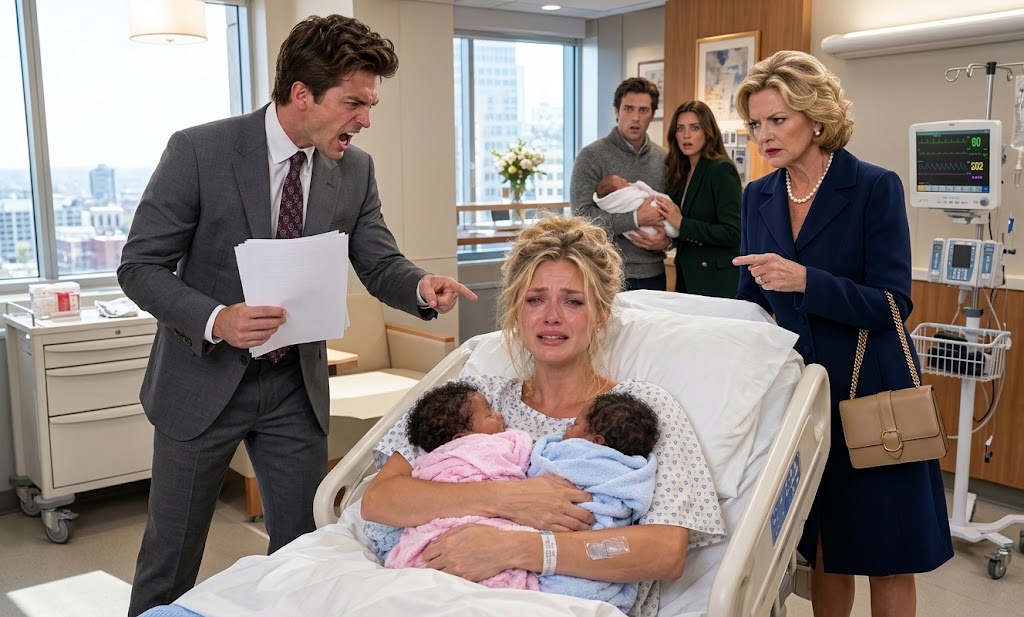
The horizontal incision across my lower pelvis felt like a strip of molten lead every time my diaphragm expanded. It was the seventh morning following an emergency caesarean section at Oakbrook Memorial Hospital, tucked into the sterile affluence of Chicago’s western suburbs. Carrying twins to thirty-six weeks had turned my five-foot-four frame into an overextended scaffolding. When the surgical team finally lifted them from my dissected womb, my blood pressure had plummeted so precipitously that the anesthesiologist’s fingers had left bruises on my clavicle while trying to keep me tethered to consciousness.
Now, the room smelled perpetually of antiseptic foam, warmed formula, and the quiet rot of discarded floral arrangements from patients discharged days ago.
On the other side of the shared curtain, a young woman who had delivered vaginally thirty-six hours prior was humming a nursery rhyme. Her partner had spent the entire dawn hovering over her: blowing softly across spoonfuls of hot bone broth, wringing warm washcloths with lavender oil to press against her swollen temples, whispering endearments into her neck. Every soft kiss between them sounded in my ears like a wet lash against bare skin. I kept my cheek glued to the coarse hospital pillow, staring at the blank drywall, forcing my breath through cracked lips.
Beside my mattress stood two clear polycarbonate bassinets. Lily and Rowan were sleeping with their miniature foreheads pressed together, chests rising and falling in shallow, synchronized cadences. I extended an arm that felt cast in wet concrete, my fingers trembling as they reached over the plastic rim. I brushed the downy crowns of their heads. Even in their newborn state, their hair was not the wispy blonde peach-fuzz typical of the men in my husband’s line; it was a dense, tight forest of raven-black curls, springing defiantly against the sterile hospital linen. Their skin, flushed deep copper against the bleached swaddling sheets, carried a rich, golden-olive hue.
To me, they were miraculous. They had survived forty hours of stagnant labor and fetal distress. To someone else, they were an indictment.
The heavy door was kicked open without warning. It slammed back against the magnetic rubber stop with a sharp crack that vibrated the metal drip pole beside my bed.
Harrison stepped inside.
He wore no coat despite the brisk October wind blowing off Lake Michigan, only a trim charcoal sweater that smelled faintly of expensive cedar cologne and espresso. His hands were thrust deep into his trouser pockets. He carried no overnight duffel, no insulated thermos of postpartum soup, no nursing pads from my bedside vanity at home. For an entire week, his mother, Eleanor, had maintained a theatrical absence, alleging an acute flare-up of sciatica that conveniently prevented her from ascending the hospital elevator to lay eyes on her first grandchildren.
Harrison did not look at my face. His eyes swept across the plastic bassinets with a flat, clinical disgust—the exact gaze an executive casts upon misprinted balance sheets before tossing them to the shredder.
I propped my weight onto my raw elbows, a sharp spasm tearing through the surgical staples across my bikini line. The metallic taste of adrenaline surged under my tongue.
“Harrison,” I whispered, my voice frayed from days of dehydration and quiet sobbing. “Did you manage to sleep? Did your mother finish the bone broth? The nurses said the discharge papers are almost—”
Before the sentence could cross the space between us, he pulled his right hand from his jacket pocket. Between his manicured fingers was an unsealed, manila document folder. He flicked his wrist. The envelope whipped through the air and struck the stainless-steel bedside stand with the deafening slap of a dead weight hitting sheet metal.
The woman behind the privacy curtain stopped humming. The sudden silence in Room 412 was suffocating.
“Look at it,” Harrison said.
His voice was devoid of inflection. It was the tone he used when firing junior copywriters at his downtown marketing agency: low, clipped, calculated to leave no room for appeal.
My fingers shook so violently that the folder nearly slid into the medical waste bin. Inside were two pristine sheets of cream-colored twenty-pound bond paper.
The letterhead belonged to an accredited genomics laboratory on Michigan Avenue. The first sheet was an intake requisition for a comprehensive paternity DNA test. The second was an itemized receipt. In bold, laser-printed ink near the top, the total leaped out like an open wound: $795.00. Method of payment: Harrison Vance, Personal Visa.
The oxygen drained from the room. My field of vision shrank to a pinprick, black static crackling at the edges of my sight.
“What is this?” I asked. I could barely hear my own voice over the violent, rhythmic hammering of the pulse against my temples. “You bought a genetic test? While I’m lying here unable to walk to the bathroom without a nurse holding my catheter bag?”
“Do not play the martyr with me, Chloe,” he said, stepping closer, his loafers clicking sharply on the linoleum. He leaned over the bed, his shadow blocking the pale autumn light filtering through the window. “I have spent forty-eight hours staring at those bassinets. My family has been in DuPage County for four generations. Look at my father. Look at my sister. Look at me. We have blue eyes, straight chestnut hair, and skin that turns strawberry pink after ten minutes in the midday sun. Your parents down in Terre Haute are the same. Chalk-white, corn-fed Anglo-Saxons.”
He pointed a stiff, accusatory index finger toward the bassinets.
“Those two infants do not belong to my lineage. Their hair is coiled like springs. Their pigment looks like they were born in Andalusia or the Caribbean. I am an intelligent man, Chloe. I am a marketing director with a firm grasp of statistics and reality. You expect me to accept an absurd genetic anomaly just because you were supposedly carrying my seed?”
“They are your children!” I choked out, the hot sting of tears finally breaking down my cheeks, scalding the dry skin of my face. “I underwent three rounds of ovulation induction! I spent eight months vomiting blood into the porcelain bowl of our master bathroom! I laid on that steel table while three surgeons cut my fascia open to save them! How dare you stand in this room and wave an eight-hundred-dollar receipt in my face like I’m a common cheat?”
Harrison sneered, a tight, vicious twist of his upper lip that I had never seen in the five years we had shared a bed.
“Save the hysterics for the magistrate. If you are innocent, you will offer their heels to the phlebotomist tomorrow without a whimper. But if that laboratory envelope comes back showing zero percent probability, you will take those two dark-skinned bastards, pack your bags into a rental van, and never set foot in my house again. The dissolution petition will be filed before the week is out.”
He turned on his heel, his coat swirling like a shroud.
“End of discussion,” he spat toward the linoleum.
The heavy door swung shut behind him with another deafening thud. Across the room, startled by the violent concussive sound, baby Rowan opened his mouth, letting out a thin, pitiful newborn shriek that pierced straight into the marrow of my bones.
I gripped the edge of the mattress, my teeth sinking into my bottom lip until warm blood trickled into my mouth, washing away the taste of salt. He wanted science. He wanted black ink on white paper. He had no idea what dormant ghosts lived in the soil of the family he had just discarded.