Part 1
The man everyone was waiting to bury moved his hand and curled his fingers around my baby’s blanket.
I froze beside the bed, convinced my mind was playing tricks on me.
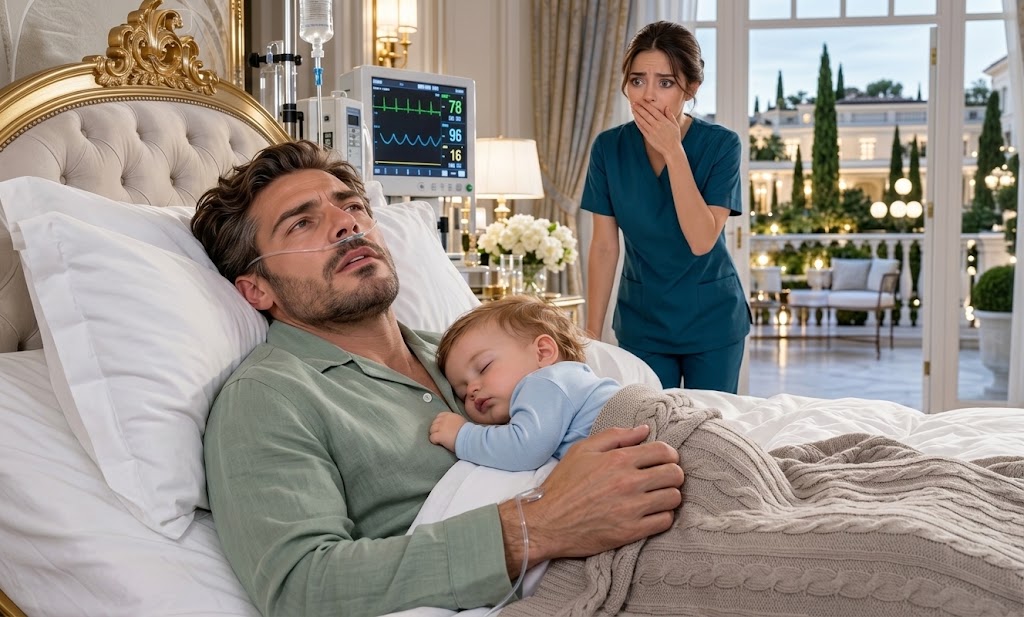
For three hours, I had been pacing the cramped service quarters of the massive Bel Air estate, cradling my nine-month-old son, Leo. He had a fever from teething, and nothing could soothe him. I’d walked him, hummed softly, and tried feeding him, but he just kept crying.
Desperate for a quiet space, I had slipped into Grant Sterling’s master suite.
The doctors said he only had days left.
Grant was forty-six years old. He had built an immense transportation and logistics empire from scratch, but for two months, he had been bedridden—unable to speak or move a single muscle. His nephew, Julian, was already discussing funeral arrangements with the casual tone most people use to reserve a dinner table.
I was working as Grant’s live-in caregiver because I desperately needed the paycheck, and no other job would allow me to keep my baby with me.
That night, I sat in the armchair beside Grant’s bed just to rest my aching arms. Leo was still whimpering, so without overthinking it, I gently laid him against the sick man’s chest.
The baby instantly grew quiet and fell fast asleep.
And then it happened.
Grant’s fingers twitched, slowly sliding across the fabric until his grip tightened around the edge of Leo’s blanket.
“Mr. Sterling?” I whispered, my heart hammering against my ribs.
His eyelids fluttered. One eye opened just a sliver.
He was conscious. Fully, completely aware.
I spent the rest of the night learning how to communicate with him. One blink meant yes. Two blinks meant no. Looking toward the door meant someone was coming.
“Can you hear everything they say around you?” I asked softly.
One slow blink.
A cold shiver ran down my spine.
By morning, he had gained enough strength to faintly move his lips. I leaned in until my ear was inches from his mouth.
“Julian… isn’t waiting for my inheritance,” Grant rasped, his voice barely a whisper. “He’s… accelerating it.”
Before I could ask what he meant, heavy footsteps echoed down the hallway.
Julian walked in without knocking. Tailored suit, expensive watch, a permanent scowl on his face. He didn’t even look at his uncle.
“How’s our patient?” Julian asked, his voice dripping with annoyance.
“No change,” I replied smoothly, stepping in front of the bed to block his view.
“Good. Dr. Barragan will be here at four,” Julian sneered, eyeing my son. “And another thing, Mariana: if your kid keeps crying through the night, you and that bastard can find somewhere else to live.”
I gritted my teeth. “It won’t happen again.”
The moment Julian’s footsteps faded down the hall, Grant opened his eyes.
“Don’t… tell him… anything,” Grant whispered.
I nodded solemnly.
At four o’clock sharp, Dr. Ruben Barragan arrived carrying a worn leather medical bag. He pulled out an unlabeled white box with a single name handwritten on the side. He drew a clear liquid into a syringe and injected it directly into Grant’s IV line.
Ten minutes later, the rhythm of Grant’s breathing faltered. His fingers went entirely limp.
“He’s slipping away,” Dr. Barragan remarked with terrifying calm. “Five days. Maybe six.”
Instead of leaving the ampoules with the rest of Grant’s prescribed medication, Barragan slipped them back into his personal bag.
Late that night, while the house slept, I looked up the drug name I had memorized from the box.
I read the medical description once. Then twice.
The drug was a heavy paralytic agent. Administered in unmonitored doses, it induced profound muscle immobility and suppressed breathing—simulating the final stages of a terminal neurodegenerative collapse.
I looked over at Grant.
He wasn’t dying naturally.
Someone was trapping him inside his own body, suffocating him in slow motion. And the nephew standing to inherit millions walked in every single day to ask how much time was left.
I reached out and took Grant’s cold hand. “I’m not going to let them kill you.”
His fingers mustered a faint, trembling squeeze against my wrist.
In that quiet room, I realized I had just stepped into something far more dangerous than losing a job. But I had no idea what was waiting for me next…
Part 2
My silent war against Julian began that very night.
Every time Dr. Barragan left, I carefully monitored Grant’s vitals and subtly flushed his IV line to dilute the paralytic. I documented every dosage, noted every shift in his vitals, and took discreet photos of the unlabeled ampoules.
Without the full poison in his system, Grant’s recovery was astonishing.
First, he regained control of his wrist. Then his arm. Four days later, he could hold his head up on his own.
“In the bottom drawer of my desk… there’s a burner phone,” Grant told me during the quiet hours of the night. “Nobody knows it exists.”
I found it tucked behind an old tax ledger.
Grant dictated a phone number. “It’s my personal attorney. Not the company lawyer. My own.”
We sent a short, encrypted text. Then I wiped the call log and hidden cache.
During the day, Grant played the part of a dying man perfectly. Whenever Julian walked into the room, Grant dropped his jaw, let his eyes go glassy, and stared blankly at the ceiling.
“I never knew acting like a corpse would be such a useful skill,” Grant whispered after one of Julian’s brief visits.
I had to cover my mouth to smother a laugh.
But the laughter vanished two days later.
I returned to my living quarters after buying diapers and immediately noticed something was off. My travel bag was zipped slightly differently. The baby formula jars on the counter had been shifted.
And in the trash bin, I found two opened wrappers for sterile buccal DNA swabs.
Used.
I rushed up the back stairs into Grant’s room, locking the door behind me.