Chapter 1: The Itinerary of Betrayal
The very first time my spouse realized I was truly gone, he was standing on the expansive, wraparound porch of our $2.8 million estate, aggressively jabbing his silver key into a brass deadbolt that no longer recognized him. From the vantage point of my imagination—fueled by the frantic voicemails he would soon leave me—I could picture the scene with crystal clarity. Behind him, my mother-in-law, Patricia, was likely dragging her oversized, designer suitcase up the stamped-concrete driveway, loudly lamenting the grueling duration of their transatlantic flight from Europe. Beside her, my sister-in-law, Emily, shifted her sleeping newborn against her shoulder, swaying in the humid afternoon heat. They all looked exhausted, sunburned, and desperately eager to breach the cool, air-conditioned sanctuary they believed was waiting for them.
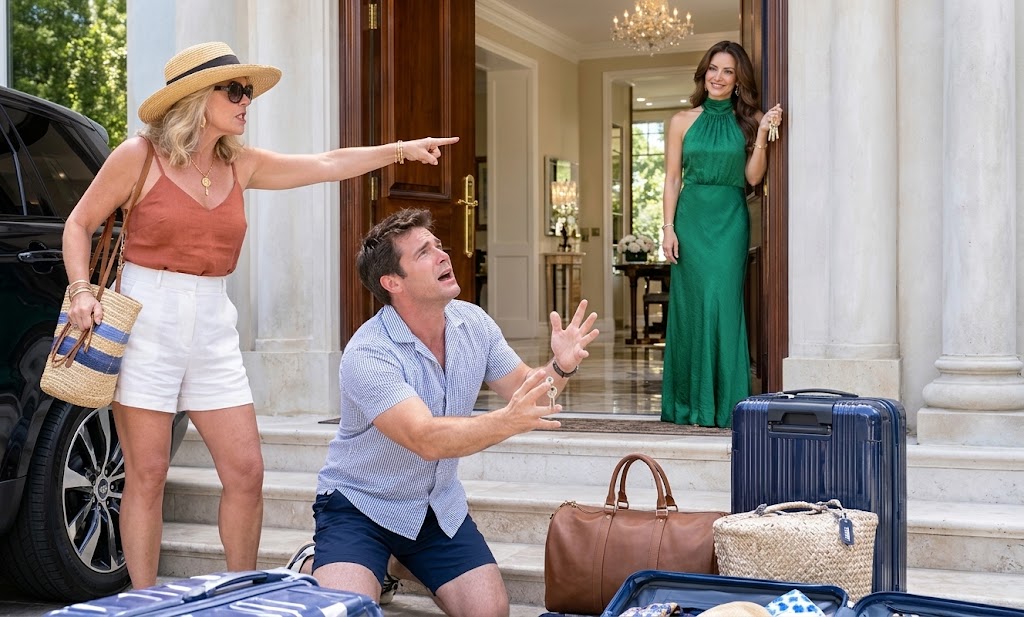
Daniel tried the familiar key a second time. It refused to turn.
“What on earth?” he muttered, rattling the heavy brass handle.
Patricia marched up the steps, her patience already worn paper-thin. “Daniel, just open the door. I need a hot shower and a glass of Chardonnay.”
He knocked, the sound echoing hollowly against the thick mahogany. Moments later, the door swung inward. A stranger—a man in his late forties wearing a casual polo shirt—stood in the foyer of what my husband had confidently called his domain for the past seven years.
“Can I help you?” the stranger asked, his brow furrowing in confusion.
Daniel simply stared, his brain struggling to process the impossible visual. “Who are you? The owner?”
“We closed on the property three weeks ago,” the man replied evenly.
In that fractured second, my husband’s entire reality went completely still. He pulled out his phone and dialed my number. It rang precisely once before diving straight into voicemail. He called again, and then again, his thumb furiously tapping the screen, but I was not there to answer his rising panic. I was sitting in the sun-drenched kitchen of a quiet, unassuming rental house hundreds of miles away, nursing a mug of dark roast coffee beside a bay window that overlooked a magnificent row of autumn-kissed maple trees. For the first time in nearly a decade, nobody was dictating what I owed them, whose fragile egos I needed to meticulously protect, or which members of my own bloodline deserved to be casually excluded.
The avalanche that buried our marriage hadn’t started with a massive explosion. It had begun with a single, cowardly text message, sent three weeks prior.
Daniel had typed it while I was sitting at our expansive kitchen island, my reading glasses perched on the bridge of my nose, reviewing the finalized, leather-bound itinerary of the European vacation I had spent the last eight months meticulously curating.
Your parents can’t come to Europe. Mom wants just family.
I read those eleven words twice. The letters seemed to blur, detach from the screen, and float in a sea of sudden, icy nausea. I slowly lowered the phone and looked down at the glossy brochures spread across the pristine quartz counter. London. Paris. Florence. Rome.
Thirty-five thousand dollars.
That was the exact sum I had quietly transferred from my personal savings to make my parents’ lifelong, impossible dream a tangible reality. My father, Robert, was a man whose hands were permanently calloused from thirty-two years of backbreaking labor at an auto parts factory on the gritty outskirts of Columbus, Ohio. My mother, Helen, had spent the entirety of her adult life juggling exhausting part-time retail jobs, raising me with an abundance of love, and clipping coupons just to ensure the heating bill was paid before the first snow fell. They had never been people who demanded the world’s attention, let alone its luxuries. When my childhood friends boasted about Caribbean cruises, my parents planned modest weekend camping trips. When neighbors chatted about summering in Europe, my father would offer his trademark, gentle smile and whisper, “Maybe someday, kiddo.”
Someday had evolved into a bittersweet, running joke in our household. A myth we collectively maintained. But when my father blew out the sixty-seven candles on his birthday cake, I made a silent vow. Someday was finally going to materialize.
I spared absolutely no expense. I booked extra-legroom flights to accommodate my father’s aching knees, secured breathtaking boutique hotels overlooking ancient plazas, arranged intimate guided tours of historic ruins, and purchased first-class train tickets to weave them seamlessly between iconic cities. I even went so far as to arrange a private, after-hours walking tour of the Vatican in Rome, specifically because my mother had once confided that she had spent her teenage years admiring those very frescoes in a battered library encyclopedia.
When I finally presented them with the tickets, tucked inside a beautiful leather travel journal, my mother wept until she couldn’t catch her breath. My father, a man who rarely showed overt emotion, pulled me into a hug so fierce it bruised my ribs.
“You didn’t have to do all this, sweetheart,” he had whispered, his voice cracking, tears tracking through the deep lines of his weathered face.
“I know, Dad,” I replied, burying my face in his familiar flannel shoulder. “That’s exactly why I wanted to.”
For months following that reveal, they talked of absolutely nothing else. My mother invested in a specialized pair of orthopedic walking shoes and spent hours breaking them in around her tiny living room. My father practically moved into the local library, checking out towering stacks of travel guides, marking hundreds of pages with neon yellow sticky notes. They even purchased a language program, adorably butchering Italian phrases over their evening meatloaf. I was soaring on a cloud of pure, unadulterated joy.
And then, Daniel’s message arrived, shattering the atmosphere like a brick through stained glass.
I didn’t text back. I called him immediately. He answered on the second ring, the chaotic, abrasive hum of the airport departure terminal bleeding through the speaker. He and his mother had arrived early for a domestic flight to visit Emily, who had recently delivered her first child. They were already strategizing the upcoming European expedition.
“What exactly do you mean, my parents can’t come?” I demanded, my voice trembling with a terrifying blend of rage and disbelief.
“Exactly what I said in the text,” he replied, his tone shockingly casual.
“Daniel, I paid for this trip. Every single dime. Your mother is fully aware of that fact. My parents have been packing their bags in their minds for six months!”
“Mom wants it to be immediate family only,” he countered, dropping his voice as if managing a toddler throwing a tantrum in a grocery store.
I closed my eyes, pressing two fingers hard against my throbbing temples. “Your mother is your family. Emily is your family. I am your wife. And my parents are my family. It’s two sides of the same coin.”
He expelled a long, dramatic sigh, painting himself as the victim of my deliberate unreasonableness. “Claire, please don’t start this right now. Mom thinks having your parents tagging along will completely change the dynamic. Emily has the new baby, and Mom wants the environment to be totally focused on her and her first grandchild. No distractions.”
“So,” I breathed, my heart hammering against my ribs, “my parents are supposed to forfeit their singular, lifelong dream vacation simply because your mother has decided she doesn’t want to share the spotlight with them?”
“It’s not like that,” he deflected automatically.
“Then explain to me exactly what it is like, Daniel.”
He didn’t offer a logical explanation. Instead, he unleashed the single sentence that served as the guillotine for our marriage.
“Why do you always have to make things about your side of the family?”
I went completely rigid. I stared blankly at the expensive subway tile on my kitchen backsplash. My side of the family. He said it with such casual disdain, as if the extraordinary people who had nurtured me, sacrificed for me, and loved me decades before Daniel ever learned my name were nothing more than bothersome outsiders intruding on his royal bloodline.
I could have screamed. I could have verbally eviscerated him, reminding him that my personal wealth had funded nearly every luxury he enjoyed. I could have delivered a fiery ultimatum, forcing him to choose between his mother’s tyrannical, unreasonable demands and his wife’s fundamental dignity.
But in that suffocating silence, the fog of denial abruptly lifted. I understood a devastating truth I had spent seven exhausting years actively refusing to see. Daniel did not view us as a united partnership when it came to the architecture of our family. He believed, down to his marrow, that my sole purpose was to endlessly accommodate the whims of his.
I slowly pulled the phone away from my ear, looked down at the glowing screen, and placed my trembling fingers over the keyboard. I didn’t type a paragraph of rage. I didn’t beg. I typed four simple words.
Then have fun.
I hit send, terminated the call, and placed the device face-down on the cold marble. He didn’t call back. I knew his playbook; he likely assumed I would retreat to our bedroom, sulk for a few dramatic hours, complain tearfully to my mother, and eventually—as I always did—capitulate and accept his decree.
That was, tragically, the exact pattern I had established over the years whenever his mother recklessly crossed an unspoken boundary. Patricia had once completely rearranged my entire formal dining room while I was at work because she determined my antique furniture “looked a bit cheap for this zip code.” She had boldly invited twelve of her extended relatives to our Thanksgiving dinner without uttering a word of warning to me, and then openly criticized the organic turkey I had spent two grueling days brining and roasting when my parents arrived to eat it. She habitually referred to our sprawling estate as “Daniel’s place,” despite the glaring fact that she had never contributed a single, solitary dollar toward its upkeep.
I had swallowed every bitter insult, every backhanded compliment, every blatant act of disrespect, because I was desperate for my marriage to succeed. I thought peace was a synonym for endurance.
But the house itself? The house had come directly from my father. He had miraculously inherited the estate from a wealthy, distant relative years ago and, knowing he could never afford the property taxes on his factory salary, he legally transferred the deed into my name long before he fell ill. When he eventually passed the responsibility entirely to me, it came with a sealed letter that I still kept meticulously preserved in my bedside drawer. The property’s value had skyrocketed substantially over the years. The title remained exclusively in my maiden name. I had painstakingly maintained the historic structure, funded the modern renovations, and paid every astronomical tax bill from my separate accounts. While Daniel thoroughly enjoyed the prestige of residing in a multi-million-dollar mansion without ever bearing the crushing anxiety of a mortgage, I had never, not once, weaponized that fact against him. I had never felt the need to.
Until today.
Sitting alone in the echoing silence of that vast, beautiful kitchen, a profound question bloomed in my mind: Why had I spent so much of my finite energy protecting a marriage to a man who couldn’t even summon the courage to defend my parents’ fundamental right to basic human respect?
I pushed myself away from the counter, walked up the grand curving staircase, and entered our master bedroom. I opened the nightstand drawer and withdrew my father’s letter. The heavy parchment was soft from being handled so many times. His handwriting was shaky and uneven toward the bottom, a cruel testament to the illness that had eventually made even holding a pen a monumental struggle.
Claire, my brilliant girl, a home should be a fortress where your soul feels entirely safe. Never, ever stay somewhere just because you are terrified of what leaving might mean.
I sat on the edge of the plush, king-sized mattress and traced the faded ink until my vision blurred with hot, angry tears. I didn’t just wipe my face; I scrubbed away the remnants of the compliant, shrinking woman I had allowed myself to become. I picked up my phone and dialed the direct line for Margaret Lewis, the formidable attorney who had flawlessly executed my father’s estate planning.
She answered crisply on the third ring. “Claire? Is everything all right? It’s been a while.”
“I need to ask you a hypothetical question, Margaret,” I said, my voice eerily devoid of tremor.
“I deal in facts, not hypotheticals, but go ahead.”
“If I make the absolute decision to sell my estate and completely start over, what legal landmines do I need to be aware of?”
There was a profound, heavy silence on the other end of the line. The kind of silence that usually preceded a massive billable hour. Then, Margaret asked the only question that mattered. “Are you entirely sure you want to open this particular door, Claire?”
I looked around the luxurious bedroom I had shared with Daniel for seven years. At his expensive golf clubs in the corner. At the framed wedding photo where I was smiling, unaware of the compromises to come.
“No,” I admitted honestly, a cold resolve settling deep in my bones. “I’m not sure of the outcome. But I am absolutely certain that I cannot survive another decade living like this.”
“Then I suggest you come into the office,” Margaret said, her tone shifting from friendly to tactical. “Let’s map out your exit strategy.”
As I hung up the phone, my eyes drifted back to the framed wedding photo on the dresser, and I realized with a chilling clarity that the man smiling back at me had absolutely no idea that his perfectly curated life was about to be meticulously dismantled.