Chapter 1: The Architecture of Neglect
I go under the knife on Thursday. I just need a designated driver for the ride home.
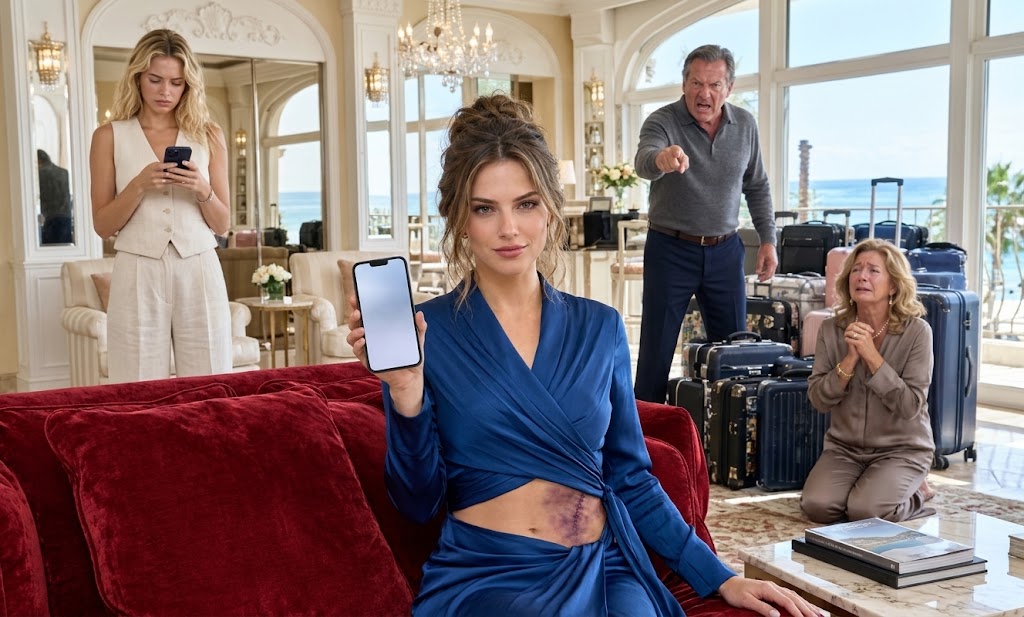
That was the precise sequence of words I typed into my family’s digital group chat on a suffocatingly humid Monday night. I sat perched on the frayed edge of my mattress, a sterile hospital pre-admission packet resting heavily on my thighs. It was a mere eighteen words. I read them aloud twice to the empty room before my thumb hovered over the send button. I needed the phrasing to be stripped of any underlying plea. It wasn’t a desperate cry for salvation, nor was it a catastrophic emergency demanding their tears.
It was just a ride.
My younger sister, Kayla, fired back a response before a full sixty seconds had eclipsed.
We’re flying to Cancun, Emma. You don’t get to hold everyone hostage just because you think you’re more important than the rest of the family.
The notification pinged again. This time, it was my mother.
Stop trying to manufacture guilt, Emma. It’s exhausting.
My father didn’t bother stringing together a single syllable. He simply attached a digital thumbs-up icon to Kayla’s venomous message.
My name is Emma Haron. I am thirty-four years old, a card-carrying master electrician, and for the vast majority of my breathing existence, I have been the solitary load-bearing pillar in a family that firmly believes the roof supports itself.
A hollow, metallic taste flooded the back of my throat. I stared at the glowing screen. For three decades, I had swallowed my pride, bit my tongue, and played the stoic soldier. Not tonight. I typed one final, definitive sentence, and I meant every single keystroke down to my marrow.
Don’t stress yourselves. You won’t have to worry about me again.
Silence. Not a single typing indicator bubbled up on the screen.
I dropped the device onto the quilt and returned my attention to the discharge protocol sheet. The second page featured a paragraph highlighted in aggressively bright yellow ink, presumably marked by a surgical coordinator who had already deduced my isolated existence. It mandated that patients undergoing general anesthesia must be released directly into the custody of a responsible adult who would physically drive them home and monitor them for a mandatory twenty-four-hour window. It explicitly outlawed ride-shares and taxi cabs.
I pressed the heel of my hand against my left flank. Deep beneath the muscle, hovering just below my ribcage, sat a dull, persistent ache. It had taken up residence back in the muddy thaw of spring. It was the insidious kind of pain—the sort your brain learns to filter out while you’re hauling heavy conduit under the blinding afternoon sun, only to come roaring back to the surface the moment your head hits the pillow.
It was a three-centimeter necrotic mass clinging to my left kidney.
The urology department had stumbled upon it entirely by accident back in May while hunting for a kidney stone. The stone had ultimately passed on its own, a fleeting agony. The sinister shadow lurking behind it on the contrast scan, however, refused to vacate the premises.
You think you’re more important than the rest of the family.
I whispered Kayla’s words to the shadows of my bedroom. Out loud, stripped of the digital screen, the cadence sounded exactly like our mother. At thirty years old, my sister still habitually pilfered our mother’s rhetorical weaponry whenever she needed a strike to hit bone.
The phone vibrated against the mattress. Kayla again.
Also, we leave Wednesday. Feed Muffin.
I leaned my head back against the solid oak headboard, closing my eyes. Out of the thousands of memories I could have summoned in the face of a looming cancer surgery, my brain violently dragged me backward twenty-three years, to a sweltering Saturday in late June.
I was eleven years old. I had slid wildly into second base on a dusty Little League diamond, planting my right hand at an awkward, unnatural angle. I still remember the horrific, wet crunch—a sound exactly like a thick green branch snapping over a knee. My coach had to drive me home in his beat-up station wagon because my parents hadn’t bothered to attend the playoffs. They were entirely consumed with prepping seven-year-old Kayla for her summer dance recital. She was cast as a sunflower, drowning in yellow felt petals my mother had meticulously stitched by hand.
When I walked through the kitchen door, cradling my swollen, throbbing forearm against my chest, my mother barely glanced up from her hot glue gun.
“Can you wiggle the fingers?” she had asked, her tone laced with deep inconvenience.
I managed a microscopic twitch. White-hot agony flared up to my shoulder.
“Then it can wait two hours,” she declared, turning back to the felt. “Your sister has been rehearsing this routine since March. Get in the car.”
I spent the next two hours sitting in the stifling, un-air-conditioned back row of a middle school auditorium. I held my fractured bones tight against my ribs, sweating profusely through my dirt-stained jersey, while a stage entirely populated by miniature sunflowers waved at a sea of adoring parents. At one point, the pain spiked so viciously that I let out a sharp, involuntary whimper. My father, without diverting his eyes from the stage, leaned over and hissed that I needed to toughen up and stop crying like a baby.
When they finally dragged me to the urgent care clinic well past sundown, the attending physician stared at the stark white X-ray on the lightbox. Both the radius and ulna were cleanly severed. He turned a furious gaze upon my mother, demanding to know exactly what time the trauma had occurred.
“She didn’t complain,” my mother offered, crossing her arms defensively.
She didn’t complain.
That phrase became my unofficial job title within the Haron family hierarchy. From age eleven to thirty-four, my sole purpose was to absorb the weight of their world without making a sound.
I didn’t sleep that Monday night. I lay rigidly under the ceiling fan, not out of fear of the surgical blade, but because I was executing cold, unforgiving mathematics in my head. My family had suffered a massive, collective lapse in memory when they callously decreed I wasn’t important.
They had forgotten the fundamental architecture of their own empire. Haron Electric legally could not pull a single commercial building permit in the state without my signature.
And as the digital clock on my nightstand ticked past 3:00 AM, a terrifying, exhilarating realization crystallized in my mind. The detonator to completely level their world was resting right in the palm of my hand.