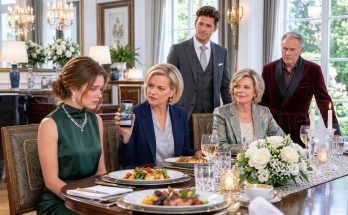
Chapter 1: The Feast of the Condemned
Navigating the narrow stretch of Italian tile between the cast-iron stove and the dining room threshold felt akin to treading barefoot across jagged shards of obsidian.
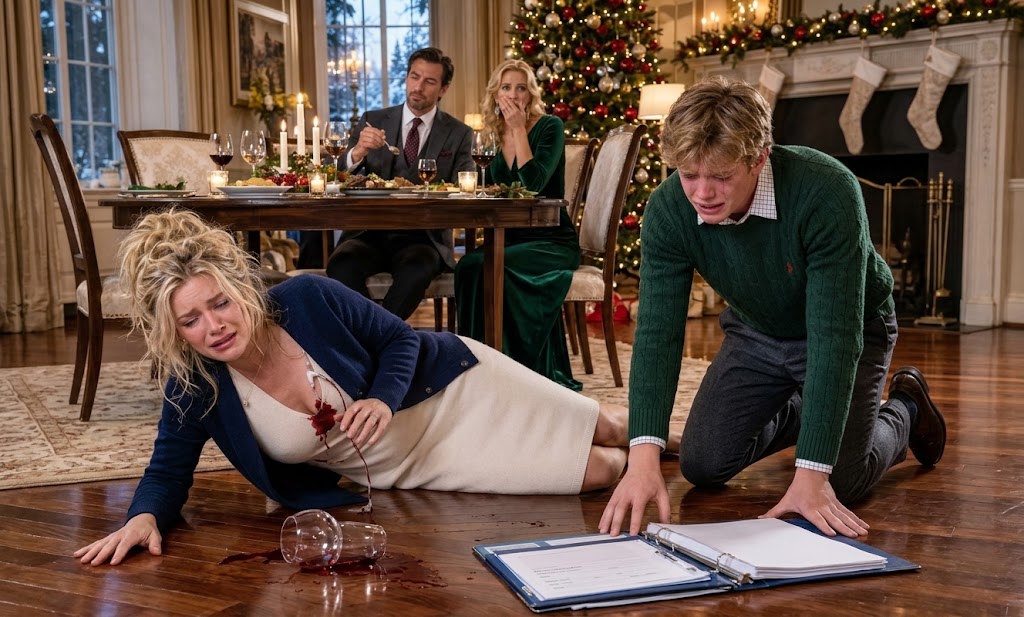
My ankles had ballooned to twice their natural circumference, the edematous tissue pressing relentlessly against the soft, yielding wool of my slippers. Hidden beneath the thick folds of my cream-colored knit cardigan, the newly implanted subclavian chemotherapy port—nested deeply beneath my right collarbone—pulsed with a rhythmic, toxic heat. It was a sickening, localized fever that radiated deep into the cavity of my chest and clawed its way upward along the fragile tendons of my neck.
For forty-eight consecutive hours, I had blatantly ignored the frantic, increasingly severe voicemails from my lead oncologist at the Memorial Cancer Center.
“Clara, your neutrophil count isn’t just low; it is virtually nonexistent,” Dr. Melissa Chen’s voice had crackled through the tinny speaker of my phone yesterday morning, cutting through the rhythmic sound of my paring knife as I peeled ten pounds of russet potatoes at the farmhouse sink. “The PET scan we ran on Tuesday confirmed my worst fears. The lesions speckling your liver and lumbar spine have doubled in volume. If you postpone this palliative cycle by even forty-eight hours, we hemorrhage whatever fragile, microscopic buffer we have left. You need to be admitted to the inpatient infusion unit immediately. I have a bed waiting.”
I had simply stared at the linen calendar hanging beside the refrigerator. December twenty-fourth.
Just two days, I had whispered to the empty, steam-filled kitchen, clutching the edge of the marble countertop as a wave of nausea rolled through me. Just give me two days.
I was thirty-eight years old. In a past life that felt centuries away, I had been a senior pediatric intensive care nurse. I had spent over a decade holding the fragile, trembling hands of other people’s dying children as monitors flatlined and grieving parents shattered. I understood the merciless, physiological mathematics of the human body. I knew exactly what unchecked metastatic neuroendocrine carcinoma accomplished when it was denied its chemical cage. It did not pause out of respect for holiday cheer or family traditions. It crawled through the lymphatic channels like a parasitic ivy consuming a crumbling brick wall, strangling every vital organ in its path.
Yet, I had actively bargained with the universe, with modern medicine, and with my own rapidly deteriorating flesh for one single, unbroken evening. I desperately craved a Christmas Eve where the heirloom silver was meticulously polished, the taper candles burned a warm, liquid gold against the frosted windowpanes, the heavy air smelled of crushed rosemary and mulled cloves, and my boys looked at me with something even vaguely resembling warmth.
With hands that shook violently inside thick silicone oven mitts, I hoisted the massive sterling silver platter bearing a twelve-pound, bone-in prime rib. The radiant heat from the roasted meat seared right through the silicone barrier, biting sharply into my calloused, cracked palms, but I locked my elbows and held on, grinding my teeth together until the hinges of my jaw ached. I carried the feast across the threshold into the formal dining room, lowering the platter precisely into the center of the hand-embroidered linen runner—a piece I had spent three exhausting weeks laundering, starching, and pressing by hand.
My husband, Mark Vance, did not bother to lift his eyes from the glowing rectangle of his iPad.
The cool, sterile blue light from the screen illuminated the sharp, impeccably handsome angles of his fifty-year-old face, catching the distinguished silvering hair at his temples. He was casually scrolling through his corporate stock portfolio, a crystal glass of shockingly expensive cabernet resting mere inches from his elbow. He looked every bit the wealthy, detached executive he was.
To his immediate right slouched my seventeen-year-old stepson, Lucas Vance.
Lucas was strikingly lean, tall, and broad-shouldered—a high school varsity swimmer whose robust, tanned color had returned so miraculously over the past thirty-six months that a stranger would never guess he had once hovered a mere forty-eight hours away from a terminal uremic coma. He was sunk deeply into the upholstery of his chair, his thumbs flying across the glass screen of his smartphone in a blur of adolescent apathy, a familiar, mocking smirk playing on his lips.
“The gravy has formed a skin on it, Clara,” Mark murmured, his thumb flicking dismissively across his screen without so much as a passing glance in my direction. “And you entirely forgot the roasted chestnuts. If you’re going to spend seven hours shuffling around the kitchen making an ungodly amount of noise, you could at least follow the traditional menu. My mother never, ever served prime rib without chestnuts.”
A cold, intensely familiar hollow opened wide in the pit of my stomach. I rested my damp palms on the cool, polished edge of the oak sideboard to stop the room from spinning. The floorboards seemed to tilt slightly beneath my feet, a dark, fuzzy vignette creeping stealthily into the peripheral edges of my vision as my fragile blood pressure plummeted.
“The specialty market was out of fresh chestnuts, Mark,” I managed to say. My voice emerged thin and reedy, carrying the dry, raspy scrape that had permanently settled into my vocal cords over the last month. “I substituted caramelized parsnips with fresh thyme and coarse sea salt. Dr. Chen specifically told me I shouldn’t be driving in the snowstorm to the grocer across town.”
Lucas let out a short, nasal bark of laughter—a jagged, grating sound dripping with unmasked condescension. He didn’t bother to lift his slate-gray eyes from his phone. “Don’t expect too much, Dad. The help does what the help can do. If you wanted authentic chestnuts, you should have hired an actual private chef instead of letting her cosplay as one for the holidays.”
The insult struck my chest like a bucket of iced water.
I stood paralyzed, staring at Lucas. I studied the boy I had meticulously sponge-bathed, patiently tutored through advanced algebra, consoled through night terrors, and fed through feeding tubes for five grueling years. I looked at the strong, defiant line of his jaw, the thick dark hair curling stubbornly over his forehead, and the vibrant, pulsing life coursing visibly through the veins in his neck.
“Lucas,” I said softly, the ache beneath my collarbone flaring with renewed, venomous intensity. “I spent the entire day preparing this meal for us. I made the Yorkshire puddings you love. I made the spiced apple cider completely from scratch.”
“Did a single person ask you to?” Lucas snapped, finally lifting his head.
His eyes—the exact cold, unforgiving slate-gray of his biological mother’s—drilled into me with a shocking hostility. “You do this pathetic routine every single year. You cook this massive, unnecessary production just so you can play the tragic martyr and make us feel incredibly guilty for simply breathing your air. Look at you. You’re shaking like a leaf. You look like a starved ghost that just crawled out of an attic. It’s depressing. You’re ruining the mood of the entire house before the night even officially starts.”
“That is quite enough, Lucas,” Mark muttered, though there was zero actual discipline in his flat tone, only the mild, passing irritation of a man whose evening news feed had been momentarily interrupted by bickering. He lifted his crystal goblet and took a slow, methodical sip of his wine. “Just sit down, Clara. You’re making the entire room tense with all this hovering and heavy breathing. Serve the meat.”
I swallowed hard, tasting the distinct, metallic tang of blood that had begun to pool under my tongue from a cracked mucosal sore inside my cheek. My ribs ached with the effort of every shallow, inadequate inhalation. I had absolutely nothing left in the reservoir. The fire in my internal hearth had burned down to cold, gray ash, and my physical vessel was systematically shutting down, organ by organ, system by system.
Slowly, deliberately, I turned my back to the sideboard and moved toward the high-backed, intricately carved mahogany armchair positioned at the head of the long table—the master seat directly opposite Mark. It was the seat I had occupied during every family dinner for half a decade.
I placed my trembling, blue-veined hands on the smooth, polished wood of the chair’s crest, dragging it backward across the hardwood so I could finally sit down and relieve the agonizing pressure in my swollen legs.
Before the wooden chair legs had scraped two inches across the floor, Lucas’s open palm slammed down onto the mahogany tabletop with the concussive, deafening force of a gunshot.
The boy launched himself upward, his chair skidding violently backward into the wall.