My eighteen-year-old son had been gone for just seventeen days when his best friend walked into the funeral wearing a bright red dress.
I thought the boy was making a spectacle out of our grief, but what he was carrying in his pocket would reveal a conversation my son had kept secret for six months.
My name is Margaret Harris, and until that morning, I thought I knew almost everything about my son Jack. I knew his favorite foods, his terrible jokes, and the way he always left his shoes in the hallway. I even believed I understood how he’d faced the fourteen months of illness that had changed our family forever.
But there was one part of those months Jack had kept from me. He’d shared it with Theo, his best friend since childhood, and that secret was about to change how I remembered my son’s final days.
The chapel was nearly full when Theo arrived. Dark suits, black dresses, and quiet conversations filled the room, while photographs of Jack stood beside arrangements of white flowers. My husband, Daniel, sat beside me, staring at the program he’d already read a dozen times.
Then the whispers began.
I looked toward the entrance and saw Theo standing near the doorway. He was wearing a simple, knee-length red dress, the kind a young woman might wear to a summer gathering. His short brown hair was slightly messy, and his hands were clasped tightly in front of him.
At first, I didn’t recognize the expression on his face. I’d known Theo since he was seven, and I’d rarely seen him without a mischievous grin. Now he looked frightened, as though he’d walked into a room where everyone had already decided he didn’t belong.
A woman sitting behind me leaned toward her husband.
“Is that Jack’s friend?”
Another guest whispered something about the dress. Several people turned to stare, and I watched Theo lower his eyes as he made his way toward an empty seat near the aisle.
I didn’t understand any of it.
Theo had practically grown up in our house. He lived four doors down, and by the time the boys were ten, he spent so many nights in our spare bedroom that Daniel jokingly suggested putting his name on the door.
His parents’ marriage had been difficult. There were Christmases when Theo stayed with us because neither parent could agree where he was supposed to spend the holiday. Jack never treated it as unusual.
“Mom, Theo’s staying for Christmas.”
That was usually the entire conversation. I’d set another place at the table, and the boys would disappear upstairs to argue about video games or old horror movies.
When Jack became sick, Theo’s loyalty became something I could never adequately repay. He came after school, completed assignments on Jack’s bedroom floor, and watched terrible movies with him when Jack wasn’t feeling well enough to go anywhere.
He stayed through frightening hospital appointments and long afternoons when Jack didn’t want to talk. There were weeks when Daniel and I were juggling work and medical appointments, and Theo spent more ordinary hours with our son than either of us could manage.
He never complained or asked for anything.
That was why the red dress confused me so deeply. If anyone understood how much this funeral mattered, it should have been Theo.
I leaned toward two boys from Jack’s school.
“Did something happen between them? Did they argue before Jack died?”
Both shook their heads.
“No, Mrs. Harris. They were still best friends.”
I looked back at Theo. He was staring at his hands, seemingly unaware that half the chapel was watching him, and suddenly I wondered whether he’d chosen the dress deliberately to attract attention.
The thought embarrasses me now.
But grief had left me exhausted and quick to take offense. Every small misunderstanding felt unbearable, and I wasn’t prepared for something so unexpected on the day we were supposed to honor my son.
Daniel finally noticed Theo.
“What on earth is he wearing?”
“I don’t know.”
“Margaret, this is Jack’s funeral.”
“I know.”
He started to rise, his expression hardening. I caught his sleeve before he could step into the aisle.
“Daniel, please. Not now.”
“He’s making a mockery of this.”
“We don’t know that.”
“Then why would he come dressed like that?”
I had no answer, but I tightened my grip until Daniel reluctantly sat down. He remained rigid beside me, watching Theo with an expression that made me afraid of what might happen next.
A few minutes later, the minister announced that Jack’s best friend would deliver the eulogy.
I’d known Theo was supposed to speak, but in the confusion of the morning, I’d forgotten. My stomach tightened as he slowly stood and approached the podium.
The whispers followed him across the room.
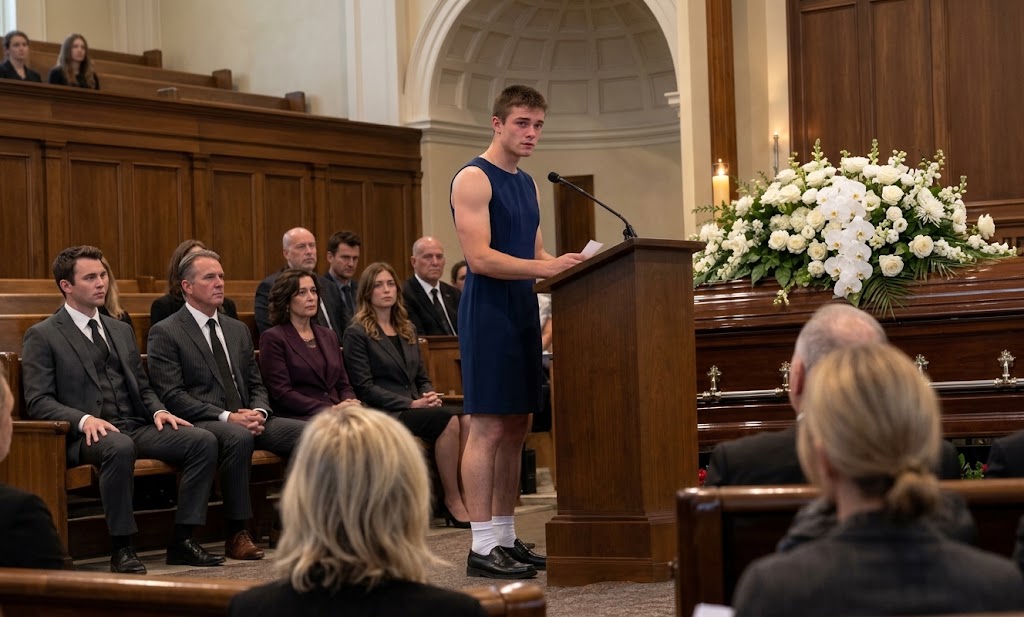
He placed both hands against the wooden lectern and looked out at the congregation. For a long moment, he said nothing, and I began wondering whether he was too overwhelmed to continue.
Then he leaned toward the microphone.
“I know half of you want me out of here right now.”
His voice trembled, and several guests shifted uncomfortably. Daniel moved beside me, but I held his hand.
Theo looked down at his dress.
“And I know how this looks. It isn’t even mine. I borrowed it from my sister.”
Nobody laughed. He swallowed, staring at the wooden surface of the podium.
“The reason I’m wearing it is very simple. And it’s the saddest thing I know.”
He looked toward Jack’s photograph before continuing.
“Six months ago, Jack and I were sitting in his bedroom after another hospital appointment.”
I remembered that afternoon. The results hadn’t been encouraging, although Jack had come home making jokes about the hospital cafeteria and demanding grilled cheese for dinner.
Theo took a shaky breath.
“He asked me to do something for him. Something I didn’t think I’d ever have to do.”
My hands tightened around Daniel’s.
“He asked if I’d speak at his funeral.”
The room became completely still.
Daniel lowered his head, and I felt the air leave my chest. Jack had never spoken about his own funeral with us, not even when we knew his condition was serious.
He’d talked about college, traveling, and the things he wanted to do when treatment ended. Hearing that he’d discussed a funeral with Theo felt like discovering a locked room inside the life I’d thought I understood.
Theo wiped his eyes.
“I told him to stop talking like that. I was angry because he was supposed to get better.”
He gave a small, unsteady laugh.
“So I told him I’d speak at his funeral when he showed up at mine wearing a dress.”
A few people smiled, but Theo wasn’t finished.
“Jack looked at me and said, ‘Fine. Then you have to wear one to mine.’”
He glanced down at the red fabric.
“I told him absolutely not. And that’s when he said it had to be red.”
Someone behind me let out a surprised laugh. Theo smiled for a moment, remembering the conversation.
“He said black made me look like an undertaker, and if I was going to embarrass myself, I might as well do it properly.”
That sounded so much like Jack that I almost laughed.
Almost.
Theo reached into the pocket of the dress and removed a folded piece of paper. His hands trembled as he opened it, carefully smoothing the creases against the podium.
“Jack knew I wouldn’t believe he was serious, so he wrote it down.”
Then he looked directly at me.
“Mrs. Harris, I’m sorry I didn’t tell you. I promised him I would do this, but I didn’t know how to explain it without making everything worse.”
I wanted to stand up, but my legs wouldn’t move.
Theo lowered his eyes to the page.
“He told me to read this if anyone tried to stop me.”
The boy I had almost thrown out of my son’s funeral was standing there in a red dress because my son had asked him to.
And the note in his hands contained words Jack had never dared to say to us.
Theo unfolded the paper completely and began reading.
“Dear Theo, if you’re reading this because I’m not around anymore, first of all, that’s extremely inconvenient for me.”
A ripple of laughter moved through the chapel.
It was Jack’s humor, unmistakably his. Even in serious moments, he’d always found a way to say something ridiculous.
Theo continued.
“Second, you promised. Red dress. Don’t suddenly become sensible just because my relatives are watching.”
Daniel let out a sound that was half laugh and half sob. I pressed my fingers against my lips, trying to hold myself together.
“Third, don’t let my funeral be the first time you break a promise just because I’m not there to remind you.”
Theo stopped reading.
His shoulders trembled, and he stared at the paper as though he couldn’t bear to look at the next line.
For several seconds, nobody spoke.
Then Theo whispered into the microphone.
“I almost didn’t wear it.”
He explained that his father had told him people would misunderstand. His mother worried that Jack’s family might feel disrespected, and even his sister had questioned whether it was a good idea.
But when Theo told her about the promise, she’d opened her wardrobe and given him the dress.
“She told me I was completely ridiculous. Then she helped me find shoes.”
A young woman near the back covered her mouth, smiling through tears. I recognized Emma, Theo’s older sister, and suddenly understood why she’d been watching him so anxiously.
Theo looked toward her before turning back to us.
“I wasn’t trying to upset anyone. I just couldn’t let him down.”
Something inside me broke.
I’d spent the entire morning wondering whether Theo was trying to attract attention. In reality, he’d been terrified of causing us pain while struggling to fulfill a promise to the person who’d been his closest friend.
I stood.
Daniel looked up at me, confused.
“Margaret?”
I didn’t answer. I walked slowly toward the podium, aware that everyone was watching but unable to care.
Theo saw me approaching and went pale. He stepped back from the microphone, clutching Jack’s letter against his chest.
“Mrs. Harris, I’m sorry.”
I climbed the small step beside him.
“Please don’t be angry. I really wasn’t trying to—”
I wrapped my arms around him before he could finish.
For a second, he stood completely still. Then his arms closed around me, and he began crying against my shoulder.
I’d known this boy since he was small enough to hide behind our sofa. Now he was taller than I was, yet in that moment, he seemed like the frightened little child who used to come to our house when things became difficult at home.
“I’m sorry,” he whispered again.
“No, sweetheart. You haven’t done anything wrong.”
“I should’ve told you.”
“You told me when you were ready.”
He drew a shaky breath.
“I didn’t want today to be worse.”
I held him a little tighter.
“You’ve given me something I didn’t know I needed.”
When I finally stepped back, I placed one hand against his cheek.
“Finish what Jack wanted you to say.”
Theo nodded, wiping his eyes.
I returned to my seat, where Daniel was crying openly. He reached for my hand and held it so tightly that I could feel his fingers trembling.
Theo unfolded several additional pages on the podium.
“I actually wrote a proper eulogy. Seven pages.”
One of Jack’s friends called softly from the third row.
“Seven pages, Theo? Seriously?”
Several people laughed.
Theo smiled.
“Exactly. Jack would’ve hated every second of it.”
He placed the pages aside.
“So I’m not going to read them.”
Instead, he began talking about the boy we’d all known.
He told us about the afternoon they broke our garage window with a hockey puck when they were twelve. Rather than confessing, they’d spent three hours inventing explanations before deciding to blame an unusually strong bird.
Daniel remembered confronting them.
“What kind of bird carries a hockey puck?”
Theo smiled at the memory.
“Jack said, ‘A very determined one.’”
The chapel filled with laughter.
It was the first genuine laughter I’d heard from Daniel in weeks, and the sound startled me. For a moment, we weren’t sitting at a funeral. We were remembering a ridiculous afternoon when our son had been healthy, mischievous, and wonderfully alive.
Theo told another story about Jack cheating at Monopoly and insisting that taking extra money was acceptable because the bank probably had insurance.
Then he described their first day of high school.
Theo had been overwhelmed and had hidden in a bathroom because he couldn’t face walking into class. Jack found him and sat on the floor outside the stall, telling everyone who passed that they were conducting an important scientific experiment.
“He stayed there until I was ready to come out.”
Theo looked toward Jack’s photograph.
“He never made me feel embarrassed about being scared.”
As he continued, I realized how many parts of my son’s life had existed beyond our family. There had been small acts of kindness, private jokes, and moments of courage that Daniel and I had never witnessed.
Jack hadn’t hidden those things from us deliberately. He’d simply been growing into his own person, with friendships and experiences that belonged to him.
Theo’s voice grew quieter.
“When Jack got sick, people started calling him brave all the time.”
He looked down.
“He hated that.”
I smiled through my tears because I remembered Jack complaining about the word. He’d once told me that being sick wasn’t something he’d volunteered for and that he wished people would stop treating ordinary hospital appointments like heroic adventures.
Theo continued.
“He said he wasn’t brave just because he was going through something difficult. He said he was mostly tired, annoyed, and worried about missing the next season of his favorite show.”
More laughter moved through the room.
Then Theo looked directly at Daniel and me.
“But I think Jack was brave in a different way.”
His expression changed.
“He knew there was a chance he wouldn’t get better. He knew it before some of us were ready to admit it.”
I looked down at my hands.
For fourteen months, I’d tried to make every conversation about the future. I’d talked about college applications, graduation, and the trip we’d take once the doctors said he was strong enough.
Jack had joined those conversations enthusiastically. I’d taken that as proof that he believed everything would work out. Now I understood that hope and fear could exist together.
Theo rested his hands against the podium.
“He was scared sometimes. He told me that. But even when he was frightened, he kept trying to make everyone else laugh.”
His eyes filled again.
“The dress was one of those jokes. I think he wanted us to have one last ridiculous memory together.”
He looked down at the red fabric and smiled.
“Unfortunately, I was the one who had to wear it.”
Emma called from the back.
“You look amazing!”
The room erupted into laughter. Theo shook his head, his face turning red almost as brightly as his dress.
“Thank you, Emma. I’m never borrowing clothes from you again.”
He paused, looking at Jack’s photograph.
“Actually, Jack would probably tell me I should’ve chosen better shoes.”
Even Daniel laughed at that.
Theo folded the note carefully and placed it back into his pocket. Then he looked toward the flowers beside the podium.
“I kept my promise, Jack. I hope you’re satisfied.”
His voice softened.
“You win, idiot.”
He stepped away from the microphone, and for several seconds, nobody moved. Then people began standing, not in applause exactly, but in a quiet expression of love and gratitude.
I watched Theo return to his seat, where Emma moved beside him and placed an arm around his shoulders.
Daniel leaned close to me.
“I was going to send him away.”
“I know.”
“I didn’t even give him a chance to explain.”
I looked at Theo.
“Neither did I.”
We sat together in silence, realizing how close we’d come to hurting someone who had spent fourteen months helping our son through the hardest period of his life.
After the service, people approached Theo one by one. Some hugged him, while others told him they’d never forget what he’d done for Jack.
Daniel’s older brother was among the first.
He’d been particularly upset when Theo entered, and I’d heard him mutter something unkind about the dress.
Now he stood awkwardly in front of the young man.
“Theo, I owe you an apology.”
Theo looked surprised.
“You don’t have to.”
“Yes, I do. I judged you before you said a word.”
Theo glanced down.
“It’s okay.”
Daniel’s brother shook his head.
“It wasn’t okay. Your speech was beautiful.”
He held out his hand, and Theo shook it. Then the older man pulled him into a brief hug.
I watched from across the room, feeling both grateful and ashamed.
By the end of the funeral, the same people who had whispered about Theo’s red dress were lining up to thank him.
And I realized how easily grief had made us mistake loyalty for disrespect.
Later, after most of the guests moved into the reception hall, I remained beside a table displaying photographs of Jack.
There was one of him at eight years old, standing in our backyard with Theo. Both boys were covered in mud, missing shoes, and grinning as though they’d just completed an extraordinary adventure.
Theo approached quietly.
“Mrs. Harris?”
I turned toward him.
“Hello, sweetheart.”
He stood beside me, looking at the photograph.
“I need to tell you something else.”
His expression made my stomach tighten.
“About Jack?”
He nodded.
“He didn’t want you to know how often he thought about what might happen.”
I looked at the picture again.
Theo continued carefully.
“Not because he didn’t trust you. He just knew how badly you and Mr. Harris wanted everything to be okay.”
I felt tears gathering.
“He was the one who was sick, Theo. He shouldn’t have been worrying about us.”
“I told him that.”
“What did he say?”
Theo smiled sadly.
“He said you were already worrying enough for the entire neighborhood.”
I laughed despite myself.
“That sounds like him.”
Theo looked toward the chapel doors.
“He wasn’t pretending to be hopeful. He really wanted to go to college, travel, and do all the things he’d planned.”
He hesitated.
“But he also knew there was a chance he wouldn’t get to.”
I listened without interrupting.
“He talked about it a few times. Not every day, and not even every week. Mostly we just did homework and watched movies.”
I touched the edge of the photograph.
“Was he frightened?”
Theo took his time answering.
“Sometimes.”
The word hurt, but I was grateful he didn’t try to soften it into something untrue.
“He was scared of missing things. He talked about all the ordinary stuff he’d never thought about before.”
Theo paused.
“He wanted to see Caleb graduate.”
I frowned.
“Caleb?”
“His cousin. He kept talking about how Caleb would probably end up taller than everyone in the family.”
I smiled faintly. Jack and Caleb had spent years competing over their height, and Jack had taken great pleasure in reminding the younger boy that he’d never catch up.
Theo continued.
“He wanted to teach Emma how to play chess properly. He wanted to take his driving test again because he hated the picture on his permit.”
I remembered that photograph. Jack had complained about it for weeks.
“He wanted you and Mr. Harris to take that vacation you’d been postponing.”
That surprised me.
“What vacation?”
“The trip to Maine. He said you always talked about going, but something kept getting in the way.”
I stared at him.
Daniel and I had discussed visiting Maine for years. Jack used to tease us about planning vacations we never actually took. Theo looked uncomfortable.
“He said he hoped you’d still go someday.”
I couldn’t answer immediately.
For months, I’d imagined that Jack’s final days had been filled only with appointments, uncertainty, and the effort to remain hopeful.
But Theo was showing me something else.
My son had still been thinking about his friends, our family, and the ordinary future he wanted everyone else to enjoy.
He hadn’t spent every moment worrying about what might happen.
There had still been jokes, plans, arguments over movies, and afternoons when he was simply Jack.
“Thank you for telling me.”
Theo nodded.
“I didn’t want you to think he’d given up.”
I looked directly at him.
“Did he?”
“No.”
His answer came without hesitation.
“He wanted to get better. He just didn’t want to pretend he was never scared.”
I thought about how often I’d told Jack everything would be fine, even when I didn’t know whether that was true.
I had meant to comfort him.
Now I wondered whether he’d sometimes needed permission to admit that he was frightened too.
Theo seemed to understand what I was thinking.
“He knew you were trying to help.”
A tear rolled down my cheek.
“He told you that?”
Theo nodded.
“He said you made him feel safe, even when you couldn’t fix anything.”
I covered my face.
I’d spent so many nights questioning whether I’d done enough, said the right things, or noticed every moment when Jack needed me.
Hearing those words didn’t erase the grief, but they gave me something precious.
They gave me the chance to believe that my son had understood how much I loved him.
Theo gently touched my shoulder.
“He knew, Mrs. Harris.”
I nodded through my tears.
“I hope so.”
“He did.”
We stood beside Jack’s photographs for a long time, sharing memories neither of us had known the other possessed.
Later that evening, after the guests had left and Daniel and I returned to our quiet house, I found myself thinking about the dress again.
I remembered the first moment Theo entered the chapel and the shameful assumptions I’d made. I’d seen something unusual and immediately treated it as an insult.
I hadn’t considered that the boy might be carrying a private promise.
Daniel sat beside me on the sofa.
“I keep thinking about Jack writing that note.”
“So do I.”
“He knew Theo would actually wear the dress.”
I smiled faintly.
“He certainly hoped so.”
Daniel rubbed his eyes.
“I wish he’d told us he was thinking about those things.”
I looked toward the staircase where Jack used to appear every evening, usually asking whether there was anything left to eat.
“Maybe he needed one conversation that didn’t involve being our son.”
Daniel looked at me.
“What do you mean?”
“With us, he probably felt he had to be hopeful. With Theo, he could just be an eighteen-year-old boy making a terrible joke.”
Daniel sat quietly for a while.
Then he nodded.
“I think you’re right.”
The next morning, Theo came by to return a few books he’d borrowed from Jack. He was wearing jeans and a faded sweatshirt, looking so ordinary that the previous day’s events suddenly seemed almost impossible.
I invited him into the kitchen.
Daniel was making coffee and offered him breakfast. Theo accepted a piece of toast but barely touched it.
Eventually, I asked what had happened to the dress.
He laughed awkwardly.
“Emma says I have to keep it.”
“Why?”
“She says it has too much emotional history now, and she doesn’t want it back.”
Daniel laughed into his coffee.
“Your sister sounds very sensible.”
Theo smiled.
“She said she’ll put it in a frame if I don’t take care of it.”
I imagined that bright red dress hanging in Theo’s bedroom and shook my head.
“Jack would’ve loved that.”
Theo looked down at his toast.
“Yeah. He would’ve.”
We talked about Jack for most of the morning.
Theo told us about their unfinished movie marathon and the list of terrible films they’d promised to watch together. Daniel offered to help him finish the list, and for the first time since the funeral, I saw Theo genuinely smile.
From then on, he continued visiting.
Sometimes he came for dinner. Other times he stopped by just to sit in the kitchen while I cooked, much as he’d done when he was younger.
He never tried to replace Jack, and we never expected him to.
But having Theo around reminded us that our son’s friendship hadn’t ended simply because Jack was no longer there to share it.
The months passed slowly.
There were birthdays and holidays that felt strangely incomplete. There were evenings when I set three plates on the table before remembering that only two of us would be eating.
Sometimes I still expected to hear Jack calling from upstairs.
Other days, I could laugh at something he’d said without immediately crying.
Grief didn’t follow any timetable I understood.
Theo eventually left for college. Before he went, Daniel helped him pack his car, and I insisted on sending food he would probably never eat.
He hugged us both beside the driveway.
“I’ll call.”
“You’d better.”
He smiled.
“Jack would never forgive me if I let you start worrying about somebody else.”
I laughed and held him tightly.
“Take care of yourself, Theo.”
He nodded, climbed into his car, and drove away.
For a moment, I stood beside Daniel feeling the familiar ache of watching a young man leave our driveway.
Then Daniel took my hand.
“He’s going to be okay.”
“I know.”
We kept in touch through phone calls, holiday visits, and photographs Theo sent from college.
He studied engineering, which surprised me until he reminded me that Jack had always insisted he was better at mathematics than he admitted.
Every achievement Theo shared made me happy, but there was also a quiet sadness in knowing Jack would never experience those milestones beside him.
Still, we celebrated.
When Theo graduated four years later, Daniel and I attended the ceremony. We sat beside his mother, watched him walk across the stage, and cheered so loudly that Emma turned around laughing.
Afterward, Theo found us in the crowd.
He was taller, more confident, and wearing a graduation gown that suited him considerably better than the red dress had.
He hugged Daniel, then me.
“Thanks for coming.”
“We wouldn’t have missed it.”
He grinned.
“I thought about wearing red underneath the gown.”
Daniel raised an eyebrow.
“Don’t push your luck.”
Theo laughed, and for a moment, I heard Jack’s laughter in my memory.
We’d brought him a gift.
It wasn’t expensive or elaborate, just the black wristwatch Jack had worn almost every day before he became ill.
I’d kept it in a small wooden box in Samuel’s old study, unable to decide what to do with it.
When Theo opened the box, he stared at the watch without speaking.
“Mrs. Harris, I can’t take this.”
“Yes, you can.”
“But it was Jack’s.”
“That’s why we want you to have it.”
Theo looked toward Daniel, who nodded.
“Jack would’ve wanted somebody who appreciated it.”
Theo held the watch carefully, turning it over in his hands.
Then he began crying.
I hugged him, and Daniel placed a hand on his shoulder. Around us, graduates and families laughed, posed for photographs, and celebrated the beginning of new chapters.
For a few moments, the three of us stood together remembering someone who should have been there.
But we also felt proud of Theo.
He’d grown into a thoughtful, compassionate young man, and I was grateful Jack had known him.
That evening, after the graduation celebration, Theo asked whether he could show me something.
We sat on a bench outside the restaurant while Daniel went to bring the car around.
Theo reached into his wallet and removed a carefully folded piece of paper.
I recognized it immediately.
Jack’s note.
“You still carry that?”
He nodded.
“Not every day. But on important days.”
I watched him smooth the paper across his knee.
“There’s one line I never read at the funeral.”
I looked at him.
“Why not?”
Theo hesitated.
“Because it was about you.”
He pointed toward the bottom of the page, where Jack’s familiar handwriting slanted across the paper.
If Mom looks angry, give her thirty seconds. She usually becomes nice again once she knows the whole story.
I stared at the words.
Then I laughed.
I laughed so hard that tears began rolling down my cheeks, and Theo started laughing with me.
“That little troublemaker.”
Theo smiled.
“He knew you.”
I looked at the handwriting again.
“He gave me far too much credit.”
“No, Mrs. Harris. He knew you’d understand.”
I folded the note carefully and handed it back.
For years, I’d thought about the moment Theo entered the chapel wearing red. I’d remembered Daniel standing, the whispers moving through the room, and my own impulse to ask someone to remove him.
I’d been ashamed of how quickly I’d judged a boy who had been like a second son to us.
But Jack’s words helped me see that moment differently.
He hadn’t expected us to be perfect.
He’d known we’d be confused, upset, and probably a little angry.
Yet he’d also believed that once we understood, we’d recognize the love behind Theo’s decision.
My son had left us more than a final joke; he’d left us one last chance to understand that love sometimes arrives in a form we aren’t prepared to recognize.
I sat beside Theo for a while, listening to the sounds of people celebrating nearby.
Then I asked him something I’d wondered about for years.
“Did you ever regret wearing it?”
He considered the question.
“During the first five minutes? Absolutely.”
I laughed.
“I thought everybody hated me.”
“They didn’t hate you.”
“I know that now.”
He looked down at Jack’s note.
“But even when I was standing there feeling ridiculous, I knew I couldn’t break that promise.”
I nodded.
“I’m glad you didn’t.”
Theo smiled faintly.
“Me too.”
Daniel arrived a few minutes later, and we drove back to the hotel together.
That night, I placed the photograph from Theo’s graduation beside one of Jack and Theo at eight years old.
In the first, the boys were covered in mud and smiling as though the entire world belonged to them. In the second, Theo stood in his graduation gown with Jack’s watch on his wrist.
Fourteen years separated those photographs.
Jack had been present for only part of that journey, yet his influence could still be seen in the man Theo had become.
I understood then that people leave traces of themselves in ways we don’t always recognize.
A joke repeated years later.
A kindness remembered.
A promise kept.
A friend who continues showing up for the people someone loved.
The red dress had become one of the things people remembered most about Jack’s funeral.
At first, that bothered me. I didn’t want my son’s life reduced to an unusual story people repeated because it sounded shocking.
But eventually, I realized the dress represented something far more important.
It reminded us that Jack hadn’t stopped being himself during his illness.
He’d still been sarcastic, stubborn, funny, and occasionally infuriating. He’d still been making ridiculous plans with Theo, even when the future felt uncertain.
And he’d trusted his best friend to carry one last joke into a room full of people who desperately needed a reason to smile.
Years have passed, but I still think about that morning.
I remember the bright red fabric, Theo’s trembling hands, and the moment he unfolded Jack’s letter.
Most of all, I remember how wrong I was when I thought I understood what I was seeing.
I saw a boy dressed strangely at a funeral.
I didn’t see the promise he’d been carrying for six months.
I saw my husband’s anger.
I didn’t recognize the fear and exhaustion beneath it.
I saw a room filled with people whispering.
I didn’t realize that many of them were simply struggling to understand something unexpected during an already painful day.
And I saw a young man who looked different from everyone around him.
I nearly forgot that he was the same child we’d welcomed into our home for years, the same teenager who’d spent countless hours beside our son when the rest of us couldn’t.
Now, whenever someone tells me about a person whose behavior seems strange or inappropriate, I remember Theo standing at that microphone.
I remind myself that there may be a conversation I haven’t heard, a promise I don’t know about, or a story hidden beneath the surface.
That doesn’t mean every action is right.
It means I should understand what happened before deciding what it means.
Sometimes people are carrying more than we can see.
Theo still visits us whenever he’s in town. He brings Emma occasionally, and she never lets him forget the dress.
Daniel keeps a photograph of Theo’s graduation on his desk, right beside one of Jack.
As for me, I keep a copy of Jack’s note in the drawer beside my bed.
On difficult evenings, I take it out and read the last line again.
If Mom looks angry, give her thirty seconds.
I always smile.
Then I think about my son sitting in his bedroom six months before his funeral, laughing with his best friend and making a promise neither of them wanted to fulfill.
He couldn’t have known exactly how that day would unfold.
But he knew Theo. And he knew us.
Perhaps that is what I treasure most now.
Not the dress itself. Not the surprise.
Not even the laughter that filled the chapel.
It’s knowing that my son understood the people he loved well enough to leave behind a moment that would bring us together when we needed one another most.
On the day I thought my family couldn’t bear another surprise, a frightened young man walked into a funeral wearing a red dress.
I nearly asked him to leave. Instead, he gave us one last glimpse of the boy we’d lost.
And whenever I remember that day, I no longer see a stranger standing at the microphone in inappropriate clothing.
I see Theo, keeping a promise to his best friend. I see Daniel laughing through his tears. I see a room full of grieving people beginning to understand.
And I see Jack, eighteen years old, still finding a way to make the people he loved smile.
That was his final gift to us.
And I’ll be grateful for it for the rest of my life.
THE END