Chapter 1: The Trespasser in My Own Home
I navigated my SUV through the dense, emerald corridors of the Wisconsin Northwoods, driving my two children four agonizing hours north for the Fourth of July weekend. The anticipation humming from the backseat was palpable, a stark contrast to the cold knot tightening in my own chest. As my tires finally crunched onto the familiar gravel of the driveway, the idyllic vision of our inherited lake cabin shattered.
My mother stormed off the cedar porch of my own property as though we were a band of feral marauders kicking in the front door.
A monstrous, dual-axle pickup truck was parked squarely in my designated spot. Strangers’ neon beach towels were draped carelessly over my freshly stained wooden railing, and a charcoal grill was billowing greasy grey smoke into the pristine pine air.
“You’re trespassing!” my mother shrieked, her voice slicing through the tranquil chorus of cicadas. “Get back in your car. I am calling the cops!”
My younger brother, Kyle Brandt, lounged in the screened doorway. He held a sweating can of cheap beer, his eyes flat and cowardly, saying absolutely nothing. Peering past his shoulder through the front window, I could see the violation of my sanctuary: my son’s bunk bed had been stripped bare, his beloved dinosaur sleeping bag rolled up and unceremoniously dumped onto the dusty porch boards.
Beside me, my nine-year-old son, Owen, shrank into the upholstery. He tugged at my sleeve, his voice a terrified whisper. “Mom… are we in trouble?”
I unbuckled my seatbelt, turned to my boy, and forced a smile that didn’t reach my eyes. “No, honey. We’re exactly where we’re supposed to be.”
I stepped out of the vehicle, the humid July air clinging to my skin. I didn’t yell. I didn’t curse. I simply offered my mother a serene, terrifying smile. “Please do call them, Mom. I insist.”
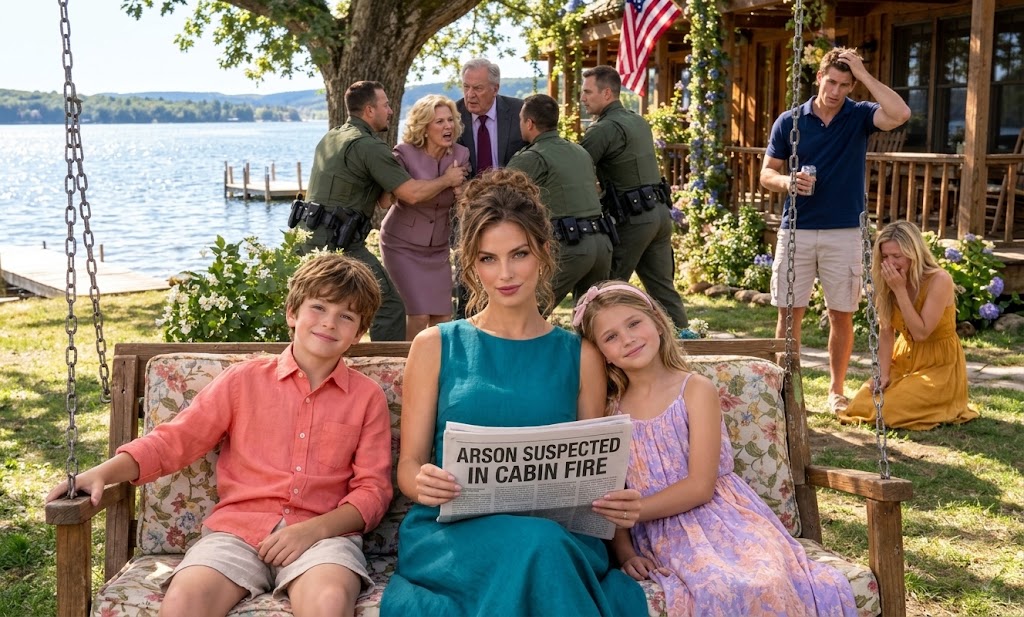
Ignoring her sputtering outrage, I took my children by the hands, marched them right past her flailing form, and sat down on the heavy, wooden porch swing—the very swing I had forbidden myself from touching for nearly three decades. My hands were trembling, but my mind was crystalline. I pulled out my phone and dispatched a single text message to a number I had acquired just weeks prior.
They’re here. All of them. Can you come today?
The reply materialized on my screen before my mother even finished dictating my address to the local dispatcher.
Leaving now. Three hours. Look for the white Buick.
The last time law enforcement had been summoned to this specific sliver of Little Tamarack Lake on behalf of my family, this cabin was nothing but a smoldering crater of ash, and every single adult in my life was staring at me with quiet, condemning eyes.
“The dispatcher said it could be two hours,” my mother announced, marching up the wooden steps to loom over the swing. She delivered the timeline like a judge handing down a terminal sentence. “Maybe longer. Every deputy in Vilas County is out on the water for the holiday.” She crossed her arms, her lips a thin, cruel line. “Maybe you’ll come to your senses before they arrive, Heidi, and spare yourself the humiliation.”
I offered no response. Instead, I retreated into the sanctuary of my own mind. I started counting. It is what I do for a living, and it is the mechanism I deploy when my nervous system is hovering on the brink of collapse.
Through the cabin’s front window, my eyes drifted to the refrigerator. Affixed to the stainless steel door was a glossy paper calendar, its squares filled with the bubbly, rounded handwriting of my sister-in-law, Tessa. Every single day of June was claimed: Swim lessons, Dentist, Brody’s baseball game. On the granite island counter sat a thick stack of mail bound by a thick rubber band. The top envelope, stark and undeniable, was addressed directly to Kyle Brandt at my address. Not “in care of,” but formatted as if he had resided here his entire useless life.
Around the corner of the detached garage appeared my father. He held a yellow-handled screwdriver, making his way toward the hinges of the screen door—a repair I had been meaning to tackle since the spring thaw. He didn’t lift his eyes to meet mine.
“Hi, kiddo,” he mumbled to the rusted metal hinge.
That subtle interaction screamed volumes more than the stolen mail ever could. My father is a man of rigid habits; he does not perform maintenance at a rest stop. He fixes the things where he plans on staying.
Suddenly, the screen door groaned open. Tessa leaned out, gripping a wooden cooking spoon like a defensive weapon. She wore the horrified expression of someone who had just walked into a funeral wearing a clown suit.
“Oh,” she stammered, the color draining from her cheeks. “Hi, Heidi… we, um, we thought you were coming up in August.”
“We are coming in August, Tessa,” I replied smoothly. Someone had evidently gifted her a schedule, and it certainly wasn’t me.
I shifted my gaze back to the matriarch of this delusion. “I have a scheduled appointment here tomorrow morning,” I stated, modulating my tone so the kids wouldn’t catch the razor blade hidden in the velvet. “I’m not going anywhere.”
My mother scoffed, a harsh, abrasive sound. “An appointment? Here? With who?”
I let the silence stretch, thick and suffocating, before looking away. I placed my palm firmly over Owen’s knee until his nervous bouncing subsided. Whatever cataclysm was destined to unfold on this property today, I was determined it would happen under the scrutiny of someone who didn’t share our tainted last name.
My daughter, Maisie, is twelve going on thirty. She possesses a hawk’s eyes and misses absolutely nothing. She leaned into my shoulder, her voice a conspiratorial breath against my collarbone. “Mom… is Grandma going to say it? About the fire?”
Before I could form a reassuring lie, my mother’s head snapped toward us. She possessed the auditory range of a bat when it came to gossip. She had caught the word fire.
“You’ve got some nerve, Heidi,” my mother bellowed, ensuring her voice carried across the lawn to Tessa and the cousins playing near the water. “Showing up here, on the Fourth of July of all days, after what you did to this family’s legacy!”
Tessa’s eyes darted frantically between us. Her ten-year-old son, Brody, paused his game of bouncing a tennis ball against the cedar siding. “What did Aunt Heidi do?” he yelled.
A suffocating quiet fell over the yard. No adult moved to answer him. Maisie’s fierce blue eyes found mine, pleading in a silent language only mothers and daughters speak. Mom, tell her. Fight back.
I gave a microscopic shake of my head. Not here. Not like this.
With my children standing vulnerable in the damp grass, and my mother holding court like a tyrannical queen on her throne, I stood up. I took both my kids by their hands. “Go down to the water and swim with your cousins,” I instructed them, my voice steady. “Stay exactly where I can see you. This is not your battle.”
Owen hesitated at the far edge of the wooden dock, his small toes curled tightly over the precipice. Brody shouted for him to jump. Finally, Owen leaped, the dark lake swallowing him with a loud slap before spitting him back out in a fit of genuine, unburdened laughter.
I retreated back to the porch swing. My fingers found the cold iron chains and clamped on as if bracing for a hurricane. The dock they were jumping off was relatively new. But the water—and the ghosts it held—were ancient.
If I sent the text to cancel my appointment, they would win forever, I thought, the chains biting into my palms. But as the afternoon sun began its slow descent, painting the Wisconsin sky in bruised shades of purple and orange, I knew the reckoning could no longer be delayed.