“Dad doesn’t hurt me.”
“Then what makes going home feel unsafe?” Dana asked.
Lily looked toward me and requested the pink swim bag Sarah had packed. Inside, beneath her dry clothes, she found a small brass locker key attached to a faded number tag.
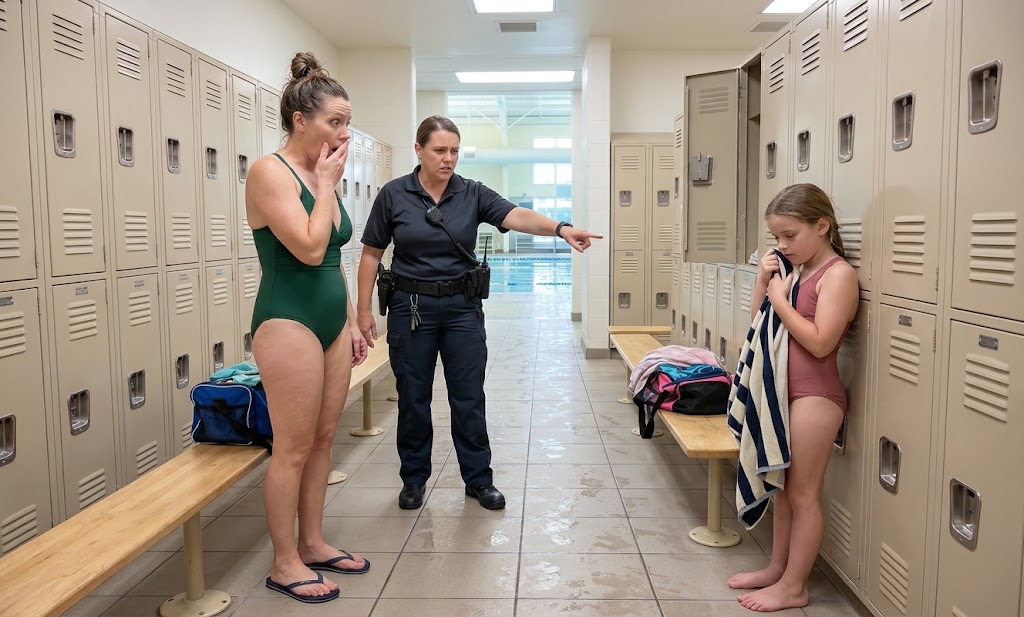
“I hid something here before Mom took me,” she said. “I told her about it, but she said the judge wouldn’t believe us.”
The key belonged to a rental locker in an older section of the pool complex. Nora checked the number and confirmed that Lily had used that area during swimming lessons several weeks earlier.
When Dana asked what she had hidden, Lily’s voice became almost inaudible.
“A phone that records things.”
“Who were you recording?”
Lily looked through the glass at her father. “Not Dad. He doesn’t know what happens after he leaves for work.”
She closed her fingers around the locker key.
“It was Uncle Dean—and he told me nobody would believe a child over a police officer.”
Part 3: The Phone Behind Locker 214
The key led to locker 214 in a corridor used by children enrolled in swimming lessons. Nora confirmed that the locker had remained locked for nearly three weeks because no one knew which family had rented it.
A detective photographed the locker before opening it. Inside was an old phone wrapped in two plastic bags beneath a child’s sweatshirt.
Lily identified the phone but was not asked to unlock it or describe every recording in the changing room. Dana arranged for her to speak later with a trained child interviewer in a quieter setting.
Sarah had given Lily the phone after noticing bruises on her arms and hearing conflicting explanations. She told Lily to activate the recorder whenever Dean was responsible for her after Mark left for his overnight shifts.
That decision troubled Dana because it had placed an eight-year-old in the position of collecting evidence against an adult. It also explained why Lily had hidden the device at the pool instead of carrying it home.
The battery was dead, and the screen had been cracked. Investigators secured the phone and advised us that recovering its contents could take time.
Mark was informed only that Lily had identified a safety concern involving his younger brother. He immediately confirmed that Dean had been staying in his house for four months while working as a police officer in a neighboring county.
“I trusted him with her,” Mark said. “He’s family.”
Sarah shouted from across the lobby that she had warned him repeatedly. An officer separated them before their argument reached Lily.
Mark admitted that Sarah had accused Dean of being too strict. She had shown him photographs of bruises, but Dean claimed Lily received them during gymnastics and said Sarah was manufacturing allegations to regain custody.
A pediatrician could not determine where the marks came from. When Sarah filed an emergency motion, the judge maintained the existing arrangement pending further investigation.
Instead of waiting, Sarah took Lily from the supervised visit and began preparing to leave the country. Her fear might have been genuine, but she had still isolated Lily, forged documents and placed her daughter at greater legal risk.
Lily and Emma were taken to a child-advocacy center rather than questioned repeatedly at the pool. Emma remained with me while Lily spoke privately with a trained interviewer.
Afterward, Dana told us only what we needed for immediate safety. Lily described being forced to stand facing a wall for long periods, being locked in a utility room and having her arms gripped whenever she cried or tried to leave.
There was no disclosure of sexual harm. The allegations involved physical punishment, confinement and threats that Dean would arrest Sarah if Lily told anyone.
Mark listened without interrupting. When Dana finished, he said Lily would not return to his house while Dean remained there.
That afternoon, investigators recovered several audio files from the phone. Most contained household sounds, but three captured Dean speaking directly to Lily.
In one recording, he ordered her to hold her hands above her head and remain against the wall until he returned. Twenty-six minutes passed before his voice appeared again.
Another file contained the sound of a door closing and Lily asking to be released. Dean told her that children who lied about police officers could be taken away from both parents.
The third recording was harder to understand. Lily was crying while Dean accused her of sending messages to Sarah.
Then another man entered the room.
Mark recognized his own voice before anyone identified it. On the recording, he told Dean to unlock the utility-room door.
For a moment, I felt relieved. Then Dean asked why Mark cared when he had allowed the same punishment the previous week.
Mark did not deny it.
“Just let her out before Sarah arrives,” he said. “I don’t need another custody complaint.”
The recording ended several seconds later. Mark sat across from us with his face in his hands.
He had not known everything Dean had done, but he had known Lily was being confined. Protecting his custody case had mattered more than asking why his daughter was afraid.
Dana informed him that Lily would not be released to either parent that day. A temporary kinship placement would be considered while the court reviewed Sarah’s abduction and Mark’s failure to protect her.
Before anyone could discuss whether Lily might stay with me, the detective received a call from Mark’s house. Officers had gone there to locate Dean, but he was already gone.
On Lily’s bedroom door, they found a newly installed lock.
It was mounted on the outside.
Part 4: The Officer Who Closed His Own Complaints
A caseworker inspected my home that evening and completed the required background checks. With Mark’s agreement and a temporary court order, Lily was allowed to stay with me while both parents’ decisions were reviewed.
Sarah remained in custody overnight because of the false passport and the attempt to take Lily out of the country. Mark was not arrested, but he returned to an empty house knowing that his silence had cost him his daughter’s trust.
Dean’s police department placed him on administrative leave after learning he was named in a child-abuse investigation. Officers collected his service weapon and badge, but they could not locate him immediately.
Internal affairs reviewed every report involving Sarah, Mark or Lily. The records revealed that Sarah had called police three times during the previous two months.
In the first call, she reported finding Lily locked in the utility room. Dean arrived at the house in uniform even though the address was outside his normal patrol area.
His report described the lock as a temporary child-safety measure and Sarah as an agitated noncustodial parent. He did not mention that he lived in the home or that he was the adult accused of installing it.
During the second call, Sarah reported bruising on Lily’s arms. Dean entered the complaint into the system as a continuation of a custody dispute, then closed it without requesting an independent child-welfare review.
The third call had no written report at all. Dispatch records showed Sarah asking for an officer because Dean had threatened her, but the response was canceled six minutes later using his employee identification.
“He made himself the person deciding whether complaints against him were credible,” the internal-affairs investigator told us. “That should never have happened.”