Part 1: The Birthday My Family Chose a Side
My daughter asked for a castle cake on her tenth birthday because her mother once drew one for her on a paper placemat. Rebecca had died two years earlier, and June remembered the crooked towers, glowing windows and tiny flag more clearly than almost anything else from that afternoon.
A bakery quoted nearly four hundred dollars, so I decided to make the cake myself. After finishing long shifts as an HVAC foreman, I spent three nights learning how to shape vanilla towers and build amber-colored sugar windows.
The first batch cracked, and the second turned cloudy. The third finally caught the kitchen light the way June remembered from her mother’s drawing.
When she entered the dining room, her face brightened.
“Dad, you made the windows glow.”
“Every castle needs lights,” I told her.
My parents hosted the party at Hawthorne House, where my brother Blake and I had grown up. I agreed only because they promised the afternoon would belong to June and that no one would turn it into another argument about why I had refused to join the family’s property-development business.
Blake arrived forty minutes late wearing a wool coat that probably cost more than my monthly rent. My father greeted him warmly and announced that important men rarely controlled their own schedules.
Blake inspected the cake before looking at my work clothes. I had come directly from an emergency service call and still had dust near one sleeve.
“You repair furnaces all week and build princess castles at night?” he asked. “Rebecca would have enjoyed this.”
The mention of my wife silenced me. Blake knew it would, and the small smile on his face showed that he had achieved what he wanted.
I told everyone it was time for June to make her wish. She leaned toward the candles while I stood beside her holding the matches.
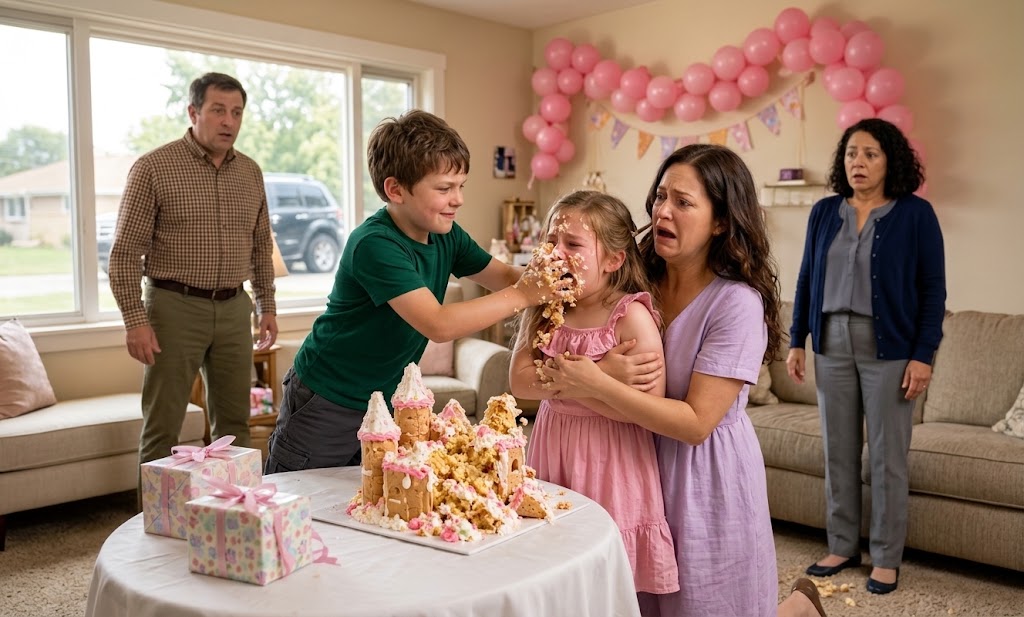
Blake moved behind her and announced that every birthday needed a memorable photograph. Before I understood what he intended, he placed one hand between her shoulders and pushed her toward the cake.
He probably expected soft frosting and laughter. Instead, June struck one of the hardened sugar panels before the towers collapsed around her.
She cried out and covered her face. When I lifted her upright, frosting filled her hair and a thin cut appeared beneath her left eye.
“Dad, it hurts.”
I pulled June against me and pushed Blake away from the table when he tried to reach for her. He stumbled into a chair but remained standing.
For one second, everyone froze. Then my mother hurried toward Blake and began inspecting the front of his coat.
“The frosting may stain,” she said. “This was custom-made.”
I stared at her while June trembled against my chest. My father told me I had overreacted and accused me of putting my hands on my brother because a joke went wrong.
“He pushed a child into something that cut her face,” I said. “Blake needs to apologize to June.”
Blake insisted he had barely touched her. He said June moved unexpectedly and suggested she was frightened because I had raised her to take everything too seriously.
That was how my family had protected him since childhood. Blake’s intentions mattered more than the damage he caused, while my reaction became the real offense.
My father struck his signet ring against the table and ordered me to apologize for pushing my brother. I refused unless Blake first admitted what he had done to June.
“You have spent your entire life resenting him,” my father said. “Do not use your daughter to continue it.”
June heard every word. Her fingers tightened around my shirt, and I felt her trying to make herself smaller.
Then my father gave me a choice.
“Apologize now, or walk out of this family and forget the inheritance.”
I looked at Blake waiting confidently beside the ruined cake. My mother was still wiping his sleeve, and neither of them had asked whether June needed a doctor.
I carried my daughter to the car.
At urgent care, a physician cleaned the cut and closed it with medical adhesive. June’s eye was not damaged, but the doctor advised me to watch for swelling and changes in vision.
On the drive home, June remained silent until we stopped at a red light.
“Did you lose your family because of me?”
I pulled into a parking lot so I could look at her properly. I told her that adults were responsible for their own choices and that protecting her could never be something she caused me to regret.
That night, my father left a voicemail. He said I had until morning to apologize, or he would remove me from his will and make sure Hawthorne Properties never hired anyone connected to me again.
I worked for a regional HVAC contractor, and nearly one-third of our commercial maintenance jobs came from Hawthorne buildings. My father could not fire me directly, but he could damage the company that employed me.
I saved the voicemail, forwarded it to my personal email and blocked his number. Whatever happened next, I would not teach June that security depended on apologizing to the person who hurt her.
At seven the following morning, my supervisor called. Hawthorne Properties had canceled every scheduled maintenance contract with our company overnight, and six technicians no longer had enough work to fill the month.
Then he told me my father had offered to restore the contracts on one condition.
I had to return to Hawthorne House with June and apologize to Blake in front of the entire family.
Part 2: The Cost of Refusing Him
My supervisor, Tom, did not ask me to take June back to Hawthorne House. He listened to my father’s voicemail twice, then said no commercial account was worth forcing a child to apologize for being injured.
That did not make the canceled work disappear. Hawthorne Properties had been free to end the maintenance agreements at renewal, and the loss left Tom facing payroll he could no longer support.
I offered to resign before he had to choose who would lose hours because of my family. Tom refused at first, but two weeks later, he eliminated my position along with two others after another Hawthorne contract ended.
My father sent one message through my mother.
“This can all stop when Ethan remembers who gave him his opportunities.”
I had never received my HVAC training from him. I completed an apprenticeship, earned my certifications and spent more than a decade crawling through mechanical rooms while Blake sat in Hawthorne’s offices learning how to repeat our father’s decisions.
Still, my father understood leverage. By tying Hawthorne’s contracts to my apology, he made other people carry part of the cost of my refusal.
I met the two technicians who had also lost their jobs and showed them the voicemail. Neither blamed me, although that did little to quiet the guilt I felt when one mentioned delaying his daughter’s dental treatment.
Tom provided references and helped all three of us find temporary work. He also told me something that stayed with me.
“You know the systems, customers and crews better than half the contractors bidding on these buildings,” he said. “Maybe it’s time you stopped waiting for someone else to decide whether you have a job.”
Starting a business sounded impossible. I had modest savings, an aging truck and a daughter whose sense of security had already been shaken enough.
June was also struggling more than she admitted. She avoided mirrors while the cut healed and became tense whenever someone stood behind her at school.
I arranged several sessions with a child counselor. June slowly explained that the worst part had not been the pain; it was watching her grandparents defend Blake while she stood there frightened.
She asked whether they would take our apartment because I refused to apologize. I promised that her grandfather did not own our home and that I would always tell her before any change affected us.
For several months, I accepted service calls through smaller contractors. I repaired furnaces, replaced damaged ductwork and saved every dollar I could after rent, food and June’s needs.
One of the other laid-off technicians, Luis Mendoza, began joining me on weekend jobs. He had experience with building controls and proposed that we form a company together instead of continuing as temporary labor.
We spent weeks studying costs before making the decision. I already held the required technical license, while Luis completed additional certification in energy-management systems.
We registered the company, purchased liability insurance and financed a used service van. We called it Northlight Mechanical because June said buildings should feel safe when their lights came on after dark.
Our first office was a desk inside my laundry room. June drew a small castle beside the company name on our first handwritten invoice, but I asked a designer to create a professional logo before we sent anything to commercial clients.
The first year was difficult. Some weeks we had more calls than two people could handle, while other weeks I worried we would not earn enough to cover the van payment.
What kept us working was not a dramatic connection or family money. We arrived when promised, explained repairs clearly and returned calls after customers had paid.
A property manager named Elena Ortiz hired us after another contractor failed to restore heat in one of her apartment buildings during a January storm. Luis and I worked through the night, found a damaged control board and kept temporary heaters operating until the replacement arrived.
Elena later gave us maintenance work at three smaller properties. Her recommendation led to a school contract, then a senior-living complex and eventually enough revenue to hire the two technicians who had lost their positions when Hawthorne canceled Tom’s accounts.
Four years passed. Northlight grew to eighteen employees, including estimators, service technicians and an office manager who prevented Luis and me from misplacing every important document we touched.